Walls
The best garage tool wall storage
Getting hand tools onto a wall is the cheapest win in the whole garage. The only number that matters is what one hook can hold, and almost nobody publishes it.
Disclosure: Rail & Rafter earns a commission on qualifying purchases made through links on this page, at no cost to you. Commission does not decide what we recommend — our criteria do, and here is how we are funded.

Quick picks
Our ranking, verdict first. Every row links to the full write-up below, and every price cell goes straight to Amazon. Scores follow the criteria on our methodology page.
| # | Product | Best for | Score | Price |
|---|---|---|---|---|
| 1 | 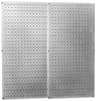 Wall Control Metal Pegboard20-gauge steel pegboard with published per-panel and per-hook limits, which is more honesty about capacity than the entire hardboard-pegboard category offers combined. Wall Control Metal Pegboard20-gauge steel pegboard with published per-panel and per-hook limits, which is more honesty about capacity than the entire hardboard-pegboard category offers combined. | Best for hand tools | 8.6 | $42.28View on AmazonPrice as of October 17, 2026. #ad how this is funded |
| 2 |  Gladiator GearTrack Channels75 lb per linear foot, published in the installation manual rather than buried in marketing copy. Track beats full-panel systems when what you are hanging is heavy and few rather than light and many. Gladiator GearTrack Channels75 lb per linear foot, published in the installation manual rather than buried in marketing copy. Track beats full-panel systems when what you are hanging is heavy and few rather than light and many. | Best track system | 8.8 | $25.49View on Amazon |
| 3 |  Proslat PVC SlatwallPVC rather than MDF or steel, rated to 75 lb per square foot and backed by a lifetime warranty. In a garage that gets damp, the material is the whole argument. Proslat PVC SlatwallPVC rather than MDF or steel, rated to 75 lb per square foot and backed by a lifetime warranty. In a garage that gets damp, the material is the whole argument. | Best in a damp or unheated garage | 8.4 | $199.99View on AmazonPrice as of October 17, 2026. #ad how this is funded |
Scores are our editorial assessment against the criteria on how we pick. They are not test results and are not marked up as review ratings.
A tool wall is the highest-return thing you can do in a garage, and it is also the cheapest. Tools on a bench become a pile. Tools in a drawer become a search. Tools on a wall stay where you put them, because returning one takes the same two seconds as putting it down.
What makes this decision hard is that the marketing photographs all look the same and the capacity information is mostly missing. So this ranks on the one figure that decides it in practice: what a single hook is rated for. Our criteria are on how we pick.
Read this first
The hook is the limit, not the panel. Wall Control publishes 200 lb per panel into studs — and 10 to 15 lb per hook engaging two slots, 5 to 10 lb for a hook engaging one. You will hit the hook limit twenty times before the panel notices. Any tool heavier than about 15 lb needs track, not pegboard.
What actually belongs on a tool wall
Sort your tools by weight before you buy anything, because the answer splits cleanly at about 15 lb:
| What | Roughly | Format |
|---|---|---|
| Screwdrivers, pliers, wrenches, clamps | Under 5 lb each | Pegboard, single-slot hooks |
| Hammers, hand saws, cordless drills | Under 10 lb each | Pegboard, two-slot hooks |
| Circular saw, angle grinder, small toolbox | 10 to 20 lb | Pegboard shelf or track |
| Sledgehammer, chainsaw, larger power tools | Over 20 lb | Track, or a cabinet |
| Rakes, shovels, long-handled tools | Under 10 lb, awkward | Track, or dedicated long hooks |
How we ranked these
Published capacity, coverage per dollar, accessory range, install simplicity, and documentation. Documentation matters unusually much on a tool wall, because the per-hook limits are low enough that guessing them gets things dropped — and Wall Control is the only brand in this space that publishes per-hook, per-shelf and per-bin figures at all.
The number that surprises people
Wall Control publishes a pegboard shelf assembly at 10 to 20 lb evenly distributed, and a plastic bin at 2 lb.
Two pounds. That is a handful of screws, not a bin of them. If your plan involves a wall of small-parts bins full of hardware, pegboard bins are not it — that is a job for a parts cabinet or a drawer unit sitting on a shelf, where the weight goes down into the floor instead of out from the wall.
Layout does more work than product choice
Once you have picked a format, where things go determines whether the wall gets used. Three rules that hold in every garage:
- Between shoulder and hip is prime real estate. That band is where your hand goes without thinking. Put the ten tools you actually use there and nothing else.
- Above shoulder height is for the rarely used and the light. Anything you need a step for should be something you need twice a year — and per the leverage note in the wall load guide, keep the weight at the base of the hook.
- Below hip height is dead. Do not put tools there. It is where the bench, a cabinet, or a bin belongs.
The detailed version, including tool outlines and why they work, is on the pegboard layout guide.
The tool wall and the bench are one decision
A tool wall works best directly above a workbench, because the distance between where you use a tool and where it lives is what decides whether it goes back. Eighteen inches of reach is a habit that survives. Across the room is a habit that does not.
If you are planning both, plan them together: bench height first, then the pegboard starting about 6 to 8 inches above the benchtop so the bottom row of hooks clears whatever sits on the bench.
Who should skip a tool wall
- Anyone who needs tools locked away. An open tool wall is visible and reachable, which is the point and also the problem if the garage is shared, unlocked, or has children in it. That is a cabinet question.
- Anyone in a dusty workshop. Open-wall tools collect everything in the air. If you do a lot of cutting or sanding, closed storage keeps things cleaner.
- Anyone whose tools are mostly heavy power tools. Per-hook limits do not cover them. Those want a cabinet or a shelf.
The picks in full
Every pick carries the manufacturer's published specs, our scoring against stated criteria, and a reason you might want to skip it.
#1 · Best for hand tools
Wall Control Metal Pegboard
Wall Control
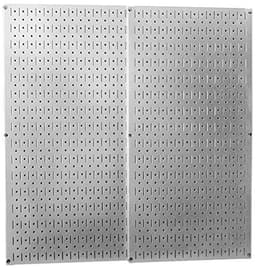
20-gauge steel pegboard with published per-panel and per-hook limits, which is more honesty about capacity than the entire hardboard-pegboard category offers combined.
Published specs
- Material
- 20-gauge galvanized steel
- Into studs
- Up to 200 lb per panel
- Into drywall anchors
- Up to 100 lb per panel
- Per hook, two slots
- 10 to 15 lb
- Per hook, one slot
- 5 to 10 lb
- Per shelf assembly
- 10 to 20 lb, evenly distributed
Figures are the manufacturer's, from Wall Control's published capacity guidance, read 2026-09-01. We have not verified them by testing and do not imply that we have.
Our scoring
- Published capacity
- 6.5
- Coverage per dollar
- 9.5
- Accessory range
- 9.0
- Install simplicity
- 8.0
- Documentation
- 10.0
What works
- Steel rather than hardboard, so the holes do not blow out and the board does not bow
- Publishes limits per panel, per hook AND per shelf — nobody else in pegboard does this
- Takes both round-hole and slotted accessories, so most existing pegboard hooks still work
- Cheapest way to get a lot of small tools off a bench and onto a wall
What doesn't
- Per-hook limits are genuinely low; this is a hand-tool wall, not a ladder-and-bike wall
- 100 lb per panel into drywall anchors is much less than 200 lb into studs, and most people install into drywall
- Panels are small, so a full wall is a lot of panels and a lot of alignment
Skip this one if what you need on the wall is bikes, ladders, or a wheelbarrow. A 10 to 15 lb hook limit is not a suggestion, and the right answer for those is track or heavy-duty hooks into studs.
#2 · Best track system
Gladiator GearTrack Channels
Gladiator GarageWorks
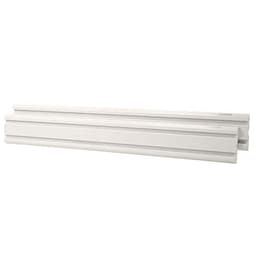
75 lb per linear foot, published in the installation manual rather than buried in marketing copy. Track beats full-panel systems when what you are hanging is heavy and few rather than light and many.
Published specs
- Rated capacity
- 75 lb per linear foot
- Mounting
- Into wood studs, including through drywall
- Format
- Horizontal channels, sold in packs
Figures are the manufacturer's, from Gladiator installation instructions W11087876 Rev A, read 2026-09-01. We have not verified them by testing and do not imply that we have.
Our scoring
- Published capacity
- 9.5
- Coverage per dollar
- 7.0
- Accessory range
- 9.0
- Install simplicity
- 8.5
- Documentation
- 9.5
What works
- 75 lb per linear foot is the highest published figure of the mainstream wall systems here
- Track means you only cover the strip of wall you need, not the whole thing
- Accessory range is broad and stays available
- The capacity figure is published in the installation instructions, which is where a figure you are going to rely on belongs
What doesn't
- Only holds things at the height of the track, so you are installing two or three runs to get real coverage
- The per-linear-foot rating assumes the track is fastened into studs, which caps you at where the studs are
- Accessories are proprietary
Skip this one if the wall is going to hold a lot of small light things — hand tools, spray cans, cordless batteries. That is pegboard's job, and pegboard does it for a fraction of the price.
#3 · Best in a damp or unheated garage
Proslat PVC Slatwall
Proslat
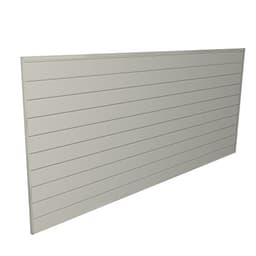
PVC rather than MDF or steel, rated to 75 lb per square foot and backed by a lifetime warranty. In a garage that gets damp, the material is the whole argument.
Published specs
- Rated capacity
- 75 lb per square foot
- Heavy-duty line
- Patented aluminum core rated to 200 lb
- Mounting
- 16 in studs
- Material
- PVC
- Warranty
- Lifetime
Figures are the manufacturer's, from the Proslat PVC slatwall collection page, read 2026-09-01. We have not verified them by testing and do not imply that we have.
Our scoring
- Published capacity
- 9.0
- Coverage per dollar
- 7.0
- Damp tolerance
- 9.5
- Install simplicity
- 7.5
- Documentation
- 8.5
What works
- PVC does not swell, rot or rust, which is the failure mode of MDF slatwall in an unheated garage
- 75 lb per sq ft is higher than Gladiator's panel rating
- Lifetime warranty
- The heavy-duty aluminum-core line is there when 75 lb per sq ft is not enough
What doesn't
- Published for 16 in stud spacing — a 24 in stud wall needs checking before you order
- Full-wall coverage is expensive, same as any panel system
- PVC has a plastic look that some people dislike next to steel cabinets
Skip this one if your studs are 24 in on center. The published mounting is 16 in, and stretching a panel system across wider studs is exactly the shortcut that ends with a panel pulling off the wall.
Questions people actually ask
How much weight can a pegboard hook hold?
Wall Control publishes 10 to 15 lb for a hook engaging two slots and 5 to 10 lb for a hook engaging one, assuming the weight sits at the base of the hook rather than the tip. That is the binding limit on a pegboard wall, well before the panel's 200 lb figure.
What is the best wall system for hand tools?
Metal pegboard, on cost per square foot of wall and on accessory range. Wall Control's 20-gauge steel does not bow or blow out its holes the way hardboard does, and it is the only brand here publishing per-hook limits.
Can I put small-parts bins on pegboard?
Only light ones. Wall Control publishes 2 lb per plastic bin, which is a handful of screws rather than a bin of them. A wall of hardware bins wants a parts cabinet on a shelf, where the weight goes into the floor.
How high should a tool wall start?
About 6 to 8 inches above the benchtop if it sits over a bench, so the bottom row of hooks clears whatever is on the bench. The band between hip and shoulder is where your most-used tools belong.
Sources
- Wall Control published capacity guidance — per panel, per hook, per shelf and per binChecked September 1, 2026
- Gladiator GearTrack installation instructions W11087876 Rev A — 75 lb per linear footChecked September 1, 2026
- Proslat PVC slatwall — 75 lb per sq ftChecked September 1, 2026
Manufacturer documentation, manuals, warranty terms and exact product models reviewed September 1, 2026.
Read next
- How to lay out a garage pegboardThe layout that survives contact with a real garage, and the published hook limits that constrain it.
- Pegboard vs slatwall vs trackThree formats for three jobs. Which one you need is decided by what you are hanging, not by budget.
- How much weight can a garage wall hold?The fixing decides it, not the wall. Published stud-versus-drywall figures and how to find your studs.
- Where the tools goTools in a bin become a search. The wall is the answer, and the hook limits decide what goes where.
- The best garage workbenchesAdjustable height and top material, plus the honest question of whether you need a bench at all.
- How to organize a garage wallThree height bands, four walls, and the order to install in so you do not do it twice.
- Proslat or Gladiator GearWall: the panel systems compared75 lb per square foot against 50, in the same published unit — plus damp tolerance, warranty and accessory range.
- The best small parts organizers for a garageDrawer cabinets, a louvered bin wall and a sealed portable case, ranked on sorting density and drawer size.
- Garage hooks: what the weight ratings actually meanWhat garage hook ratings really mean, and which wall system to hang heavy things from.
- Where the rakes, shovels and yard tools goLong-handled and top-heavy — what actually holds yard tools, and the hook ratings that do not.
- Wall Control metal pegboard: the numbers nobody else publishes20-gauge steel pegboard on published per-panel, per-hook and per-shelf limits — and who should not buy it.
- The best magnetic tool holdersMagnetic tool bars on published pull force per inch, and the honest limits of what a magnet holds.