Cabinets
Garage cabinets with doors
Doors are worth paying for on a short list of things and a waste of money on everything else. Here is the short list, and what to look for if safety is the reason.
Disclosure: Rail & Rafter earns a commission on qualifying purchases made through links on this page, at no cost to you. Commission does not decide what we recommend — our criteria do, and here is how we are funded.

Doors cost money, capacity and accessibility. On the right contents they are worth all three. On the wrong contents they are the most expensive way to store a bin you could have stored on a shelf.
So the useful question is not "should I buy cabinets with doors". It is which specific things in your garage need a door, and the honest list is shorter than most people expect.
What genuinely needs doors
1. Chemicals, fuel and anything a child could reach
This is the strongest case and it is a safety one rather than a tidiness one. Paint, thinners, solvents, fuel, pesticides, adhesives, and — in a garage children use — sharp and powered tools.
If this describes your garage, buy the lockable cabinet and stop reading the cost-per-cubic-foot argument. Steel body, lockable doors, and put it where a child cannot climb to it. Both Seville UltraHD cabinets are steel bodied and lockable.
2. Things fine dust ruins
If you cut, sand or grind in the garage, everything on an open shelf wears a layer of it. Finishing supplies, spare filters, anything with a fine mechanism, and anything you want clean when you pick it up.
3. The category that will never look tidy
Every garage has one — half-used consumables, mismatched packaging, the miscellaneous shelf. Some things do not look tidy on an open shelf no matter how well organized they are. A door is a legitimate answer.
What does not need doors
Nearly everything else, and specifically:
- Anything already in a lidded bin. The bin is the container. Putting a container inside a container is paying twice for the same job — see best garage storage bins.
- Seasonal bulk. Holiday decorations, camping gear, spare bedding. That belongs overhead, not behind a door at eye level.
- Hand tools you use weekly. Two motions instead of one is exactly why tools end up on the bench instead of put away. They want a wall.
- Sports gear and kids' equipment. High turnover, awkward shapes, and it needs to be grabbable. Bins on shelves, or hooks.
What to look for if safety is the reason
If you are buying primarily to lock chemicals or tools away, these are the things to check rather than the capacity figure:
- A steel body, not just steel doors. A lock on a cabinet with a thin back panel is a lock on a box you can get into another way.
- Where it can be anchored. A tall cabinet that can be pulled over is a hazard in its own right, particularly if the reason you bought it is children.
- Whether it sits flat to the wall. A gap you can get fingers into behind a cabinet defeats some of the point.
- Ventilation. A sealed steel box holding solvents in a garage that gets warm is not ideal. Do not seal the doors, and leave a gap behind the cabinet for air movement.
The damp problem with closed cabinets
An unheated garage swings through humidity, and a closed steel cabinet does not dry as quickly as an open shelf. Warm damp air condenses on cold steel and stays there.
The fix is not to avoid cabinets — it is to be deliberate about what goes in them. Keep bare-steel tools and anything moisture-sensitive in a sealed bin inside the cabinet, leave a gap behind the unit for airflow, and put the genuinely damp-tolerant things on open wire shelving instead.
The depth trap, again
It bears repeating here because it bites hardest on cabinets: a standard 27-gallon tote is about 19.6 inches wide, and an 18 inch cabinet cannot close its doors on one.
On open shelving, a bin that overhangs is annoying. On a cabinet it is fatal — the doors do not shut and you have bought an expensive shelf. If bins are going inside, the cabinet needs to be 24 inches deep. The full numbers are on the cabinet roundup.
How many you actually need
Usually one. Make a list of the things on the "genuinely needs doors" list above, in your garage, right now. For most people it fits in a single 30 inch cabinet with room left over.
A wall of cabinets looks like a finished garage in a photograph and costs several times what the same capacity in shelving costs. The layout that actually works is one cabinet against a wall of open storage — worked through on cabinets vs shelves, and planned in detail on how to plan a cabinet wall.
What we would buy for this
Every pick carries the manufacturer's published specs, our scoring against stated criteria, and a reason you might want to skip it.
#1 · Best all-steel cabinet
Seville Classics UltraHD Storage Cabinet, 30 x 18 x 72 in
Seville Classics
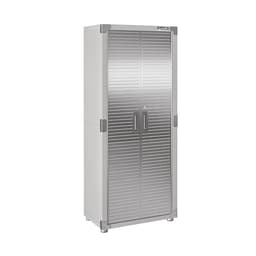
600 lb across the cabinet and 150 lb per shelf, in a footprint 18 inches deep. The depth is the reason it works in a garage where a 24 in cabinet would eat the walkway.
Published specs
- Dimensions
- 30 in W x 18 in D x 72 in H
- Total capacity
- 600 lb
- Capacity per shelf
- 150 lb
- Body
- Steel, lockable
Figures are the manufacturer's, from Seville Classics published specifications; the UltraHD 30 in cabinet (SKU UHD20162B) re-read 2026-09-12. We have not verified them by testing and do not imply that we have.
Our scoring
- Published capacity
- 7.5
- Footprint efficiency
- 9.0
- Build
- 8.5
- Security
- 8.5
- Tote fit
- 4.5
What works
- 18 in depth keeps the walkway usable in a single-car garage
- Steel body and lockable doors, which matters if the garage is also where the chemicals live
- 150 lb per shelf is enough for anything that belongs behind a door
- Doors mean the contents stay out of sight, which is most of what a garage tidy actually is
What doesn't
- 600 lb total is modest next to open shelving of the same size
- 18 in depth will not take a 27-gallon tote across the depth
- Steel cabinets in an unheated garage will sweat in a humidity swing
Skip this one if what you are storing is bins. A 27-gallon tote is over 19 in wide and this cabinet is 18 in deep — you would be buying doors you cannot close.
#2 · Best big cabinet
Seville Classics UltraHD Extra-Wide Cabinet, 60 x 24 x 72 in
Seville Classics
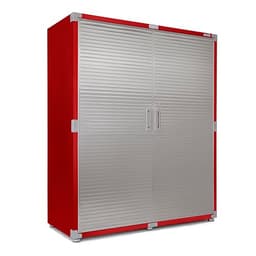
800 lb total with a reinforced 200 lb bottom shelf — the bottom shelf rating is the one to notice, because that is where the heavy things end up anyway.
Published specs
- Dimensions
- 60 in W x 24 in D x 72 in H
- Total capacity
- 800 lb
- Capacity per shelf
- 100 lb
- Bottom shelf
- 200 lb
Figures are the manufacturer's, from Seville Classics published specifications; the UltraHD 30 in cabinet (SKU UHD20162B) re-read 2026-09-12. We have not verified them by testing and do not imply that we have.
Our scoring
- Published capacity
- 8.0
- Footprint efficiency
- 6.5
- Build
- 8.5
- Security
- 8.5
- Tote fit
- 9.0
What works
- 24 in depth takes a 27-gallon tote across the depth, which the 18 in cabinet cannot
- The 200 lb bottom shelf is rated for what people actually put there
- 60 in of closed storage clears a lot of clutter in one purchase
What doesn't
- 100 lb per shelf on the upper shelves is not much for a cabinet this size
- 24 in deep and 60 in wide is a serious amount of garage
- The strong shelf is the bottom one, so anything heavy has to live at floor level
Skip this one if your garage is a single bay and you still park in it. 60 in wide by 24 in deep against a side wall is often the difference between opening the car door and not.
Questions people actually ask
Do I need garage cabinets with doors?
For chemicals, fuel, anything a child could reach, and things fine dust ruins — yes. For bins, seasonal bulk, hand tools and sports gear — no. Most garages need one cabinet, not a wall of them.
Are lockable garage cabinets worth it?
If the garage has children in it and there are chemicals or power tools to lock away, that is a safety requirement rather than a preference. Look for a steel body rather than just steel doors, and somewhere to anchor it so it cannot be pulled over.
Will a storage tote fit in an 18 inch cabinet?
No. The common 27-gallon totes are about 19.6 in wide, so the doors will not close on one. A cabinet holding bins needs to be 24 in deep.
Do closed cabinets cause rust in a garage?
They can trap damp. An unheated garage swings through humidity and warm damp air condenses on cold steel, and a closed box dries slowly. Leave a gap behind the cabinet, do not seal the doors, and keep moisture-sensitive items in a sealed bin inside.
Sources
- Seville Classics UltraHD cabinets — steel body, lockable, published capacitiesChecked September 1, 2026
- Sterilite published tote exterior dimensionsChecked September 1, 2026
Manufacturer documentation, manuals, warranty terms and exact product models reviewed September 1, 2026.
Read next
- The best garage storage cabinetsCabinets ranked on published capacity and the depth question that decides whether your bins fit.
- Garage cabinets vs shelvesWhat doors actually buy you, when it is worth paying for, and the hybrid most garages should build.
- How to plan a garage cabinet wallSix measurements and an order of operations for the most expensive wall in the garage.
- Where the tools goTools in a bin become a search. The wall is the answer, and the hook limits decide what goes where.
- Where the kids' stuff goesIt fails for one reason: it is stored at adult height. The height rule and the open-bin system.
- The best garage storage binsThree 27-gallon totes on published exterior dimensions, and where each one actually fits.
- Metal or wood garage cabinets?Published capacity against material tolerance, and the honest case for each in a real garage.
- Seville Classics UltraHD cabinet: the 18 inch question600 lb total, 150 lb per shelf, 18 in deep — what that depth buys and who it disappoints.
- The best resin garage cabinetsResin cabinets on published shelf ratings and cubic feet, and when steel is worth the extra.