Walls
How to organize a garage wall
Most garage walls fail because everything went up at the same height. Three bands, four walls, and an order of operations that stops you installing the same thing twice.
Disclosure: Rail & Rafter earns a commission on qualifying purchases made through links on this page, at no cost to you. Commission does not decide what we recommend — our criteria do, and here is how we are funded.

A garage wall fails in a predictable way: everything goes up at chest height because that is where it is easy to install, and then the wall is full and the bikes are still on the floor.
The fix is to plan in bands and in walls before you plan in products. Twenty minutes with a tape measure and a pencil saves you installing the same run of track twice.
The three height bands
Every garage wall has three zones and they have different jobs. Assigning items to bands first is what stops the chest-height pile-up.
| Band | Roughly | What goes there | Why |
|---|---|---|---|
| High | Above 6 ft | Seasonal, light, awkward: ladders, long-handled tools, spare hose | You need a step to reach it, so it must be rarely needed and light |
| Prime | Hip to shoulder, about 3 to 5.5 ft | The ten things you use weekly | Your hand goes here without thinking. Do not waste it. |
| Low | Below hip, under 3 ft | Nothing hanging. Bench, cabinet, bins on the floor | Hanging things low means bending, and things below knee height get kicked |
The rule that follows: prime band is scarce, so ration it. If a tool has not been used in the last month it does not belong between hip and shoulder, whatever its size.
The four walls, and what each is for
The long wall opposite the car door
This is your heavy wall and the one worth spending on. Bikes, ladders, wheelbarrow, long-handled tools. Two runs of track — one at about 4 ft for bikes, one at 6 ft or above for long items — covers it. GearTrack's published 75 lb per linear foot is the relevant number here, and it needs studs.
The bench wall
A pegboard panel starting 6 to 8 inches above the benchtop, filling the prime band. Hand tools only, per the per-hook limits on the tool wall roundup. This is the highest-value square footage in the garage and it should hold the things you touch most.
The strips either side of the garage door
The most under-used surface in most garages, and it has none of the clearance problems of the space above the door. Narrow vertical strips are perfect for rakes, brooms, a folded step ladder and the snow shovel — long things standing up.
The wall shared with the house
Check what is in it before you plan anything. Shared walls carry electrical runs, plumbing and sometimes ducting, and a stud-finder reading over a pipe is a false positive that becomes a real problem. Confirm at two heights, as described on how much weight a garage wall holds.
The order to do it in
Order matters because each step constrains the next, and doing them backwards means moving things you already installed:
- Empty the wall completely. Not partially. You cannot plan around things that are already up.
- Map the studs on every wall and mark them in pencil. Everything else is constrained by where they are.
- Place the bench first. It is the largest fixed thing and it determines where the pegboard starts. Nothing else should be positioned before it.
- Install the track runs on the heavy wall. Heights first, hardware second — get the runs where the bands say they go.
- Install the pegboard above the bench.
- Hang the ten prime-band items and stop. Live with it for a fortnight before hanging anything else. What you reach for tells you more about the layout than planning does.
The fortnight rule
Resist filling the wall on day one. A wall you fill immediately is a wall organized around what you own; a wall you fill over a fortnight is organized around what you use. The second one stays tidy and the first one does not.
What should not go on the wall at all
- Bins and totes. They want a shelf or an overhead rack. Hanging them is a lot of hardware for a poor result.
- Anything over about 20 lb on pegboard. The hooks are rated at 10 to 15 lb. Heavy items go on track, into studs.
- Chemicals and anything that should be locked. Open walls are open. That is a cabinet with doors question.
If you do not know what goes where yet
Then the wall is not your first problem. Work out what the piles are and which system each one belongs to first — that is what the mess: start here is for, and it will tell you whether the bikes are a wall problem (they are) and whether the bins are (they are not).
What we would buy for this
Every pick carries the manufacturer's published specs, our scoring against stated criteria, and a reason you might want to skip it.
#1 · Best track system
Gladiator GearTrack Channels
Gladiator GarageWorks
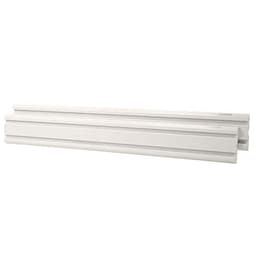
75 lb per linear foot, published in the installation manual rather than buried in marketing copy. Track beats full-panel systems when what you are hanging is heavy and few rather than light and many.
Published specs
- Rated capacity
- 75 lb per linear foot
- Mounting
- Into wood studs, including through drywall
- Format
- Horizontal channels, sold in packs
Figures are the manufacturer's, from Gladiator installation instructions W11087876 Rev A, read 2026-09-01. We have not verified them by testing and do not imply that we have.
Our scoring
- Published capacity
- 9.5
- Coverage per dollar
- 7.0
- Accessory range
- 9.0
- Install simplicity
- 8.5
- Documentation
- 9.5
What works
- 75 lb per linear foot is the highest published figure of the mainstream wall systems here
- Track means you only cover the strip of wall you need, not the whole thing
- Accessory range is broad and stays available
- The capacity figure is published in the installation instructions, which is where a figure you are going to rely on belongs
What doesn't
- Only holds things at the height of the track, so you are installing two or three runs to get real coverage
- The per-linear-foot rating assumes the track is fastened into studs, which caps you at where the studs are
- Accessories are proprietary
Skip this one if the wall is going to hold a lot of small light things — hand tools, spray cans, cordless batteries. That is pegboard's job, and pegboard does it for a fraction of the price.
#2 · Best for hand tools
Wall Control Metal Pegboard
Wall Control
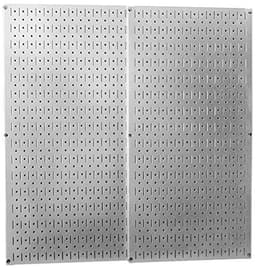
20-gauge steel pegboard with published per-panel and per-hook limits, which is more honesty about capacity than the entire hardboard-pegboard category offers combined.
Published specs
- Material
- 20-gauge galvanized steel
- Into studs
- Up to 200 lb per panel
- Into drywall anchors
- Up to 100 lb per panel
- Per hook, two slots
- 10 to 15 lb
- Per hook, one slot
- 5 to 10 lb
- Per shelf assembly
- 10 to 20 lb, evenly distributed
Figures are the manufacturer's, from Wall Control's published capacity guidance, read 2026-09-01. We have not verified them by testing and do not imply that we have.
Our scoring
- Published capacity
- 6.5
- Coverage per dollar
- 9.5
- Accessory range
- 9.0
- Install simplicity
- 8.0
- Documentation
- 10.0
What works
- Steel rather than hardboard, so the holes do not blow out and the board does not bow
- Publishes limits per panel, per hook AND per shelf — nobody else in pegboard does this
- Takes both round-hole and slotted accessories, so most existing pegboard hooks still work
- Cheapest way to get a lot of small tools off a bench and onto a wall
What doesn't
- Per-hook limits are genuinely low; this is a hand-tool wall, not a ladder-and-bike wall
- 100 lb per panel into drywall anchors is much less than 200 lb into studs, and most people install into drywall
- Panels are small, so a full wall is a lot of panels and a lot of alignment
Skip this one if what you need on the wall is bikes, ladders, or a wheelbarrow. A 10 to 15 lb hook limit is not a suggestion, and the right answer for those is track or heavy-duty hooks into studs.
Questions people actually ask
What height should garage wall hooks be?
Bikes and frequently used items between hip and shoulder, roughly 3 to 5.5 ft. Ladders and long-handled tools above 6 ft. Nothing hanging below hip height — that band belongs to the bench, cabinets and floor bins.
Which garage wall should I do first?
The bench wall, because the bench position determines where the pegboard starts and it is the largest fixed thing in the room. Then the long heavy wall with track runs.
Should I put storage on the wall shared with the house?
You can, but check what is in it first. Shared walls carry electrical, plumbing and sometimes ducting, and a stud-finder reading over a pipe is a false positive. Confirm every stud at two different heights.
How do I stop the wall getting messy again?
Ration the prime band. If something has not been used in a month it does not belong between hip and shoulder. Hanging only your ten most-used items and living with it for a fortnight before adding more is the practical version of that rule.
Sources
- Gladiator GearTrack installation instructions W11087876 Rev A — 75 lb per linear foot, stud mountingChecked September 1, 2026
- Wall Control published per-hook and per-panel capacity guidanceChecked September 1, 2026
Manufacturer documentation, manuals, warranty terms and exact product models reviewed September 1, 2026.
Read next
- The best garage wall storage systemsTrack, slatwall, panels and metal pegboard on published load ratings, converted into one comparable question.
- Pegboard vs slatwall vs trackThree formats for three jobs. Which one you need is decided by what you are hanging, not by budget.
- How much weight can a garage wall hold?The fixing decides it, not the wall. Published stud-versus-drywall figures and how to find your studs.
- Your garage is full. Start here.Four passes that turn a full garage into a list of piles, each with a system that fits it.
- Where the bikes goBikes are a wall problem, not a floor problem. The system, the stud check, and why hoists get abandoned.
- Where the tools goTools in a bin become a search. The wall is the answer, and the hook limits decide what goes where.
- Slatwall or a French cleat wall?Published load ratings against a wall you build yourself, and the honest case for each.