The Mess
Where the sports gear goes
Balls that roll, bats that fall over, and a helmet nobody can ever find. Sports gear fails in bins because it is high-turnover — it wants open storage on a wall.
Disclosure: Rail & Rafter earns a commission on qualifying purchases made through links on this page, at no cost to you. Commission does not decide what we recommend — our criteria do, and here is how we are funded.

A basketball on the floor that rolls under the car. Three bats leaning in a corner that fall over whenever one is taken. A helmet that is definitely somewhere. Two soccer balls, one flat.
Sports gear wants open storage on a wall, in baskets, at the height of the person who uses it. Not bins, not a shelf, and not a corner.
Why bins fail for this specific pile
Bins are excellent for things that are bulky, light and rarely needed. Sports gear is bulky, light and needed constantly, which is a different profile entirely.
The failure is mechanical. A lidded bin means: lift the lid, dig, find, replace, close. That is five actions to get a ball, and nobody does five actions to get a ball — they take the ball and leave the lid off and the bin open, and within a fortnight it is a pile with a plastic wall around it.
Open baskets are one action. Reach in, take, done. Putting it back is also one action, and that is the part that decides whether a system survives.
The system
A wall panel with baskets and hooks is the answer, and this is the one mess on the site where a full panel beats track.
The reason: sports gear changes with the season. Soccer in autumn, skis in winter, baseball in spring. Track holds things on a line at fixed heights, which is fine for four bikes that never change and irritating for gear that rotates. A panel lets you move a basket without drilling — GearWall publishes 50 lb per square foot, and 50 lb across a basket of balls is not close to a limit.
| Item | Storage | Height |
|---|---|---|
| Balls — soccer, basketball, footballs | Open wire basket | Child height, or where it is used |
| Bats, hockey sticks, rackets | Vertical hooks or a rail | High enough that they hang clear of the floor |
| Helmets | Individual hooks, one per helmet | Eye level |
| Gloves, pads, small kit | A shallow basket or a shelf | Eye level |
| Skis, snowboards, seasonal | Horizontal hooks, high | Above 6 ft — it is seasonal |
The rule that makes it survive a season
Put it at the height of the person who uses it. A basket of soccer balls at adult shoulder height is a basket a seven-year-old cannot reach, and a seven-year-old who cannot reach the basket puts the ball on the floor.
That is the whole reason kids' storage fails, and the same rule applies on the kids' gear page.
The constraint
Sports gear is light, so capacity is genuinely not the binding limit here — which makes this one of the few messes where you can pick on convenience rather than on load. A basket of balls is a few pounds against a published 50 lb per square foot.
What is a constraint is the fixing. Panel systems mount into studs, and a basket with a child pulling on it applies more force than the weight of what is in it. Find the studs — the method is on how much weight a garage wall holds.
The other constraint is horizontal space rather than weight. A full wall panel is more expensive per square foot than any other option — see the format comparison — so panel the section of wall the gear needs rather than the whole wall.
What it costs and how long it takes
A panel section plus baskets and hooks is an afternoon: find studs, fix the panels, hang the accessories. The accessories are where the cost lives rather than the panel — one basket per ball category, one hook per helmet.
Start with fewer accessories than you think you need. Hang the four things that are currently on the floor, live with it for a fortnight, then add. Filling a panel on day one is how you end up with baskets full of things nobody plays with — the same fortnight rule that governs any garage wall.
What not to do
- Do not put it all in one big bin. One bin for all sports gear becomes a bin you dig through, which is the pile you started with.
- Do not store it at adult height if children use it. The single most common reason a sports gear system fails.
- Do not store the flat ball. Genuinely. Every garage has one and it has been there for two years — that is a sorting question.
- Do not mix seasons at the same height. The skis do not need to be at eye level in July. Seasonal gear goes high, or into a bin and overhead.
The seasonal split
The gear that is in season lives on the wall where it is grabbable. The gear that is out of season goes in a labeled bin, and that bin goes overhead — six flat totes fit on a standard 4x8 rack, per bin sizes that fit overhead racks.
Twice a year you swap. That is the whole maintenance, and it keeps the wall holding only what is actually being used — which is what stops a sports wall becoming a display of everything the household has ever played.
What we would buy for this
Every pick carries the manufacturer's published specs, our scoring against stated criteria, and a reason you might want to skip it.
#1 · Best full-wall panel system
Gladiator GearWall Panels
Gladiator GarageWorks
50 lb per square foot across a whole panel, which is a different kind of number from GearTrack's per-foot rating: it buys you the freedom to hang anything anywhere rather than only on a line.
Published specs
- Rated capacity
- 50 lb per square foot
- Mounting
- Into wood studs, including through drywall
- Format
- Full-height slatted panels
Figures are the manufacturer's, from Gladiator installation instructions W11087876 Rev A, read 2026-09-01. We have not verified them by testing and do not imply that we have.
Our scoring
- Published capacity
- 8.5
- Coverage per dollar
- 6.5
- Accessory range
- 9.0
- Install simplicity
- 7.0
- Documentation
- 9.5
What works
- Hang anything at any height rather than only where a track run happens to be
- 50 lb per sq ft across a full panel is a large total load
- Shares the Gladiator accessory range with GearTrack
What doesn't
- Covering a whole wall in panels costs several times what two track runs cost
- It is a wall finish as much as a storage system, so it is a bigger commitment to undo
- Per-square-foot ratings are harder to reason about than per-foot ones — a single 60 lb item is not the rated case
Skip this one if you know exactly what is going on that wall and it is six things. Two runs of track will hold them for a fraction of the cost, and the wall stays a wall.
#2 · Best track system
Gladiator GearTrack Channels
Gladiator GarageWorks
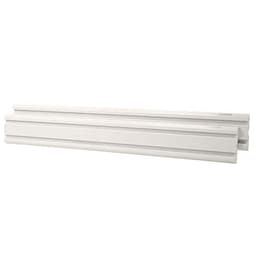
75 lb per linear foot, published in the installation manual rather than buried in marketing copy. Track beats full-panel systems when what you are hanging is heavy and few rather than light and many.
Published specs
- Rated capacity
- 75 lb per linear foot
- Mounting
- Into wood studs, including through drywall
- Format
- Horizontal channels, sold in packs
Figures are the manufacturer's, from Gladiator installation instructions W11087876 Rev A, read 2026-09-01. We have not verified them by testing and do not imply that we have.
Our scoring
- Published capacity
- 9.5
- Coverage per dollar
- 7.0
- Accessory range
- 9.0
- Install simplicity
- 8.5
- Documentation
- 9.5
What works
- 75 lb per linear foot is the highest published figure of the mainstream wall systems here
- Track means you only cover the strip of wall you need, not the whole thing
- Accessory range is broad and stays available
- The capacity figure is published in the installation instructions, which is where a figure you are going to rely on belongs
What doesn't
- Only holds things at the height of the track, so you are installing two or three runs to get real coverage
- The per-linear-foot rating assumes the track is fastened into studs, which caps you at where the studs are
- Accessories are proprietary
Skip this one if the wall is going to hold a lot of small light things — hand tools, spray cans, cordless batteries. That is pegboard's job, and pegboard does it for a fraction of the price.
Questions people actually ask
What is the best way to store sports equipment in a garage?
Open baskets and hooks on a wall panel, at the height of the person who uses the gear. Sports equipment is high-turnover, and a lidded bin adds enough friction that things end up on the floor instead.
Why not just use a big bin for sports gear?
Because getting a ball out of a lidded bin is five actions and putting it back is five more. Nobody does that, so the lid comes off and it becomes a pile with a plastic wall around it. Open baskets are one action each way.
Should sports gear go on track or a panel?
A panel, unusually for this site. Sports gear rotates with the season and a panel lets you move a basket without drilling. Track is better where the items are heavy, few and unchanging — like bikes.
How high should sports storage be?
At the height of whoever uses it. In-season gear for children goes at child height; out-of-season gear goes above 6 ft or into a labeled bin on an overhead rack.
Sources
- Gladiator GearWall published rating — 50 lb per square foot, stud mountingChecked September 1, 2026
- Sterilite 27 gal Industrial Tote — published dimensions for the seasonal binChecked September 1, 2026
Manufacturer documentation, manuals, warranty terms and exact product models reviewed September 1, 2026.
Read next
- The best garage wall storage systemsTrack, slatwall, panels and metal pegboard on published load ratings, converted into one comparable question.
- Where the kids' stuff goesIt fails for one reason: it is stored at adult height. The height rule and the open-bin system.
- Where the bikes goBikes are a wall problem, not a floor problem. The system, the stud check, and why hoists get abandoned.
- The best garage storage binsThree 27-gallon totes on published exterior dimensions, and where each one actually fits.
- Pegboard vs slatwall vs trackThree formats for three jobs. Which one you need is decided by what you are hanging, not by budget.
- How to organize a garage wallThree height bands, four walls, and the order to install in so you do not do it twice.
- Where the skis and snowboards goLong, light and seasonal — skis are a wall problem for eight months a year. What to hang them on.