The Mess
Where the lumber and plywood go
Offcuts behind the door, a sheet of plywood leaning on the wall warping as it stands there. These are two different problems with two different answers.
Disclosure: Rail & Rafter earns a commission on qualifying purchases made through links on this page, at no cost to you. Commission does not decide what we recommend — our criteria do, and here is how we are funded.
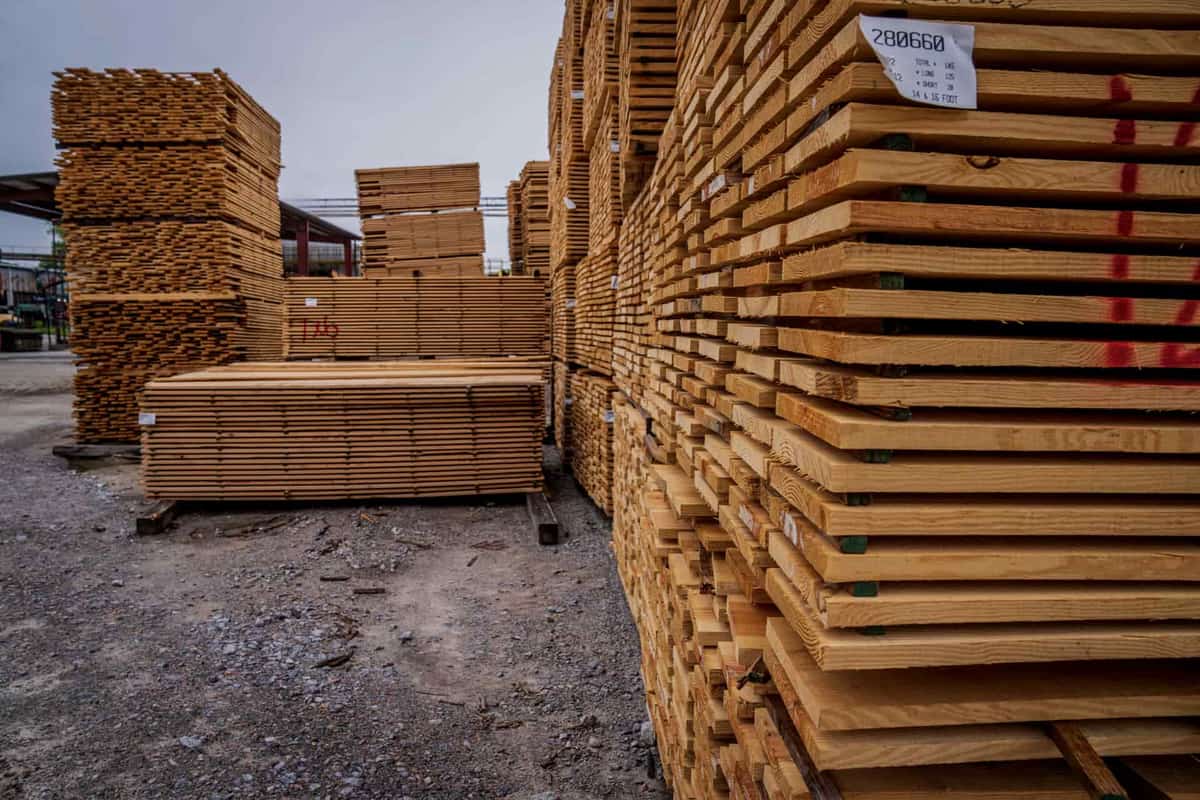
A stack of offcuts behind the door that you step over. Two sheets of plywood leaning against the wall, slowly taking on the shape of the wall. A couple of long boards balanced across the tops of two shelving units.
These are two different problems, and treating them as one is why nobody solves either. Long stock wants the ceiling. Sheet goods want to be flat or truly vertical. Offcuts mostly want to leave.
Long stock goes on the ceiling
Boards, trim, moldings and anything over about six feet want to be overhead, on hooks or a rack, running parallel to the joists. There are two good reasons and one very good one.
The good reasons: it is dead space, and long stock is exactly the awkward shape that ruins a shelf. The very good reason: lumber stored horizontally and supported at intervals stays straight. Lumber leaning in a corner does not — it takes a set, and a board with a bow in it is firewood as far as most jobs are concerned.
Support it at multiple points along its length rather than at the two ends. A board supported only at the ends sags in the middle over months, and that sag becomes permanent.
Sheet goods: flat, or genuinely vertical
A leaning sheet of plywood is a warping sheet of plywood
Plywood leaning against a wall at an angle is supported along one edge and unsupported everywhere else, and it will follow gravity. Given a few months in a garage that swings through humidity, it takes on a curve you cannot get out.
Two acceptable storage positions: flat and fully supported, or genuinely vertical — square to the floor, not leaning — with support along its length. Anything in between is slow damage.
Flat is better and takes more room. A full sheet is 4 by 8 feet, which is a lot of floor or a lot of shelf. In most garages the practical answer is a narrow vertical rack against a wall, holding sheets on edge and square.
Do not store sheet goods directly on the slab. Garage floors sweat and slope toward the door, and the bottom two inches of a sheet standing on concrete is where the delamination starts. Get it up on battens.
Offcuts: the honest conversation
Every workshop has an offcut pile and every offcut pile is 80 percent material that will never be used. The pile grows because throwing away usable wood feels wasteful, and the result is that you cannot find the piece you actually want.
The rule that works: keep offcuts by size, in one container, and when the container is full something leaves before something enters.
- One tall bin or a vertical rack for short offcuts standing on end.
- Sort roughly by size rather than by species — size is what you search by.
- Anything under about a foot goes, unless you have a specific named use for it. Small offcuts are the bulk of the pile and the smallest fraction of what gets used.
This is a sorting problem rather than a storage one, and no rack fixes it.
The constraint: lumber is heavy
This is the mess where the ceiling arithmetic genuinely bites. Lumber is dense, and a rack of boards is a very different load from a rack of holiday bins.
Before you put stock overhead, work out what your ceiling can carry. A garage framed for an uninhabitable attic without storage is designed for a 10 lb per square foot live load; with limited storage, 20. Neither number is large, and a stack of construction lumber goes past them faster than almost anything else people put overhead. The complete joist span tables are on how much weight a garage ceiling holds.
Two practical consequences:
- Spread the load across more joists rather than concentrating a heavy stack on two. Support at multiple points does this and keeps the boards straight at the same time.
- Put it near a bearing wall, not mid-span. A joist is weakest in the middle and positioning is free.
If the arithmetic says no, heavy stock goes on heavy-duty shelving instead — the Husky welded rack publishes 2,500 lb per shelf, and the slab does not care.
What it costs and how long it takes
Overhead lumber storage is either a rack or a set of hooks into joists, and the hooks version is genuinely cheap — an hour, a stud finder and some lag hooks. The rack version is the same two-to-three-hour job as any overhead rack.
A vertical sheet-goods rack against a wall can be built from offcuts, which is the one genuinely satisfying use for the offcut pile.
What not to do
- Do not lean sheet goods against a wall. Flat or square, nothing in between.
- Do not stand lumber in a corner. It takes a set and you lose the board.
- Do not store wood directly on the slab. Garage floors sweat and slope. Get it up on battens.
- Do not put a heavy lumber stack overhead without running the joist numbers. This is the one mess where people most often exceed what their ceiling was designed for.
What we would buy for this
Every pick carries the manufacturer's published specs, our scoring against stated criteria, and a reason you might want to skip it.
#1 · Best drop range and warranty
SafeRacks 4 x 8 Overhead Rack
SafeRacks
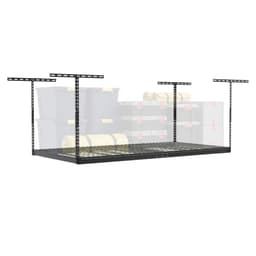
A 12 to 45 inch drop range is the widest published in this category, which makes it the rack that fits both a 7 ft ceiling and a cathedral one. The limited lifetime warranty is the other reason it is here.
Published specs
- Size
- 4 ft x 8 ft
- Rated capacity
- 600 lb total, evenly distributed
- Ceiling drop
- 12 in to 45 in, adjustable
- Brackets
- Patented 27 in brackets spanning two wood joists
- Warranty
- Limited lifetime
- Included
- 8 accessory hooks
Figures are the manufacturer's, from the SafeRacks 4x8 product page, read 2026-09-01. We have not verified them by testing and do not imply that we have.
Our scoring
- Published capacity
- 9.0
- Fit range
- 9.5
- Mounting honesty
- 9.0
- Low-ceiling suitability
- 9.5
- Documentation
- 8.5
What works
- 12 in minimum drop is the shortest published in the mainstream field — this is the low-ceiling answer
- Brackets are designed to span two joists rather than load one
- Limited lifetime warranty, which almost nobody else in the category offers
- Accessory hooks included rather than sold separately
What doesn't
- Wood joists only. The instructions explicitly rule out I-beams, steel joists and concrete ceilings
- The 12 to 24 in and 24 to 45 in drop ranges are separate purchases, so you have to measure before you order rather than after
- 600 lb assumes even distribution; a concentrated load in one corner is not the rated case
Skip this one if your garage ceiling is concrete, steel joist, or an engineered I-beam floor system. SafeRacks says in writing not to install into any of those, and that is not a warning to work around.
#2 · Best heavy-duty shelving
Husky 4-Tier Welded Steel Rack, 77 x 78 x 24 in
Husky
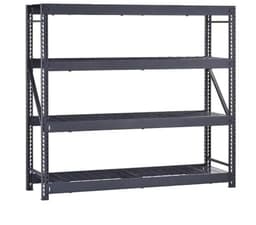
2,500 lb per shelf and 10,000 lb across the unit. That is not a garage number, it is a warehouse number, and it means this is the last shelving you buy for that wall.
Published specs
- Model
- HBR782478W4R
- Dimensions
- 77 in W x 78 in H x 24 in D
- Capacity per shelf
- 2,500 lb, evenly distributed
- Total capacity
- 10,000 lb
- Adjustment
- Shelves adjust in 3 in increments
- Warranty
- Lifetime
Figures are the manufacturer's, from the Home Depot listing for Husky HBR782478W4R, read 2026-09-01. We have not verified them by testing and do not imply that we have.
Our scoring
- Published capacity
- 10.0
- Build
- 9.5
- Tote fit
- 9.0
- Footprint efficiency
- 7.0
- Warranty
- 9.5
What works
- 2,500 lb per shelf is far beyond what a garage will ever ask of it, which is exactly why it never sags
- Welded construction rather than bolt-together, so it does not develop a wobble over years
- 24 in depth swallows a 27-gallon tote sideways with room to spare
- Lifetime warranty
What doesn't
- 77 in wide is a lot of wall. In a single-car garage this is a real commitment
- Welded means it arrives heavy and assembles in one configuration
- Only 3 in adjustment increments, so a tall item may cost you a whole shelf of headroom
Skip this one if you are storing light bulk — holiday bins, sleeping bags, empty coolers. You are paying for steel you will never load, and the same money buys twice the shelf area in a lighter unit.
#3 · Best track system
Gladiator GearTrack Channels
Gladiator GarageWorks
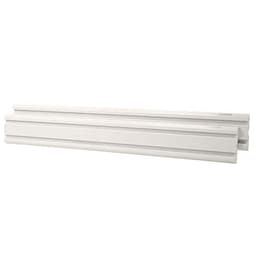
75 lb per linear foot, published in the installation manual rather than buried in marketing copy. Track beats full-panel systems when what you are hanging is heavy and few rather than light and many.
Published specs
- Rated capacity
- 75 lb per linear foot
- Mounting
- Into wood studs, including through drywall
- Format
- Horizontal channels, sold in packs
Figures are the manufacturer's, from Gladiator installation instructions W11087876 Rev A, read 2026-09-01. We have not verified them by testing and do not imply that we have.
Our scoring
- Published capacity
- 9.5
- Coverage per dollar
- 7.0
- Accessory range
- 9.0
- Install simplicity
- 8.5
- Documentation
- 9.5
What works
- 75 lb per linear foot is the highest published figure of the mainstream wall systems here
- Track means you only cover the strip of wall you need, not the whole thing
- Accessory range is broad and stays available
- The capacity figure is published in the installation instructions, which is where a figure you are going to rely on belongs
What doesn't
- Only holds things at the height of the track, so you are installing two or three runs to get real coverage
- The per-linear-foot rating assumes the track is fastened into studs, which caps you at where the studs are
- Accessories are proprietary
Skip this one if the wall is going to hold a lot of small light things — hand tools, spray cans, cordless batteries. That is pegboard's job, and pegboard does it for a fraction of the price.
Questions people actually ask
How should I store lumber in a garage?
Long stock horizontally overhead, running parallel to the joists and supported at multiple points along its length so it stays straight. Support only at the ends and it sags permanently over months.
How do you store plywood so it does not warp?
Flat and fully supported, or genuinely vertical — square to the floor rather than leaning — with support along its length. A sheet leaning at an angle is supported along one edge and will take on a curve you cannot remove.
Can I store lumber on an overhead rack?
Yes, but check the ceiling first. Lumber is dense and this is the mess that most often exceeds what a garage ceiling was framed for. Spread the load across more joists and place it near a bearing wall rather than mid-span.
What should I do with offcuts?
Keep them by size in one container, and when the container is full, something leaves before something enters. Anything under about a foot goes unless you have a specific named use for it — small offcuts are most of the pile and the least of what gets used.
Why should wood not sit on the garage floor?
Garage slabs sweat and slope toward the door for drainage. The bottom couple of inches of a sheet standing on concrete is where delamination starts. Get it up on battens.
Sources
- IRC Table R802.5.1 ceiling joist spans and R301.5 attic live loads, via UpCodesChecked September 1, 2026
- Husky HBR782478W4R — 2,500 lb per shelf, 10,000 lb totalChecked September 1, 2026
- SafeRacks 4x8 — published capacity and wood-joist mounting requirementChecked September 1, 2026
Manufacturer documentation, manuals, warranty terms and exact product models reviewed September 1, 2026.
Read next
- The best overhead garage storage racksFour overhead racks ranked on capacity, drop range and joist fit, with a reason to skip each one.
- How much weight can a garage ceiling hold?The complete 2x4 to 2x10 joist span tables at four spacings, and the arithmetic for your own ceiling.
- The best heavy-duty garage shelvingHeavy-duty shelving on published load figures, plus when you are buying steel you will never load.
- How much weight can a garage wall hold?The fixing decides it, not the wall. Published stud-versus-drywall figures and how to find your studs.
- Your garage is full. Start here.Four passes that turn a full garage into a list of piles, each with a system that fits it.
- Where the tools goTools in a bin become a search. The wall is the answer, and the hook limits decide what goes where.
- The best folding workbenchesFolding benches on published capacity, clamping and folded thickness — and when a fixed bench is the better buy.