The Mess
Where the rakes, shovels and yard tools go
Long handles, heavy heads, and a habit of falling on the car. Yard tools are a wall problem with a specific failure mode, and the fix is where you grip them.
Disclosure: Rail & Rafter earns a commission on qualifying purchases made through links on this page, at no cost to you. Commission does not decide what we recommend — our criteria do, and here is how we are funded.
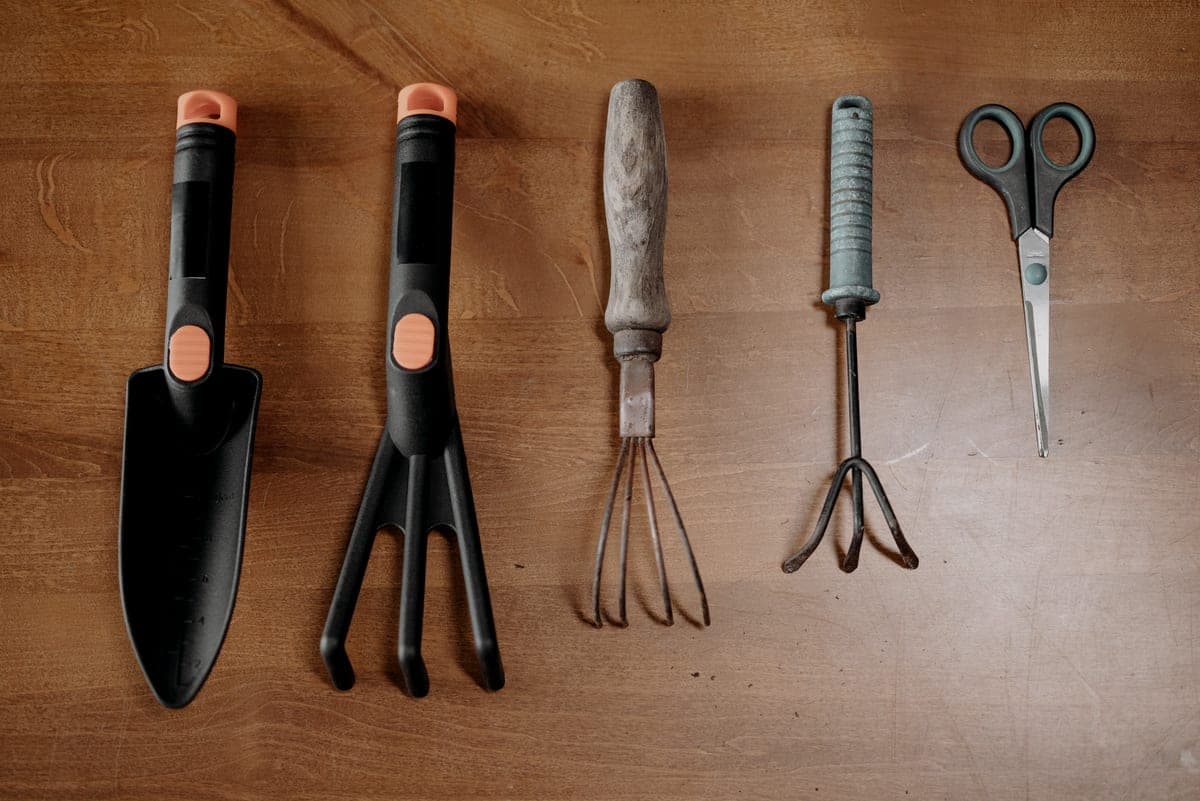
Hang them by the handle, high, on track fixed into studs. Yard tools fall over because they are top-heavy — the weight is in the head and the handle is a lever. Standing them in a corner or a barrel guarantees the pile ends up on the floor, or on the car.
They are also the single most common thing people try to hang on a hook rated for hand tools, which is where this goes wrong. If you are sorting the whole garage, start at the triage guide; the systems are ranked in the wall hub.
What yard tools actually weigh
The reason hook choice matters here is that yard tools span a huge weight range, and the light end and the heavy end want different hardware.
| Tool | Rough weight | Pegboard hook (10-15 lb) | Track (75 lb/linear ft) |
|---|---|---|---|
| Leaf rake | 1 to 3 lb | Yes | Yes |
| Garden spade or fork | 4 to 6 lb | Yes | Yes |
| Loppers, shears | 3 to 6 lb | Yes | Yes |
| String trimmer | 10 to 15 lb | Marginal | Yes |
| Hedge trimmer, blower | 8 to 12 lb | Marginal | Yes |
| Wheelbarrow | 30 to 60 lb | No | Yes, into studs |
The pattern is clear: hand tools go on pegboard, powered tools and the wheelbarrow go on track. Wall Control publishes 10 to 15 lb per two-slot hook, which covers a rake easily and a string trimmer marginally. Gladiator GearTrack publishes 75 lb per linear foot into studs, which covers everything on the list.
Hang them by the handle, not the head
This is the detail that decides whether the wall stays tidy.
A long-handled tool hung by its head has its entire weight hanging below a single point, and it swings. Hung by the handle near the top, the head rests low and the tool sits still against the wall. It also puts the sharp or dirty end near the floor rather than at face height, which matters with a spade.
Two hooks beat one for anything heavy
A string trimmer or a hedge trimmer on one hook is a point load and a pivot. Across two hooks it becomes a beam, the load halves per hook, and it stops swinging. This costs one extra hook.
The wheelbarrow is its own problem
It is the biggest thing in this category and the one people give up on. Standing it on the floor consumes a genuinely useful piece of garage; leaving it outside is how the tray rusts.
Hang it vertically, nose-up, on two heavy hooks into studs. A wheelbarrow at 30 to 60 lb is well past any pegboard hook rating and squarely inside what GearTrack publishes at 75 lb per linear foot. Two fixing points, both into structure, and it takes about two square feet of wall instead of six square feet of floor.
What the wall itself will carry is the question underneath all of this, and it is answered in how much weight a garage wall can hold.
Keep the blades above child height, or behind a door
Spades, shears, loppers and axes are sharp, heavy and hung at exactly the height a child reaches. If there are children in the house, the honest answer for the sharp end of this category is high on the wall or in a closed cabinet — the case for doors is in garage cabinets with doors.
Damp, soil and the reason to choose PVC
Yard tools come in wet and dirty in a way hand tools do not. Two consequences worth designing around.
- The wall surface gets wet. Proslat's classic PVC slatwall publishes 75 lb per square foot and does not swell, rot or need sealing — in the one corner of the garage that reliably gets damp, that is a real material advantage over a wood-based panel.
- Soil falls off. Whatever is directly under the tool wall will collect it, so this is the wrong wall to put a workbench or open bins against.
The small stuff that defeats a tool wall
Long handles are the easy half. What actually stops a yard-tool wall working is the bag of small things that comes with gardening and has no obvious home.
- Gloves, twine, ties, labels, seed packets. Small, light and numerous — these want a bin or a drawer rather than a hook. On a hook they fall off; loose on a shelf they migrate.
- Hose fittings and sprinkler heads. Classic small-parts drawer contents, and the reason the drawer belongs near the tool wall rather than at the workbench.
- Half-used bags of feed, seed and grit. The item most likely to end up split on the floor. A lidded tote keeps them dry and keeps rodents out.
The pattern across all three: put a container at the tool wall, not just hooks. A single lidded tote on a low shelf under the hanging tools absorbs everything that would otherwise end up on the floor beneath them.
What not to do
- Do not stand them in a barrel or a corner. Top-heavy tools in a container fall as a group, and they fall towards whatever is parked next to them.
- Do not hang a trimmer or blower from one pegboard hook. At 10 to 15 lb published per hook you are at the limit with a single point carrying a swinging load.
- Do not put the tool wall behind the car. You need these in spring and autumn with muddy boots on; a wall you can only reach by moving the car is a wall you stop using.
- Do not store fuel with the tools. Gas cans for mowers and trimmers are a separate storage question with real safety constraints, and a hook wall is not the answer.
What to put on the wall
Gladiator GearTrack for the heavy end — trimmers, blowers, the wheelbarrow. 75 lb per linear foot published, into studs, and hooks slide along the channel as the collection changes.
Proslat PVC slatwall if this wall gets wet and you want to cover it properly. 75 lb per square foot, PVC, lifetime warranty.
Gladiator GearWall if the garage is becoming a matched Gladiator system. 50 lb per square foot published — lower than Proslat, still far more than a rake asks for.
Wall Control metal pegboard for the light end — hand trowels, secateurs, gloves, twine. Cheapest coverage, and the most honest published per-hook figures in the category. The full ratings explanation is in the garage hooks guide.
What we would buy for this
Every pick carries the manufacturer's published specs, our scoring against stated criteria, and a reason you might want to skip it.
#1 · Best track system
Gladiator GearTrack Channels
Gladiator GarageWorks
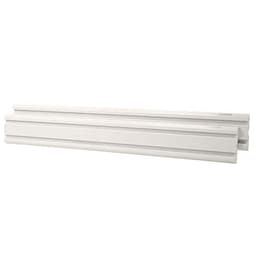
75 lb per linear foot, published in the installation manual rather than buried in marketing copy. Track beats full-panel systems when what you are hanging is heavy and few rather than light and many.
Published specs
- Rated capacity
- 75 lb per linear foot
- Mounting
- Into wood studs, including through drywall
- Format
- Horizontal channels, sold in packs
Figures are the manufacturer's, from Gladiator installation instructions W11087876 Rev A, read 2026-09-01. We have not verified them by testing and do not imply that we have.
Our scoring
- Published capacity
- 9.5
- Coverage per dollar
- 7.0
- Accessory range
- 9.0
- Install simplicity
- 8.5
- Documentation
- 9.5
What works
- 75 lb per linear foot is the highest published figure of the mainstream wall systems here
- Track means you only cover the strip of wall you need, not the whole thing
- Accessory range is broad and stays available
- The capacity figure is published in the installation instructions, which is where a figure you are going to rely on belongs
What doesn't
- Only holds things at the height of the track, so you are installing two or three runs to get real coverage
- The per-linear-foot rating assumes the track is fastened into studs, which caps you at where the studs are
- Accessories are proprietary
Skip this one if the wall is going to hold a lot of small light things — hand tools, spray cans, cordless batteries. That is pegboard's job, and pegboard does it for a fraction of the price.
#2 · Best in a damp or unheated garage
Proslat PVC Slatwall
Proslat
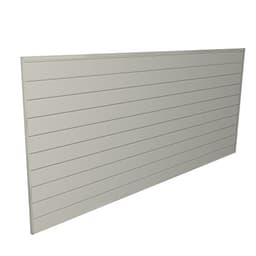
PVC rather than MDF or steel, rated to 75 lb per square foot and backed by a lifetime warranty. In a garage that gets damp, the material is the whole argument.
Published specs
- Rated capacity
- 75 lb per square foot
- Heavy-duty line
- Patented aluminum core rated to 200 lb
- Mounting
- 16 in studs
- Material
- PVC
- Warranty
- Lifetime
Figures are the manufacturer's, from the Proslat PVC slatwall collection page, read 2026-09-01. We have not verified them by testing and do not imply that we have.
Our scoring
- Published capacity
- 9.0
- Coverage per dollar
- 7.0
- Damp tolerance
- 9.5
- Install simplicity
- 7.5
- Documentation
- 8.5
What works
- PVC does not swell, rot or rust, which is the failure mode of MDF slatwall in an unheated garage
- 75 lb per sq ft is higher than Gladiator's panel rating
- Lifetime warranty
- The heavy-duty aluminum-core line is there when 75 lb per sq ft is not enough
What doesn't
- Published for 16 in stud spacing — a 24 in stud wall needs checking before you order
- Full-wall coverage is expensive, same as any panel system
- PVC has a plastic look that some people dislike next to steel cabinets
Skip this one if your studs are 24 in on center. The published mounting is 16 in, and stretching a panel system across wider studs is exactly the shortcut that ends with a panel pulling off the wall.
#3 · Best full-wall panel system
Gladiator GearWall Panels
Gladiator GarageWorks
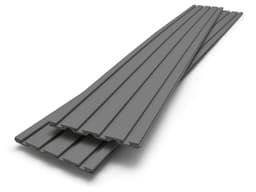
50 lb per square foot across a whole panel, which is a different kind of number from GearTrack's per-foot rating: it buys you the freedom to hang anything anywhere rather than only on a line.
Published specs
- Rated capacity
- 50 lb per square foot
- Mounting
- Into wood studs, including through drywall
- Format
- Full-height slatted panels
Figures are the manufacturer's, from Gladiator installation instructions W11087876 Rev A, read 2026-09-01. We have not verified them by testing and do not imply that we have.
Our scoring
- Published capacity
- 8.5
- Coverage per dollar
- 6.5
- Accessory range
- 9.0
- Install simplicity
- 7.0
- Documentation
- 9.5
What works
- Hang anything at any height rather than only where a track run happens to be
- 50 lb per sq ft across a full panel is a large total load
- Shares the Gladiator accessory range with GearTrack
What doesn't
- Covering a whole wall in panels costs several times what two track runs cost
- It is a wall finish as much as a storage system, so it is a bigger commitment to undo
- Per-square-foot ratings are harder to reason about than per-foot ones — a single 60 lb item is not the rated case
Skip this one if you know exactly what is going on that wall and it is six things. Two runs of track will hold them for a fraction of the cost, and the wall stays a wall.
#4 · Best for hand tools
Wall Control Metal Pegboard
Wall Control
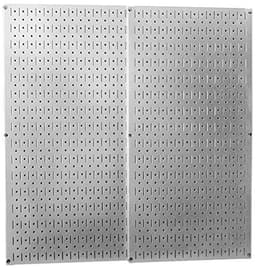
20-gauge steel pegboard with published per-panel and per-hook limits, which is more honesty about capacity than the entire hardboard-pegboard category offers combined.
Published specs
- Material
- 20-gauge galvanized steel
- Into studs
- Up to 200 lb per panel
- Into drywall anchors
- Up to 100 lb per panel
- Per hook, two slots
- 10 to 15 lb
- Per hook, one slot
- 5 to 10 lb
- Per shelf assembly
- 10 to 20 lb, evenly distributed
Figures are the manufacturer's, from Wall Control's published capacity guidance, read 2026-09-01. We have not verified them by testing and do not imply that we have.
Our scoring
- Published capacity
- 6.5
- Coverage per dollar
- 9.5
- Accessory range
- 9.0
- Install simplicity
- 8.0
- Documentation
- 10.0
What works
- Steel rather than hardboard, so the holes do not blow out and the board does not bow
- Publishes limits per panel, per hook AND per shelf — nobody else in pegboard does this
- Takes both round-hole and slotted accessories, so most existing pegboard hooks still work
- Cheapest way to get a lot of small tools off a bench and onto a wall
What doesn't
- Per-hook limits are genuinely low; this is a hand-tool wall, not a ladder-and-bike wall
- 100 lb per panel into drywall anchors is much less than 200 lb into studs, and most people install into drywall
- Panels are small, so a full wall is a lot of panels and a lot of alignment
Skip this one if what you need on the wall is bikes, ladders, or a wheelbarrow. A 10 to 15 lb hook limit is not a suggestion, and the right answer for those is track or heavy-duty hooks into studs.
Questions people actually ask
How do you store long handled garden tools in a garage?
Hang them by the handle near the top, on a wall system fixed into studs, so the head rests low and the tool sits still. Standing them in a corner or a barrel is what makes top-heavy tools fall over, usually onto whatever is parked beside them.
Can I hang a wheelbarrow on a garage wall?
Yes, vertically and nose-up on two hooks into studs. A wheelbarrow is roughly 30 to 60 lb, which is past any pegboard hook rating but inside what Gladiator GearTrack publishes at 75 lb per linear foot. It saves around six square feet of floor.
What hooks hold a string trimmer?
Track or slatwall rather than pegboard. A string trimmer is roughly 10 to 15 lb, which sits right at Wall Control's published 10 to 15 lb per two-slot hook — workable across two hooks, marginal on one. Track fixed into studs removes the doubt.
What is the best wall system for garden tools?
Gladiator GearTrack for heavy powered tools and the wheelbarrow at 75 lb per linear foot, and Proslat PVC slatwall if that wall gets wet — PVC does not swell or rot. Metal pegboard is the cheapest option and is right for the light hand tools only.
Sources
- Gladiator installation instructions W11087876 Rev A — GearTrack 75 lb per linear foot, GearWall 50 lb per square foot, stud mountingChecked September 13, 2026
- Wall Control published capacity guidance — 10 to 15 lb per two-slot hook, 5 to 10 lb per one-slot hook, 200 lb per panel into studsChecked September 13, 2026
- Proslat PVC slatwall collection — 75 lb per square foot, PVC, 16 in studs, lifetime warrantyChecked September 13, 2026
Manufacturer documentation, manuals, warranty terms and exact product models reviewed September 13, 2026.
Read next
- Where the tools goTools in a bin become a search. The wall is the answer, and the hook limits decide what goes where.
- The best garage wall storage systemsTrack, slatwall, panels and metal pegboard on published load ratings, converted into one comparable question.
- Garage hooks: what the weight ratings actually meanWhat garage hook ratings really mean, and which wall system to hang heavy things from.
- How much weight can a garage wall hold?The fixing decides it, not the wall. Published stud-versus-drywall figures and how to find your studs.
- Your garage is full. Start here.Four passes that turn a full garage into a list of piles, each with a system that fits it.