The Mess
Where the tires go
Four wheels stacked in the corner for six months of the year. Tires are dense weight in a small footprint, which makes this a shelving problem and not a ceiling one.
Disclosure: Rail & Rafter earns a commission on qualifying purchases made through links on this page, at no cost to you. Commission does not decide what we recommend — our criteria do, and here is how we are funded.

A stack of four wheels in the corner, in the way, for six months of the year. You move them to get to something, then move them back. In spring they swap with the other four and the problem changes shape without going away.
Tires go on heavy-duty shelving, near the floor, near an upright. Not overhead, and not on a wall unless you have checked the fixing.
Why not overhead
This is the mess that most tempts people toward the ceiling, and it is the one where the ceiling is most clearly wrong.
Tires are dense weight in a small footprint, which is the exact opposite of what overhead storage is good at. A garage ceiling framed for an uninhabitable attic without storage is designed for a 10 lb per square foot live load. A stack of four wheels concentrated on one small area of a rack is a point load, and point loads are a different engineering case from the distributed figure those design loads describe.
Overhead is for bulky and light — bins, decorations, camping gear. Dense things belong low, where the slab carries them and nothing is over your head. The full arithmetic is on how much weight a garage ceiling holds.
The system
A heavy-duty shelf, with the tires on the bottom or second shelf, positioned near an upright rather than mid-span.
The Husky welded 4-tier publishes 2,500 lb per shelf evenly distributed and 10,000 lb total, at 24 inches deep — comfortably more than a set of four wheels needs, and the point is that it never sags. The Seville UltraDurable wire shelving publishes 800 lb per shelf on leveling feet and has the additional advantage of airflow, which matters in a damp garage.
Near an upright, not mid-shelf
Both of those ratings are published as evenly distributed. A stack of four wheels is not evenly distributed — it is a concentrated load in one place.
Put it near a vertical upright rather than in the middle of the span. It costs nothing and it is the same principle as putting an overhead rack near a bearing wall rather than mid-joist.
How to store them, and it depends on the wheels
There is a genuine distinction here that is worth getting right:
| What you have | Position | Why |
|---|---|---|
| Tires mounted on rims, inflated | Stacked flat, or hung | The rim carries the load and the sidewall is supported |
| Unmounted tires, no rim | Standing upright, and rotated occasionally | Stacking unmounted tires puts prolonged load on the lower sidewalls |
The other conditions worth knowing: keep them out of direct sunlight, away from anything running an electric motor, and off a damp slab. Those are ordinary tire care conditions rather than storage cleverness.
The wall option, and its constraint
Tire hooks on a wall system are a real option and they save floor entirely. The constraint is the published rating.
Gladiator's GearTrack publishes 75 lb per linear foot, which is the highest rate of the wall systems we compared. A passenger tire on a rim is a meaningful fraction of that per hook, so this is a case where you spread the hooks along a run rather than clustering four wheels in two feet of track.
And as always, it assumes fixing into studs. Wall Control publishes the difference for panels — 200 lb into studs against 100 lb into drywall anchors — and a hanging wheel is a point load acting away from the wall. The stud method is on how much weight a garage wall holds.
What it costs and how long it takes
If you already have heavy shelving, this costs nothing — it is a rearrangement. If you do not, a welded heavy-duty rack is the purchase, and it will also carry every other dense thing in the garage: paint, fluids, hardware bins. That dual use is most of the argument for buying capacity you will not fully load, and it is made in full on best heavy-duty garage shelving.
Measure the clear run of wall first. A 77 inch unit is a lot of wall in a single-car garage, and a 60 or 48 inch unit may be the honest answer — the measuring order is on how to plan garage shelving.
What not to do
- Do not put a set of four on an overhead rack. Dense concentrated weight is the wrong load for a ceiling that may have been framed for 10 lb per square foot.
- Do not leave them on the slab. Garage floors sweat and slope toward the door.
- Do not stack unmounted tires for six months. Prolonged load on the lower sidewalls is what the standard guidance warns against; stand them and rotate occasionally instead.
- Do not cluster four hanging wheels in two feet of track. Per-linear-foot ratings are per linear foot for a reason. Spread them.
What we would buy for this
Every pick carries the manufacturer's published specs, our scoring against stated criteria, and a reason you might want to skip it.
#1 · Best heavy-duty shelving
Husky 4-Tier Welded Steel Rack, 77 x 78 x 24 in
Husky
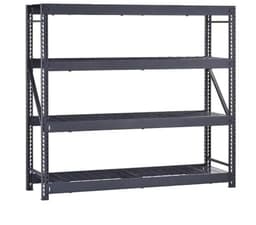
2,500 lb per shelf and 10,000 lb across the unit. That is not a garage number, it is a warehouse number, and it means this is the last shelving you buy for that wall.
Published specs
- Model
- HBR782478W4R
- Dimensions
- 77 in W x 78 in H x 24 in D
- Capacity per shelf
- 2,500 lb, evenly distributed
- Total capacity
- 10,000 lb
- Adjustment
- Shelves adjust in 3 in increments
- Warranty
- Lifetime
Figures are the manufacturer's, from the Home Depot listing for Husky HBR782478W4R, read 2026-09-01. We have not verified them by testing and do not imply that we have.
Our scoring
- Published capacity
- 10.0
- Build
- 9.5
- Tote fit
- 9.0
- Footprint efficiency
- 7.0
- Warranty
- 9.5
What works
- 2,500 lb per shelf is far beyond what a garage will ever ask of it, which is exactly why it never sags
- Welded construction rather than bolt-together, so it does not develop a wobble over years
- 24 in depth swallows a 27-gallon tote sideways with room to spare
- Lifetime warranty
What doesn't
- 77 in wide is a lot of wall. In a single-car garage this is a real commitment
- Welded means it arrives heavy and assembles in one configuration
- Only 3 in adjustment increments, so a tall item may cost you a whole shelf of headroom
Skip this one if you are storing light bulk — holiday bins, sleeping bags, empty coolers. You are paying for steel you will never load, and the same money buys twice the shelf area in a lighter unit.
#2 · Best wire shelving
Seville Classics UltraDurable NSF Wire Shelving
Seville Classics
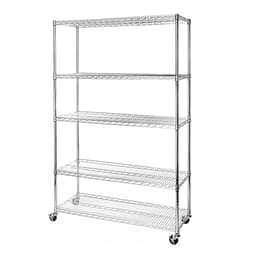
800 lb per shelf on the leveling feet and 4,000 lb across the unit, from a wire deck that lets you see what is in the back. In a damp garage the airflow is a feature, not a compromise.
Published specs
- Capacity per shelf
- 800 lb on leveling feet
- Total capacity
- 4,000 lb
- Certification
- NSF certified
- Deck
- Steel wire
Figures are the manufacturer's, from Seville Classics published specifications; the UltraHD 30 in cabinet (SKU UHD20162B) re-read 2026-09-12. We have not verified them by testing and do not imply that we have.
Our scoring
- Published capacity
- 9.0
- Build
- 8.5
- Tote fit
- 8.0
- Damp tolerance
- 9.5
- Warranty
- 7.5
What works
- 800 lb per shelf is genuinely heavy duty for a wire unit
- Wire deck means air moves and damp things dry rather than sitting in a puddle on a solid shelf
- NSF certification means it is built to a commercial standard, not a consumer one
- You can see into the back of the shelf, which is where garage items go to be forgotten
What doesn't
- Small items fall through the wire unless you sit them on a tray or in a bin
- The 800 lb figure is for the leveling-feet configuration; casters change the number
- Wire decks mark and scratch anything with a soft finish
Skip this one if you are storing loose small parts, hardware, or anything with a soft painted finish. Wire is the wrong deck for those and you will end up lining every shelf, which defeats the airflow you paid for.
#3 · Best track system
Gladiator GearTrack Channels
Gladiator GarageWorks
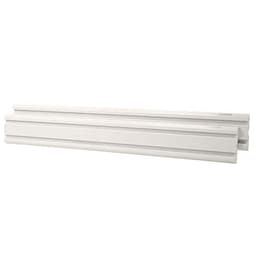
75 lb per linear foot, published in the installation manual rather than buried in marketing copy. Track beats full-panel systems when what you are hanging is heavy and few rather than light and many.
Published specs
- Rated capacity
- 75 lb per linear foot
- Mounting
- Into wood studs, including through drywall
- Format
- Horizontal channels, sold in packs
Figures are the manufacturer's, from Gladiator installation instructions W11087876 Rev A, read 2026-09-01. We have not verified them by testing and do not imply that we have.
Our scoring
- Published capacity
- 9.5
- Coverage per dollar
- 7.0
- Accessory range
- 9.0
- Install simplicity
- 8.5
- Documentation
- 9.5
What works
- 75 lb per linear foot is the highest published figure of the mainstream wall systems here
- Track means you only cover the strip of wall you need, not the whole thing
- Accessory range is broad and stays available
- The capacity figure is published in the installation instructions, which is where a figure you are going to rely on belongs
What doesn't
- Only holds things at the height of the track, so you are installing two or three runs to get real coverage
- The per-linear-foot rating assumes the track is fastened into studs, which caps you at where the studs are
- Accessories are proprietary
Skip this one if the wall is going to hold a lot of small light things — hand tools, spray cans, cordless batteries. That is pegboard's job, and pegboard does it for a fraction of the price.
Questions people actually ask
Where should I store tires in a garage?
On heavy-duty shelving near the floor and near a vertical upright rather than mid-span. Tires are dense weight in a small footprint, which is the wrong load for an overhead rack and the right one for a shelf where the slab carries it.
Can I store tires on an overhead garage rack?
We would not. A stack of wheels is a concentrated point load, and a garage ceiling framed for an uninhabitable attic without storage is designed for a 10 lb per square foot distributed live load. Overhead is for bulky and light.
Should tires be stacked or stood upright?
Tires mounted on rims can be stacked flat or hung, because the rim carries the load. Unmounted tires are generally stood upright and rotated occasionally, since stacking puts prolonged load on the lower sidewalls.
Can I hang tires on a garage wall?
Yes, on a wall system fixed into studs, with the hooks spread along a run rather than clustered. Gladiator GearTrack publishes 75 lb per linear foot, and a mounted wheel is a meaningful fraction of that per hook.
Sources
- Husky HBR782478W4R — 2,500 lb per shelf evenly distributed, 10,000 lb totalChecked September 1, 2026
- Gladiator GearTrack installation instructions W11087876 Rev A — 75 lb per linear footChecked September 1, 2026
- IRC Table R802.5.1 and R301.5 — attic live loads, via UpCodesChecked September 1, 2026
Manufacturer documentation, manuals, warranty terms and exact product models reviewed September 1, 2026.
Read next
- The best heavy-duty garage shelvingHeavy-duty shelving on published load figures, plus when you are buying steel you will never load.
- Shelving vs rackingRacking is for forklifts and pallets, shelving is for hands and boxes. Where the line sits.
- How much weight can a garage ceiling hold?The complete 2x4 to 2x10 joist span tables at four spacings, and the arithmetic for your own ceiling.
- How much weight can a garage wall hold?The fixing decides it, not the wall. Published stud-versus-drywall figures and how to find your studs.
- The best garage storage shelvesFive shelving units ranked on published per-shelf capacity and whether the depth takes a standard tote.
- Your garage is full. Start here.Four passes that turn a full garage into a list of piles, each with a system that fits it.
- The best tire storage racksWall-mount tire racks on published capacity, adjustable width and depth — and when a shelf beats all of them.