Walls
Wall Control metal pegboard: the numbers nobody else publishes
Most pegboard is sold with no capacity figure at all. Wall Control publishes three — per panel, per hook and per shelf — and the smallest one is the one that decides your wall.
Disclosure: Rail & Rafter earns a commission on qualifying purchases made through links on this page, at no cost to you. Commission does not decide what we recommend — our criteria do, and here is how we are funded.
What this review is and is not
We have not installed a Wall Control panel. What follows is a reading of Wall Control's own published specifications and capacity guidance, which in this category is unusually complete. Our method is on how we pick.
Hardboard pegboard — the brown stuff from the home center — is sold with no load rating whatsoever. You buy a 4 x 8 sheet, frame it out from the wall so the hooks have somewhere to go, and find out what it holds by watching what falls off.
Wall Control's pitch is the opposite: 20-gauge steel panels with published limits per panel, per hook and per shelf. That disclosure is the reason it appears on this site at all, and the reason this review is mostly about reading those three numbers in the right order.
The published specification
| Specification | Published figure |
|---|---|
| Material | 20-gauge steel, powder-coated or galvanized |
| Panel pack | Two 16 in x 32 in panels, 32 in x 32 in total, over 7 sq ft |
| Into studs | Up to 200 lb per panel |
| Into drywall anchors | Up to 100 lb per panel |
| Per hook, two slots engaged | 10 to 15 lb |
| Per hook, one slot engaged | 5 to 10 lb |
| Per shelf assembly | 10 to 20 lb, evenly distributed |
| Accessory fit | Both slots and 1/4 in peg holes |
The hook is the limit, not the panel
Read those rows in the order that matters and the picture inverts. The panel figure — 200 lb into studs — is the number on the box and the number you will never reach. The figure that governs your wall is 10 to 15 lb per hook.
A panel is 32 inches square. To load it to 200 lb through hooks rated 15 lb, you would need thirteen fully loaded hooks in seven square feet, every one of them at its limit. In practice you run out of hook long before you run out of panel.
What 10 to 15 lb per hook actually holds
A framing hammer, a cordless drill without its battery, a set of pliers, a tape measure, a hand saw: all comfortably inside it. A loaded cordless drill with a 5 Ah battery, a breaker bar, a full socket set on a rail: at or over it.
Those are planning assumptions for scale rather than measured weights. The 10 to 15 lb figure is Wall Control's.
This is why we describe pegboard as a hand-tool wallthroughout the site. It is not a criticism — it is what the format is for. Bikes, ladders and wheelbarrows belong on track or heavy hooks, which is the argument in pegboard against slatwall against track.
What the steel actually buys
The holes do not blow out
The failure mode of hardboard pegboard is the hole. A hook under load works at the edge of a 1/4 in hole in compressed fiber until the hole elongates and the hook falls out, usually taking a chunk of board with it. Steel does not do this.
No framing out
Conventional pegboard has to be held off the wall so hook tips have somewhere to go — that is battens, a day, and a wall that now projects an inch. Wall Control's panels have a formed return flange that spaces the face off the wall by itself. Its published line is that you put the panel against the wall or stud and screw it in with the included hardware.
It is magnetic
A steel panel is a magnetic panel. Wall Control states magnets and magnetic organizers adhere to it, which means a magnetic bar can go anywhere on the board instead of needing its own fixing — and that is a genuinely useful combination we cover in the best magnetic tool holders.
Slots and holes
The panels carry both slots and conventional 1/4 in peg holes, so they take Wall Control's own slotted accessories and the drawer of standard pegboard hooks you probably already own. Very little else in this category accepts both.
Installation, and the one number to get right
The published difference between mounting methods is the single biggest decision on this page:
| Fixing | Published capacity | What it means |
|---|---|---|
| Into studs | Up to 200 lb per panel | The rated case |
| Into drywall anchors | Up to 100 lb per panel | Half the capacity, same panel |
Half the capacity for the same panel, decided entirely by what the screws go into. Most people install into drywall because it is quicker, and most people never find out they halved the rating.
A 32 in panel spans two studs at 16 in centers, so hitting framing is realistic rather than lucky. Find the studs, mark them, and put at least the top row of screws into timber. The wall side of this is in how much weight a garage wall can hold, and the layout planning is in how to lay out a garage pegboard.
Coverage: it adds up in 7 sq ft steps
One pack is two 16 x 32 in panels, covering 32 x 32 in — just over 7 square feet. A typical 8 ft wide garage wall section is 32 sq ft, so a full wall is about four packs.
That modularity is the point. You can panel the space above a bench this month and extend it next year, and the panels line up because they are all the same module. It is also the honest cost problem: per square foot, steel pegboard is several times what a hardboard sheet costs. You are paying for the rating, the flange and the finish.
The honest cons
- Per-hook limits are genuinely low. 10 to 15 lb is a hand tool. If your wall list includes a bike or a ladder, this is the wrong product and no amount of panel rating changes that.
- Panels are small. Seven square feet at a time means a full wall is four packs and a lot of alignment. Measure and snap a line before the first screw.
- Cost per square foot. Several times hardboard. The comparison that matters is against track and slatwall rather than against the brown sheet.
- Shelf assemblies are light. 10 to 20 lb, evenly distributed — that is a shelf for spray cans, not for a battery charger and a toolbox.
- Drywall installs halve it. Published, and easy to ignore.
What we could not verify
- The "10 times stronger than conventional pegboard" claim. That is Wall Control's marketing language and we have found no test method behind it, so we are not repeating it as a specification.
- Panel thickness in inches. Published as 20-gauge; no decimal thickness is stated on the listing we read.
- Warranty term. Not published on the product listing we read.
- Screw specification. Mounting hardware is included, but no fastener size or embedment depth is published.
- Long-term finish wear. We have not lived with a panel and will not guess how the powder coat handles a decade of hooks moving.
Who should buy it, and who should not
Buy it if the wall is hand tools — wrenches, drivers, pliers, hammers, layout tools — and you want them visible, movable and off the bench. On published disclosure it is the best-documented product in the pegboard category, and the steel solves hardboard's only real failure mode.
Buy it especially if you already own pegboard hooks. The dual slot-and-hole pattern means your existing accessories still work, which is rarely true when you upgrade a wall system.
Buy track instead if the wall has to hold a bike, a ladder, a wheelbarrow or a folding chair stack. Gladiator publishes 75 lb per linear foot for GearTrack, which is a different order of magnitude — the ranked options are in the best garage wall storage systems.
Buy slatwall instead if you want to cover a whole wall and hang heavier things anywhere on it. Proslat publishes 75 lb per square foot, and the panel options are ranked in the best garage slatwall panels.
Do not buy it if the appeal was that pegboard is the cheap option. Steel pegboard is not the cheap option; it is the well-documented one.
What we would buy for this
Every pick carries the manufacturer's published specs, our scoring against stated criteria, and a reason you might want to skip it.
#1 · Best for hand tools
Wall Control Metal Pegboard
Wall Control
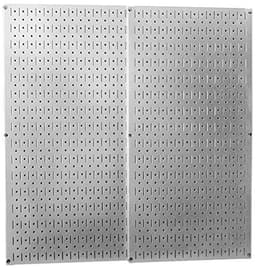
20-gauge steel pegboard with published per-panel and per-hook limits, which is more honesty about capacity than the entire hardboard-pegboard category offers combined.
Published specs
- Material
- 20-gauge galvanized steel
- Into studs
- Up to 200 lb per panel
- Into drywall anchors
- Up to 100 lb per panel
- Per hook, two slots
- 10 to 15 lb
- Per hook, one slot
- 5 to 10 lb
- Per shelf assembly
- 10 to 20 lb, evenly distributed
Figures are the manufacturer's, from Wall Control's published capacity guidance, read 2026-09-01. We have not verified them by testing and do not imply that we have.
Our scoring
- Published capacity
- 6.5
- Coverage per dollar
- 9.5
- Accessory range
- 9.0
- Install simplicity
- 8.0
- Documentation
- 10.0
What works
- Steel rather than hardboard, so the holes do not blow out and the board does not bow
- Publishes limits per panel, per hook AND per shelf — nobody else in pegboard does this
- Takes both round-hole and slotted accessories, so most existing pegboard hooks still work
- Cheapest way to get a lot of small tools off a bench and onto a wall
What doesn't
- Per-hook limits are genuinely low; this is a hand-tool wall, not a ladder-and-bike wall
- 100 lb per panel into drywall anchors is much less than 200 lb into studs, and most people install into drywall
- Panels are small, so a full wall is a lot of panels and a lot of alignment
Skip this one if what you need on the wall is bikes, ladders, or a wheelbarrow. A 10 to 15 lb hook limit is not a suggestion, and the right answer for those is track or heavy-duty hooks into studs.
#2 · Best magnetic tool bar overall
Master Magnetics 24 in Magnetic Tool Bar
Master Magnetics
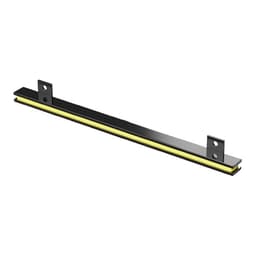
20 lb of pull per inch, published, on a 24 inch bar with welded mounting tabs and screws in the box. The only magnetic holder here with a rating you can trace to the manufacturer.
Published specs
- Pull force
- Up to 20 lb per inch
- Dimensions
- 24 in L x 0.75 in W x 1.625 in H
- Mounting
- Welded tabs with 1/4 in holes, screws included
- Other lengths
- 6 in, 13 in, 18 in
Figures are the manufacturer's, from Master Magnetics' own magnetic tool bar listings on magnetsource.com, read 2026-09-27. We have not verified them by testing and do not imply that we have.
Our scoring
- Published rating
- 9.0
- Mounting
- 9.0
- Capacity
- 8.0
- Versatility
- 5.5
- Value
- 8.5
What works
- Publishes pull force per inch, which almost nothing else in this category does
- Welded mounting tabs rather than adhesive, so it does not creep down the wall in summer heat
- Screws included, and it goes up in about five minutes
- 24 inches holds a working set of wrenches and drivers within arm's reach of a bench
What doesn't
- Pull force is measured flat against the magnet — a tool hanging by one edge gets a fraction of it
- Only holds ferrous steel; aluminum, brass and most cordless tool bodies will not stick
- A bar this strong grabs hard, and prying a large wrench off it takes real effort
- Nothing stops a knocked tool from falling, so do not mount it over a car hood
Skip this one if the tools you want on the wall are cordless drills, tape measures or anything plastic-bodied. A magnet holds none of them — that is a hook job.
#3 · Best track system
Gladiator GearTrack Channels
Gladiator GarageWorks
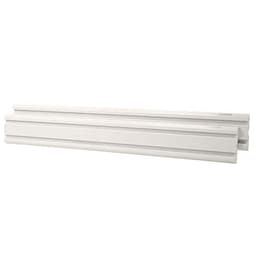
75 lb per linear foot, published in the installation manual rather than buried in marketing copy. Track beats full-panel systems when what you are hanging is heavy and few rather than light and many.
Published specs
- Rated capacity
- 75 lb per linear foot
- Mounting
- Into wood studs, including through drywall
- Format
- Horizontal channels, sold in packs
Figures are the manufacturer's, from Gladiator installation instructions W11087876 Rev A, read 2026-09-01. We have not verified them by testing and do not imply that we have.
Our scoring
- Published capacity
- 9.5
- Coverage per dollar
- 7.0
- Accessory range
- 9.0
- Install simplicity
- 8.5
- Documentation
- 9.5
What works
- 75 lb per linear foot is the highest published figure of the mainstream wall systems here
- Track means you only cover the strip of wall you need, not the whole thing
- Accessory range is broad and stays available
- The capacity figure is published in the installation instructions, which is where a figure you are going to rely on belongs
What doesn't
- Only holds things at the height of the track, so you are installing two or three runs to get real coverage
- The per-linear-foot rating assumes the track is fastened into studs, which caps you at where the studs are
- Accessories are proprietary
Skip this one if the wall is going to hold a lot of small light things — hand tools, spray cans, cordless batteries. That is pegboard's job, and pegboard does it for a fraction of the price.
Questions people actually ask
How much weight can Wall Control pegboard hold?
Wall Control publishes up to 200 lb per panel when mounted into studs and up to 100 lb into drywall anchors. The binding limit in practice is per hook: 10 to 15 lb with two slots engaged, 5 to 10 lb with one.
Is metal pegboard better than hardboard pegboard?
For a garage, yes on two counts: the holes do not elongate and blow out under load, and the formed flange means no framing out from the wall. The trade is cost per square foot, which is several times hardboard.
Do standard pegboard hooks fit Wall Control panels?
Yes. The panels carry both slots and conventional 1/4 in peg holes, so they accept Wall Control's slotted accessories and standard pegboard hooks.
Does Wall Control pegboard need to be framed out from the wall?
No. Wall Control states the formed return flange spaces the panel face off the wall, so it screws directly to the wall or stud with the included hardware — unlike conventional pegboard, which needs battens behind it.
How many panels do I need for a garage wall?
Each pack is two 16 x 32 in panels covering 32 x 32 in, just over 7 square feet. An 8 ft by 4 ft wall section is 32 sq ft, so about four packs.
Sources
- Wall Control Metal Pegboard Pack — two 16 in x 32 in panels covering 32 in x 32 in (over 7 sq ft), 20-gauge steel, slots and 1/4 in peg holes, magnetic, formed return flange requiring no framing out, mounting hardware includedChecked September 27, 2026
- Wall Control published capacity guidance — up to 200 lb per panel into studs, 100 lb into drywall anchors, 10 to 15 lb per hook engaging two slots, 5 to 10 lb engaging one, 10 to 20 lb per shelf assembly evenly distributedChecked September 1, 2026
- Master Magnetics 24 in magnetic tool bar — up to 20 lb per inch pull force, for the magnetic-panel noteChecked September 27, 2026
- Gladiator installation instructions W11087876 Rev A — GearTrack 75 lb per linear foot, for the track comparisonChecked September 16, 2026
- Proslat PVC slatwall — 75 lb per square foot, for the slatwall comparisonChecked September 19, 2026
Manufacturer documentation, manuals, warranty terms and exact product models reviewed September 27, 2026.
Read next
- The best garage tool wall storageHand tools on the wall, ranked on published per-hook limits rather than marketing photos.
- How to lay out a garage pegboardThe layout that survives contact with a real garage, and the published hook limits that constrain it.
- Pegboard vs slatwall vs trackThree formats for three jobs. Which one you need is decided by what you are hanging, not by budget.
- The best magnetic tool holdersMagnetic tool bars on published pull force per inch, and the honest limits of what a magnet holds.
- How much weight can a garage wall hold?The fixing decides it, not the wall. Published stud-versus-drywall figures and how to find your studs.
- Where the tools goTools in a bin become a search. The wall is the answer, and the hook limits decide what goes where.