Cabinets
The best garage storage cabinets
Ranked on published capacity and on the number people forget: depth. An 18 inch cabinet cannot close its doors on a 19.6 inch tote, and that is most of the decision.
Disclosure: Rail & Rafter earns a commission on qualifying purchases made through links on this page, at no cost to you. Commission does not decide what we recommend — our criteria do, and here is how we are funded.

Quick picks
Our ranking, verdict first. Every row links to the full write-up below, and every price cell goes straight to Amazon. Scores follow the criteria on our methodology page.
| # | Product | Best for | Score | Price |
|---|---|---|---|---|
| 1 |  Seville Classics UltraHD Storage Cabinet, 30 x 18 x 72 in600 lb across the cabinet and 150 lb per shelf, in a footprint 18 inches deep. The depth is the reason it works in a garage where a 24 in cabinet would eat the walkway. Seville Classics UltraHD Storage Cabinet, 30 x 18 x 72 in600 lb across the cabinet and 150 lb per shelf, in a footprint 18 inches deep. The depth is the reason it works in a garage where a 24 in cabinet would eat the walkway. | Best all-steel cabinet | 8.0 | $357.50View on AmazonPrice as of October 17, 2026. #ad how this is funded |
| 2 |  Seville Classics UltraHD Extra-Wide Cabinet, 60 x 24 x 72 in800 lb total with a reinforced 200 lb bottom shelf — the bottom shelf rating is the one to notice, because that is where the heavy things end up anyway. Seville Classics UltraHD Extra-Wide Cabinet, 60 x 24 x 72 in800 lb total with a reinforced 200 lb bottom shelf — the bottom shelf rating is the one to notice, because that is where the heavy things end up anyway. | Best big cabinet | 8.1 | $649.99View on AmazonPrice as of October 17, 2026. #ad how this is funded |
| 3 | Gladiator 60 in Heavy Duty Rack, four 18 in shelves18 inches deep rather than 24. In a garage where the shelving runs down the side of a parked car, six inches is the whole argument. | Best shallow-depth rack | 7.8 | Check price on Amazon#ad how this is funded |
Scores are our editorial assessment against the criteria on how we pick. They are not test results and are not marked up as review ratings.
A cabinet is the most expensive way to store a cubic foot of anything in a garage, and people buy them anyway for reasons that have nothing to do with capacity. Doors hide mess. Doors keep dust off. Doors lock.
Those are all legitimate, and this ranking takes them seriously. But the number that actually decides which cabinet works in your garage is neither capacity nor price — it is depth, and it is the one people check last. Our criteria are on how we pick.
Read this first
An 18 inch cabinet will not close on a standard tote. The common 27-gallon totes are about 19.6 in wide. An 18 in deep cabinet leaves them proud of the frame, which means the doors do not shut — and a cabinet whose doors do not shut is an expensive open shelf. If bins are going inside, you need 24 in.
The published capacity figures
| Cabinet | Dimensions | Total | Per shelf | Takes a tote? |
|---|---|---|---|---|
| Seville UltraHD | 36" W x 18" D x 72" H | 600 lb | 150 lb | No — 18 in is too shallow |
| Seville UltraHD extra-wide | 60" W x 24" D x 72" H | 800 lb | 100 lb, 200 lb bottom shelf | Yes |
| Gladiator 60 in rack (open) | 60" W x 18" D | Not published prominently | Not published prominently | No |
Two things worth reading twice in that table. First, the narrower Seville cabinet has a higher per-shelf rating — 150 lb against 100 lb — despite a lower total. Shelf span is why: a 36 in shelf carries more per square foot than a 60 in one, because it has less distance to bridge.
Second, the extra-wide cabinet publishes a 200 lb bottom shelf against 100 lb elsewhere. That is a genuinely useful piece of design: the bottom shelf is where heavy things end up regardless of what the manual says, and rating it accordingly is the manufacturer acknowledging reality.
How we ranked these
Published capacity, footprint efficiency, build, security, and tote fit. Footprint efficiency carries real weight in this category because a cabinet is a large object in a room where floor is the scarce resource — a 60 in wide by 24 in deep cabinet against a side wall is frequently the difference between opening the car door and not.
The depth decision, worked through
Depth is a trade against the walkway, and it is worth doing the arithmetic rather than guessing:
| Depth | Takes a 27 gal tote? | Floor it uses | Right when |
|---|---|---|---|
| 18" | No | 1.5 ft of the room | The walkway alongside a car matters most |
| 24" | Yes, with room | 2 ft of the room | Bins are going inside |
Six inches sounds trivial and is not. Park the car where it normally sits, open the door on the cabinet side fully, and measure from the wall to the outermost point of the open door. That distance is your maximum depth regardless of what your bins want — the same check that governs shelving depth.
If the answer comes in under 18 inches, cabinets are not the answer on that wall. A wall system projects a few inches instead of eighteen.
Steel cabinets in an unheated garage
Worth knowing before you buy: steel cabinets in a garage that swings through humidity will sweat. Warm damp air meets cold steel and condenses, and the inside of a closed cabinet does not dry quickly.
That is an argument for what you put in them rather than against buying them. Tools with a bare steel finish, anything that rusts, and paper products are the things that suffer. Leave a gap behind the cabinet for air movement, do not seal the doors, and keep anything genuinely moisture-sensitive in a sealed bin inside the cabinet rather than loose on a shelf.
The alternative for a genuinely damp garage is open wire shelving, where air moves and things dry — which is precisely the trade-off cabinets make in reverse.
Why steel cabinets publish capacity figures and most wood ones do not is the subject of metal against wood garage cabinets, and the cabinet at the top of this ranking gets a longer look in our Seville Classics UltraHD review.
What actually belongs behind doors
Cabinets cost too much per cubic foot to be general storage. Reserve them for the things that genuinely need doors:
- Chemicals and anything that should be locked. Paint, solvents, fuel, pesticides, power tools in a garage with children in it. This is the strongest case and it is a safety one.
- Things dust ruins. Finishing supplies, spare filters, anything with a fine mechanism.
- The visual mess you cannot solve. Some categories will never look tidy on an open shelf. A door is a legitimate answer to that and there is no shame in it.
Everything else — bins, sports gear, seasonal storage — is cheaper and more accessible on shelving, or overhead. The full argument is on cabinets vs shelves.
Who should skip cabinets
- Anyone short on floor. A cabinet occupies its full depth all the way to the ground. If floor is the problem, the answer is overhead or wall.
- Anyone storing mostly totes on a budget. Open shelving holds far more per dollar and the bins already hide the contents.
- Anyone in a genuinely damp unheated garage storing rust-sensitive items loose. Wire shelving handles damp better.
The picks in full
Every pick carries the manufacturer's published specs, our scoring against stated criteria, and a reason you might want to skip it.
#1 · Best all-steel cabinet
Seville Classics UltraHD Storage Cabinet, 30 x 18 x 72 in
Seville Classics
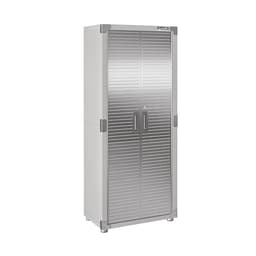
600 lb across the cabinet and 150 lb per shelf, in a footprint 18 inches deep. The depth is the reason it works in a garage where a 24 in cabinet would eat the walkway.
Published specs
- Dimensions
- 30 in W x 18 in D x 72 in H
- Total capacity
- 600 lb
- Capacity per shelf
- 150 lb
- Body
- Steel, lockable
Figures are the manufacturer's, from Seville Classics published specifications; the UltraHD 30 in cabinet (SKU UHD20162B) re-read 2026-09-12. We have not verified them by testing and do not imply that we have.
Our scoring
- Published capacity
- 7.5
- Footprint efficiency
- 9.0
- Build
- 8.5
- Security
- 8.5
- Tote fit
- 4.5
What works
- 18 in depth keeps the walkway usable in a single-car garage
- Steel body and lockable doors, which matters if the garage is also where the chemicals live
- 150 lb per shelf is enough for anything that belongs behind a door
- Doors mean the contents stay out of sight, which is most of what a garage tidy actually is
What doesn't
- 600 lb total is modest next to open shelving of the same size
- 18 in depth will not take a 27-gallon tote across the depth
- Steel cabinets in an unheated garage will sweat in a humidity swing
Skip this one if what you are storing is bins. A 27-gallon tote is over 19 in wide and this cabinet is 18 in deep — you would be buying doors you cannot close.
#2 · Best big cabinet
Seville Classics UltraHD Extra-Wide Cabinet, 60 x 24 x 72 in
Seville Classics
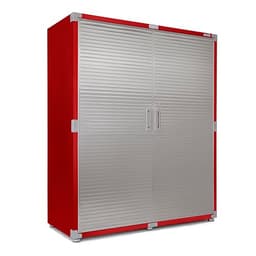
800 lb total with a reinforced 200 lb bottom shelf — the bottom shelf rating is the one to notice, because that is where the heavy things end up anyway.
Published specs
- Dimensions
- 60 in W x 24 in D x 72 in H
- Total capacity
- 800 lb
- Capacity per shelf
- 100 lb
- Bottom shelf
- 200 lb
Figures are the manufacturer's, from Seville Classics published specifications; the UltraHD 30 in cabinet (SKU UHD20162B) re-read 2026-09-12. We have not verified them by testing and do not imply that we have.
Our scoring
- Published capacity
- 8.0
- Footprint efficiency
- 6.5
- Build
- 8.5
- Security
- 8.5
- Tote fit
- 9.0
What works
- 24 in depth takes a 27-gallon tote across the depth, which the 18 in cabinet cannot
- The 200 lb bottom shelf is rated for what people actually put there
- 60 in of closed storage clears a lot of clutter in one purchase
What doesn't
- 100 lb per shelf on the upper shelves is not much for a cabinet this size
- 24 in deep and 60 in wide is a serious amount of garage
- The strong shelf is the bottom one, so anything heavy has to live at floor level
Skip this one if your garage is a single bay and you still park in it. 60 in wide by 24 in deep against a side wall is often the difference between opening the car door and not.
#3 · Best shallow-depth rack
Gladiator 60 in Heavy Duty Rack, four 18 in shelves
Gladiator GarageWorks
18 inches deep rather than 24. In a garage where the shelving runs down the side of a parked car, six inches is the whole argument.
Published specs
- Model
- GARS604TEG
- Width
- 60 in
- Shelves
- Four, 18 in deep
Figures are the manufacturer's, from the Gladiator GarageWorks catalog, read 2026-09-01. We have not verified them by testing and do not imply that we have.
Our scoring
- Published capacity
- 6.5
- Footprint efficiency
- 9.0
- Build
- 8.5
- System fit
- 9.0
- Tote fit
- 4.5
What works
- 18 in depth leaves the walkway alongside a car intact
- Matches the rest of the Gladiator system if the wall is going to grow
- 60 in width fits between common obstructions
What doesn't
- 18 in will not take a 27-gallon tote across the depth
- No prominently published per-shelf capacity
Skip this one if you are storing standard totes. Measure first: the common 27-gallon totes are about 19.6 in wide, so an 18 in shelf leaves them overhanging.
Questions people actually ask
How deep should a garage cabinet be?
24 inches if storage totes are going inside — the common 27-gallon totes are about 19.6 in wide and an 18 in cabinet cannot close its doors on them. 18 in is the right choice only when a car door or walkway makes the extra six inches impossible.
How much weight can a garage cabinet hold?
Seville Classics publishes 600 lb total and 150 lb per shelf for the 36 x 18 x 72 in UltraHD cabinet, and 800 lb total with 100 lb per shelf and a reinforced 200 lb bottom shelf for the 60 x 24 x 72 in extra-wide.
Why does the smaller cabinet have a higher per-shelf rating?
Shelf span. A 36 in shelf has less distance to bridge than a 60 in one, so it carries more per shelf even though the larger cabinet has a higher total. Width and per-shelf capacity pull in opposite directions.
Do steel garage cabinets rust?
The finish is powder-coated, but an unheated garage swings through humidity and warm damp air condenses on cold steel. Leave a gap behind the cabinet for airflow and keep genuinely moisture-sensitive items in a sealed bin inside rather than loose on a shelf.
Are garage cabinets worth it over shelving?
Only for what genuinely needs doors: chemicals, anything that should be locked, and things dust ruins. Per cubic foot, cabinets are the most expensive storage in the garage — everything else is cheaper and more accessible on open shelving.
Sources
- Seville Classics UltraHD 30 in cabinet — 600 lb total, 150 lb per shelfChecked September 1, 2026
- Seville Classics UltraHD extra-wide 60 in cabinet — 800 lb total, 200 lb bottom shelfChecked September 1, 2026
- Gladiator GarageWorks catalog — model numbers and configurationsChecked September 1, 2026
- Sterilite published tote exterior dimensionsChecked September 1, 2026
Manufacturer documentation, manuals, warranty terms and exact product models reviewed September 1, 2026.
Read next
- Garage cabinets vs shelvesWhat doors actually buy you, when it is worth paying for, and the hybrid most garages should build.
- Garage cabinets with doorsWhich garage contents genuinely need doors, and what to look for if safety is the reason.
- How to plan a garage cabinet wallSix measurements and an order of operations for the most expensive wall in the garage.
- Gladiator garage storage: an honest lookWhat the Gladiator system actually buys, where it wins, and where it does not publish enough.
- Where the tools goTools in a bin become a search. The wall is the answer, and the hook limits decide what goes where.
- Where the kids' stuff goesIt fails for one reason: it is stored at adult height. The height rule and the open-bin system.
- Metal or wood garage cabinets?Published capacity against material tolerance, and the honest case for each in a real garage.
- Seville Classics UltraHD cabinet: the 18 inch question600 lb total, 150 lb per shelf, 18 in deep — what that depth buys and who it disappoints.
- NewAge garage cabinets: Bold, Bold XL or Pro?Bold, Bold XL and Pro on published gauge, depth and per-shelf capacity, and which NewAge set fits which garage.
- Where the power tools goCased, heavy and battery-dependent — why power tools are a shelf and cabinet problem, not a wall one.
- The best resin garage cabinetsResin cabinets on published shelf ratings and cubic feet, and when steel is worth the extra.
- Gladiator or NewAge garage cabinets?Two 24-gauge welded steel systems compared on published capacity, depth, locking hardware and warranty.