Cabinets
Metal or wood garage cabinets?
Steel publishes a number and sweats in a humidity swing. Wood publishes nothing and drinks the damp. Neither of those is the disqualifier people assume.
Disclosure: Rail & Rafter earns a commission on qualifying purchases made through links on this page, at no cost to you. Commission does not decide what we recommend — our criteria do, and here is how we are funded.

The real difference is not strength. It is disclosure. Steel garage cabinets routinely publish a per-shelf and a total capacity — Seville Classics states 600 lb total and 150 lb per shelf for its 30 inch UltraHD cabinet. Most wood and MDF garage cabinets publish neither, and you are asked to buy on the word "sturdy".
That asymmetry is the single most useful thing to know before you shop, and it is why this site leans steel for the carcass. But wood is genuinely the better material in two specific places, and pretending otherwise would be selling you something. The full category is in the cabinets and workbenches hub, and our criteria are on how we pick.
The disclosure gap, stated plainly
| Steel garage cabinets | Wood / MDF garage cabinets | |
|---|---|---|
| Per-shelf capacity | Commonly published | Rarely published |
| Total capacity | Commonly published | Rarely published |
| Example figure | Seville UltraHD 30 in: 600 lb total, 150 lb per shelf | Typically no figure stated |
| Lockable doors | Common | Varies |
| Behavior in damp | Can sweat in a humidity swing; will not swell | Absorbs moisture; MDF swells at cut edges |
Read the right-hand column carefully. It does not say wood cabinets are weak. It says you cannot plan a wood cabinet wall against a number, because the number is usually not there. If the cabinet is going to hold paint cans and a car battery, that matters. If it is going to hold gloves and rags, it does not.
Where steel wins
- Published capacity. Seville's 30 in UltraHD publishes 600 lb total and 150 lb per shelf. The extra-wide 60 in version publishes 800 lb total, 100 lb per shelf and a reinforced 200 lb bottom shelf. Those are plannable figures.
- It does not absorb water. Steel can sweat on the surface in a humidity swing, which is a nuisance. MDF that gets wet at a cut edge swells permanently, which is a replacement.
- Locking. Steel cabinets with lockable doors are the standard answer for chemicals, solvents and anything that should not be at child height. This is the argument made in garage cabinets with doors.
- Fire behavior. Steel does not add fuel. In a garage that stores gasoline, solvents or a spare propane tank, that is worth having in mind even though no domestic cabinet is a fire-rated enclosure.
Where wood genuinely wins
1. The work surface
This is not close. A hardwood benchtop takes a hammer blow, a chisel slip and a dropped wrench without denting the way sheet steel does, and you can plane it flat again in ten years. The Gladiator 6 ft adjustable-height workbench uses a hardwood top for exactly this reason, and it is the right choice.
The useful shape for most garages is a steel carcass with a wood top — not one material for everything.
2. Building it yourself
Plywood cabinets built to fit an awkward wall will beat any bought cabinet on fit, because they are made for the space. If you have a table saw and a weekend, this is a legitimate route and it is the cheapest per linear foot of finished storage. Seal the edges — untreated MDF in an unheated garage is a consumable, and even plywood wants a finish.
The measurement that beats both arguments
The common 27-gallon totes are about 19.6 inches wide. Seville publishes 18 in depth for the 30 in UltraHD cabinet — so its doors will not close on a tote. The 60 in extra-wide is 24 in deep and will. If bins are going inside, depth decides this before material does, and the full fit arithmetic is on garage shelving that fits totes.
What each does in an unheated garage
Steel sweats. When warm damp air meets cold steel you get condensation on the panel, and anything with a paper label sitting against it will mark. It is a surface problem, not a structural one, and it goes away with airflow or a dehumidifier.
Wood drinks. Solid hardwood handles a garage well if it is finished. MDF does not — a wet cut edge swells and stays swollen, and MDF is what a great many inexpensive "wood" garage cabinets are actually made of. Check the material description rather than the photograph.
If the garage is genuinely damp, the more important decision may not be cabinets at all — open wire shelving lets air move, and the case for that is in cabinets against shelves.
Honest cons on each
Steel, honestly
- Published totals can be modest next to open shelving of the same size — 600 lb across a whole cabinet is well under what a single welded shelf publishes.
- Thin steel doors dent, and a dented door is a door that stops closing cleanly.
- Condensation in a humidity swing, as above.
Wood, honestly
- You are usually buying without a published capacity figure.
- MDF and moisture are a bad combination and a lot of the category is MDF.
- Heavier per unit of storage, which matters if anything is wall-hung.
Wall-hung against floor-standing, and why material decides it
The moment a cabinet leaves the floor, its own weight starts to matter, and this is where the material argument stops being theoretical.
A floor-standing cabinet puts its load straight down into the slab. Nothing about the carcass material changes that, and you can be relaxed. A wall-hung cabinet puts its own weight plus its contents into the studs, and MDF carcasses are heavy for their strength — you spend a meaningful share of the wall's capacity carrying the cabinet itself before anything goes inside.
Two practical consequences:
- Wall-hung wants steel, or at minimum plywood rather than MDF, and it wants a real fastening into studs rather than into drywall anchors.
- Work out the wall's capacity first. The cabinet's published rating is about the cabinet; what the wall holds is a separate question, answered in how much weight a garage wall can hold.
Floor-standing is the right default for a garage in almost every case. Wall- hung is for the run above a workbench where you need the floor, and that is a layout decision rather than a material one — set out in how to plan a cabinet wall.
What to look for on a spec sheet, in order
- Depth. It decides what fits and it cannot be worked around later. 18 in or 24 in, and a 27-gallon tote needs the 24.
- Per-shelf capacity, not total. You load a shelf, not a cabinet. Seville publishes 150 lb per shelf on the 30 in UltraHD and 100 lb per shelf on the 60 in extra-wide with a reinforced 200 lb bottom — note that the bigger cabinet has the lower per-shelf figure.
- The material, stated exactly. "Wood finish" is not wood. Look for the word steel, plywood or MDF, and treat a spec sheet that will not say as a spec sheet telling you something.
- Whether the shelves adjust, and in what increments. Fixed shelves at the wrong spacing waste a whole tier of height permanently.
- Whether it locks, and what that means. A domestic cabinet lock keeps children and casual hands out. It is not security, and no published specification claims it is.
What to buy
Buy the Seville UltraHD 30 in steel cabinet if the garage is narrow and you still park in it. 18 inches deep keeps the walkway usable, 150 lb per shelf is more than enough for what belongs behind a door, and it locks. Just do not plan to put totes in it.
Buy the Seville UltraHD 60 in extra-wide if bins are going inside and you have the floor. 24 in depth takes a 27-gallon tote, and the reinforced 200 lb bottom shelf is rated for what people actually put at floor level. Watch the 100 lb upper-shelf figure.
Buy the Gladiator hardwood workbench if what you need is a surface to work on rather than a box to close. Wood is the correct top material and adjustable height is the correct feature.
Build wood cabinets yourself if the wall is awkward, you own the tools, and you will seal the edges. Nothing bought fits a strange space as well as something made for it — the layout method is in how to plan a cabinet wall.
What we would buy for this
Every pick carries the manufacturer's published specs, our scoring against stated criteria, and a reason you might want to skip it.
#1 · Best all-steel cabinet
Seville Classics UltraHD Storage Cabinet, 30 x 18 x 72 in
Seville Classics
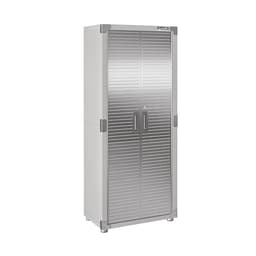
600 lb across the cabinet and 150 lb per shelf, in a footprint 18 inches deep. The depth is the reason it works in a garage where a 24 in cabinet would eat the walkway.
Published specs
- Dimensions
- 30 in W x 18 in D x 72 in H
- Total capacity
- 600 lb
- Capacity per shelf
- 150 lb
- Body
- Steel, lockable
Figures are the manufacturer's, from Seville Classics published specifications; the UltraHD 30 in cabinet (SKU UHD20162B) re-read 2026-09-12. We have not verified them by testing and do not imply that we have.
Our scoring
- Published capacity
- 7.5
- Footprint efficiency
- 9.0
- Build
- 8.5
- Security
- 8.5
- Tote fit
- 4.5
What works
- 18 in depth keeps the walkway usable in a single-car garage
- Steel body and lockable doors, which matters if the garage is also where the chemicals live
- 150 lb per shelf is enough for anything that belongs behind a door
- Doors mean the contents stay out of sight, which is most of what a garage tidy actually is
What doesn't
- 600 lb total is modest next to open shelving of the same size
- 18 in depth will not take a 27-gallon tote across the depth
- Steel cabinets in an unheated garage will sweat in a humidity swing
Skip this one if what you are storing is bins. A 27-gallon tote is over 19 in wide and this cabinet is 18 in deep — you would be buying doors you cannot close.
#2 · Best big cabinet
Seville Classics UltraHD Extra-Wide Cabinet, 60 x 24 x 72 in
Seville Classics
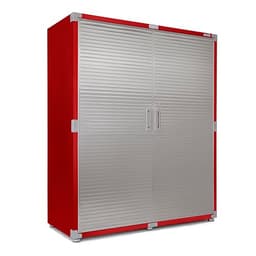
800 lb total with a reinforced 200 lb bottom shelf — the bottom shelf rating is the one to notice, because that is where the heavy things end up anyway.
Published specs
- Dimensions
- 60 in W x 24 in D x 72 in H
- Total capacity
- 800 lb
- Capacity per shelf
- 100 lb
- Bottom shelf
- 200 lb
Figures are the manufacturer's, from Seville Classics published specifications; the UltraHD 30 in cabinet (SKU UHD20162B) re-read 2026-09-12. We have not verified them by testing and do not imply that we have.
Our scoring
- Published capacity
- 8.0
- Footprint efficiency
- 6.5
- Build
- 8.5
- Security
- 8.5
- Tote fit
- 9.0
What works
- 24 in depth takes a 27-gallon tote across the depth, which the 18 in cabinet cannot
- The 200 lb bottom shelf is rated for what people actually put there
- 60 in of closed storage clears a lot of clutter in one purchase
What doesn't
- 100 lb per shelf on the upper shelves is not much for a cabinet this size
- 24 in deep and 60 in wide is a serious amount of garage
- The strong shelf is the bottom one, so anything heavy has to live at floor level
Skip this one if your garage is a single bay and you still park in it. 60 in wide by 24 in deep against a side wall is often the difference between opening the car door and not.
#3 · Best workbench
Gladiator 6 ft Adjustable Height Hardwood Workbench
Gladiator GarageWorks
Adjustable height on a hardwood top is the combination worth paying for: a bench at the wrong height is a bench you stand at badly for a decade.
Published specs
- Model
- GAWB06HWEG
- Width
- 6 ft
- Top
- Hardwood
- Height
- Adjustable
Figures are the manufacturer's, from the Gladiator GarageWorks catalog, read 2026-09-01. We have not verified them by testing and do not imply that we have.
Our scoring
- Work surface
- 9.0
- Adjustability
- 9.5
- Build
- 8.5
- Footprint efficiency
- 6.5
- System fit
- 9.0
What works
- Adjustable height, which almost no consumer workbench offers
- Hardwood top takes a beating and can be sanded back rather than replaced
- 6 ft is long enough to actually work on something
- Lines up with Gladiator cabinets and GearTrack above it
What doesn't
- 6 ft of wall is a real commitment in a small garage
- Hardwood needs the occasional oiling if the garage is damp
- Priced as a system component
Skip this one if the bench would be storage with a top on it. If nothing is ever going to be clamped, cut, or assembled on it, a cabinet run with a countertop costs less and holds more.
Questions people actually ask
Are metal or wood garage cabinets better?
Steel for the carcass, wood for the work surface. Steel cabinets publish per-shelf and total capacities you can plan against — Seville's 36 in UltraHD states 600 lb total and 150 lb per shelf — and they do not absorb water. Wood wins decisively on benchtops and when you are building to fit an awkward wall.
Do wood garage cabinets hold up in a damp garage?
Finished solid wood does. MDF does not — a wet cut edge swells permanently, and a large share of inexpensive "wood" garage cabinets are MDF. Read the material description rather than judging from the product photo.
Why do steel garage cabinets sweat?
Warm damp air meeting cold steel condenses on the panel. It is a surface issue rather than a structural one and it improves with airflow or a dehumidifier, but it will mark paper labels and cardboard left against the side.
Will a 27-gallon tote fit in a garage cabinet?
Only in a 24 inch deep one. The common 27-gallon totes are about 19.6 in wide, so an 18 in cabinet cannot close its doors on one. Seville publishes 18 in for the 30 in UltraHD and 24 in for the 60 in extra-wide.
Sources
- Seville Classics UltraHD storage cabinet 30 x 18 x 72 in (SKU UHD20162B) — 600 lb total, 150 lb per shelf, steel lockable bodyChecked September 6, 2026
- Seville Classics UltraHD extra-wide cabinet 60 x 24 x 72 in — 800 lb total, 100 lb per shelf, 200 lb bottom shelfChecked September 6, 2026
- Gladiator GAWB06HWEG 6 ft adjustable height hardwood workbench — hardwood top, adjustable heightChecked September 6, 2026
- Sterilite 27 gal Industrial Tote — published exterior width 19.625 inChecked September 6, 2026
Manufacturer documentation, manuals, warranty terms and exact product models reviewed September 6, 2026.
Read next
- The best garage storage cabinetsCabinets ranked on published capacity and the depth question that decides whether your bins fit.
- Garage cabinets with doorsWhich garage contents genuinely need doors, and what to look for if safety is the reason.
- Garage cabinets vs shelvesWhat doors actually buy you, when it is worth paying for, and the hybrid most garages should build.
- How to plan a garage cabinet wallSix measurements and an order of operations for the most expensive wall in the garage.
- Garage cabinets: what to compare before you buyThe three specifications that decide a garage cabinet, and which alternative wins on each.
- The best rolling garage storageGarage storage on wheels ranked on published capacity, caster size and whether it locks.
- The best resin garage cabinetsResin cabinets on published shelf ratings and cubic feet, and when steel is worth the extra.