The Mess
Where the kids' stuff goes
Scooters, a balance bike, a bin of outgrown things nobody will admit to. Kids' gear fails for exactly one reason: it is stored where a child cannot reach it.
Disclosure: Rail & Rafter earns a commission on qualifying purchases made through links on this page, at no cost to you. Commission does not decide what we recommend — our criteria do, and here is how we are funded.

Two scooters on their sides, a balance bike nobody rides any more, a bin of outgrown outdoor toys, and a football that has been under the car since spring.
Kids' gear fails for one reason and it is not the storage product. It is stored at adult height. A seven-year-old who cannot reach the hook puts the scooter on the floor, and they are right to.
The height rule
Store it where the child can reach it
If a child is expected to put something away, it has to be within their reach without a step. Everything else is a rule you enforce rather than a system that works.
In practice this means the bottom three feet of the wall — which is exactly the band that a garage wall guide normally tells you to leave empty. For a garage with children in it, that band is the most valuable one you have.
The corollary matters just as much: the things you do not want them to reach go high, or behind a lock. Chemicals, blades, power tools. That split is what makes the low band safe to use — see garage cabinets with doors.
The system
A wall panel with hooks and open bins at child height, and a labeled tote overhead for what is out of season or outgrown.
| Item | Storage | Height |
|---|---|---|
| Scooters, balance bikes | Wall hooks | Child shoulder height |
| Kids' bikes | Wall hooks, below the adult bikes | Child shoulder height |
| Balls and outdoor toys | Open bin at floor level | Floor |
| Helmets | One hook each | Child eye level |
| Chalk, bubbles, small things | A shallow open bin | Child chest height |
| Outgrown or out of season | Labeled tote, overhead | Adult only |
Use a panel rather than track. Children grow, gear changes constantly, and a panel lets you move a hook up six inches next year without drilling. Gladiator's GearWall publishes 50 lb per square foot, which is far beyond what a scooter asks of it — this is a case where convenience decides rather than capacity, the same as sports gear.
Open bins, always
Same reasoning as sports gear and it applies double here. A lidded bin means lift the lid, dig, find, replace, close. No child does five actions to put a ball away, and honestly neither do you.
Open bins are one action each way. The bin is not there to protect the contents; it is there to define where the contents go, and a defined destination is what makes putting-away happen at all.
The outgrown pile, honestly
Every garage with children in it has a bin of things nobody has used in two years, kept because getting rid of them feels premature.
The rule that works: one bin, and when it is full something leaves before something enters. One 27-gallon tote — 28.5 by 19.6 by 15.5 inches on the Sterilite Industrial — is a generous allowance for keepsakes and hand-me-downs, and the constraint is what stops it becoming four bins.
That bin goes overhead. It is bulky, light and rarely needed, which is the exact profile for a ceiling rack — and six flat totes fit on a standard 4x8, per bin sizes that fit overhead racks.
The constraint: fixings, and children pulling on them
Capacity is not the issue — a scooter weighs very little. What matters is that a child hanging on a hook applies considerably more force than the weight of what is on it, in a direction the hook was not designed for.
Fix into studs, not drywall anchors. Wall Control publishes 200 lb per panel into studs against 100 lb into anchors, and that gap is exactly the margin you want when the load is unpredictable. The stud method is on how much weight a garage wall holds.
Also worth checking: nothing heavy stored above where children stand or play. That is a general rule for a garage with children, and it argues for keeping the low band light and the heavy things on shelving elsewhere.
What it costs and how long it takes
A wall panel section, a handful of hooks, two or three open bins and one tote. An afternoon, and most of the cost is accessories rather than the panel.
Start with the four things currently on the floor. Add later — the fortnight rule from the wall guide applies here too, and with children it applies harder, because what they actually use is not what you predict.
What not to do
- Do not store it at adult height. The single reason kids' storage fails.
- Do not use lidded bins for anything in daily use. The friction is the whole problem.
- Do not put chemicals or blades in the low band. The low band is the child band. Everything dangerous goes high or behind a lock.
- Do not let the outgrown pile become four bins. One bin, and something leaves before something enters.
What we would buy for this
Every pick carries the manufacturer's published specs, our scoring against stated criteria, and a reason you might want to skip it.
#1 · Best full-wall panel system
Gladiator GearWall Panels
Gladiator GarageWorks
50 lb per square foot across a whole panel, which is a different kind of number from GearTrack's per-foot rating: it buys you the freedom to hang anything anywhere rather than only on a line.
Published specs
- Rated capacity
- 50 lb per square foot
- Mounting
- Into wood studs, including through drywall
- Format
- Full-height slatted panels
Figures are the manufacturer's, from Gladiator installation instructions W11087876 Rev A, read 2026-09-01. We have not verified them by testing and do not imply that we have.
Our scoring
- Published capacity
- 8.5
- Coverage per dollar
- 6.5
- Accessory range
- 9.0
- Install simplicity
- 7.0
- Documentation
- 9.5
What works
- Hang anything at any height rather than only where a track run happens to be
- 50 lb per sq ft across a full panel is a large total load
- Shares the Gladiator accessory range with GearTrack
What doesn't
- Covering a whole wall in panels costs several times what two track runs cost
- It is a wall finish as much as a storage system, so it is a bigger commitment to undo
- Per-square-foot ratings are harder to reason about than per-foot ones — a single 60 lb item is not the rated case
Skip this one if you know exactly what is going on that wall and it is six things. Two runs of track will hold them for a fraction of the cost, and the wall stays a wall.
#2 · Best overhead-rack tote
HDX 27 Gallon Tough Tote (4-pack)
HDX
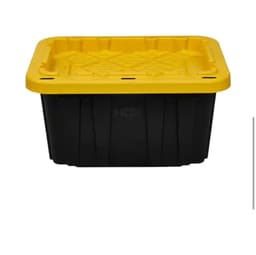
28.55 by 19.61 by 15.27 inches. Those three numbers are why it is here: two of them fit across a 4 ft rack, and the 15.27 in height clears the drop on most overhead racks.
Published specs
- Capacity
- 27 gallons
- Exterior
- 28.55 in L x 19.61 in W x 15.27 in H
- Interior at base
- 23.5 in L x 14.5 in W x 13 in H
- Material
- Polypropylene
Figures are the manufacturer's, from the HDX Tough Tote listing, read 2026-09-01. We have not verified them by testing and do not imply that we have.
Our scoring
- Overhead rack fit
- 9.5
- Stackability
- 8.5
- Durability
- 8.0
- Findability
- 5.5
- Availability
- 9.5
What works
- 15.27 in tall is short enough to clear the drop on most overhead racks
- Two fit across the 48 in width of a standard 4x8 rack
- Opaque, so contents do not degrade in the light through a garage window
- Sold everywhere, so matching more later is easy
What doesn't
- Opaque means you cannot see what is in it without a label
- Snap-on lids are not weathertight
- Polypropylene gets brittle in a cold garage over years
Skip this one if you need to see the contents. In a garage you will not remember what is in bin four, and an opaque tote without a labeling system is a box you open every time.
#3 · Best on shelving
Sterilite 27 Gallon Industrial Tote (4-pack)
Sterilite
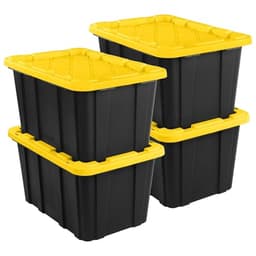
Practically the same footprint as the HDX at 28.5 by 19.625 inches, but with 14.75 in of usable interior height at the base rather than 13 in. Nearly two more inches of what you actually load.
Published specs
- Capacity
- 27 gallons
- Exterior
- 28.5 in L x 19.625 in W x 15.5 in H
- Interior at base
- 23.375 in L x 14.625 in W x 14.75 in H
Figures are the manufacturer's, from the Sterilite product pages, read 2026-09-01. We have not verified them by testing and do not imply that we have.
Our scoring
- Overhead rack fit
- 8.5
- Stackability
- 9.0
- Durability
- 8.5
- Findability
- 5.5
- Availability
- 9.5
What works
- 14.75 in interior height at the base is nearly two inches more usable depth than the comparable HDX
- Same exterior footprint, so the two mix on the same shelf without a stepped run
- Industrial line is thicker-walled than the standard Sterilite totes
What doesn't
- 15.5 in exterior height is a quarter-inch taller than the HDX, which matters under a tight rack
- Snap-on lid, not a latching one
- No handles on some colorways
Skip this one if your overhead rack drop leaves you less than 16 in of clearance. A quarter-inch sounds like nothing until the lid catches on the joist every time.
Questions people actually ask
How do I organize kids' stuff in the garage?
At child height, in open bins and on hooks they can reach without a step. A wall panel rather than track, so hooks move up as they grow. Anything dangerous goes high or behind a lock, which is what makes the low band safe to use.
Why does kids' garage storage never stay tidy?
Almost always because it is stored where a child cannot reach it. A seven-year-old who cannot reach the hook puts the scooter on the floor, and that is a system failure rather than a behavior one.
Should kids' bins have lids?
Not for anything in daily use. A lidded bin is five actions to get something out and five to put it back, and nobody does that. Open bins are one action each way.
What do I do with outgrown gear?
One labeled tote, stored overhead, and when it is full something leaves before something enters. A 27-gallon tote is a generous allowance for keepsakes, and the constraint is what stops it becoming four bins.
Sources
- Gladiator GearWall published rating — 50 lb per square foot, stud mountingChecked September 1, 2026
- Wall Control published capacity guidance — stud versus drywall anchor figuresChecked September 1, 2026
- Sterilite 27 gal Industrial Tote — published exterior dimensionsChecked September 1, 2026
Manufacturer documentation, manuals, warranty terms and exact product models reviewed September 1, 2026.
Read next
- Where the sports gear goesHigh-turnover and awkward-shaped. Why bins fail for sports gear and what open wall storage solves.
- Where the bikes goBikes are a wall problem, not a floor problem. The system, the stud check, and why hoists get abandoned.
- The best garage storage binsThree 27-gallon totes on published exterior dimensions, and where each one actually fits.
- The best garage wall storage systemsTrack, slatwall, panels and metal pegboard on published load ratings, converted into one comparable question.
- Garage cabinets with doorsWhich garage contents genuinely need doors, and what to look for if safety is the reason.
- Your garage is full. Start here.Four passes that turn a full garage into a list of piles, each with a system that fits it.
- The best garage bike racksWall-mounted bike racks ranked on published per-bike capacity, tire fit and whether they pivot.