The Mess
Where the power tools go
Cased, heavy and battery-dependent. Power tools break every rule that makes hand tools a wall problem, and the charging station is the part nobody plans for.
Disclosure: Rail & Rafter earns a commission on qualifying purchases made through links on this page, at no cost to you. Commission does not decide what we recommend — our criteria do, and here is how we are funded.

Power tools belong on a shelf or in a cabinet, not on the wall. That is the opposite of the advice for hand tools, and the reason is that power tools arrive in cases, weigh more than hook ratings allow, and need mains power to be useful between jobs.
Hand tools are a wall problem and they are covered on the tools problem page. This page is about the drill, the circular saw, the sander and the four batteries that go with them. If the garage as a whole is the problem, start at the triage guide.
Why the wall is the wrong answer here
Three reasons, and each one rules the wall out on its own.
- They live in cases. A cased circular saw is a rectangular box, and boxes go on shelves. Taking the tool out of its case to hang it means the case goes somewhere else, and now you have two storage problems.
- They are too heavy for hooks. Wall Control publishes 10 to 15 lb per two-slot pegboard hook. A cased circular saw or a corded grinder is at or past that, and a mitre saw is nowhere near it. The ratings are explained in the garage hooks guide.
- Batteries need an outlet. Storage and charging are the same problem for cordless tools, and no pegboard solves it.
The charging station is the part people forget
A modern cordless setup is three to six batteries and one or two chargers, and if they do not have a home they end up on the bench — which is the thing that stops the bench being a bench.
Give the chargers a fixed shelf near an outlet and leave them plugged in. A shelf at chest height beside a socket, chargers screwed down or sitting on a non-slip mat, batteries in a row. It takes about a foot of shelf and it removes the most persistent clutter source in a working garage.
Two things worth getting right
- Do not bury chargers in a closed cabinet. Chargers produce heat and most want airflow. An open shelf is the right place; check what your manufacturer says about enclosed use.
- Cold hurts lithium batteries. An unheated garage in deep winter is a poor place to store or charge them. Manufacturers publish operating and storage temperature ranges — read yours, because the practical answer for a very cold garage is that batteries come indoors.
Shelf or cabinet?
| Option | Published capacity | Best for |
|---|---|---|
| Husky 4-tier welded shelving | 2,500 lb per shelf, 24 in deep | Cases, in volume, at low cost per cubic foot |
| Seville UltraHD cabinet, 30 in | 600 lb total, 150 lb per shelf, 18 in deep, lockable | Anything that should be behind a locked door |
| Seville UltraHD Rolling Workstation | 500 lb total, 5 in locking casters | Tools that move to the work |
| Akro-Mils 10124 24-drawer | Drawers 6 x 4-9/16 x 2-3/16 in | Bits, blades, discs and the loose consumables |
Shelving wins on cost per case. A 24 in deep shelf takes most tool cases flat, and a welded unit publishes far more capacity than a stack of cases will ever need. This is the default.
A cabinet wins on two specific grounds: dust and access. A closed door keeps sawdust out of vents, and a lock keeps a nail gun or a circular saw away from children. Seville publishes 150 lb per shelf on the 30 in UltraHD, which is plenty for cased tools, and the depth caveat is real — at 18 in deep it will not close on a 27-gallon tote, though it takes tool cases fine.
A rolling unit wins if the work moves. If you work on the driveway in summer and the garage in winter, 500 lb on 5 in locking casters beats carrying cases back and forth — the full ranking is in the rolling garage storage roundup.
The consumables are a different problem from the tools
Drill bits, driver bits, sanding discs, blades and cut-off wheels are small, numerous and get lost in a tool case. They want drawers rather than shelves — the Akro-Mils 24-drawer publishes 6 x 4-9/16 x 2-3/16 in drawers, which takes bit sets and blades that the 64-drawer fastener cabinet will not. The options are in the small parts organizer roundup.
Dust and damp
Two environmental things shorten the life of power tools in a garage, and both are storage decisions rather than tool decisions.
- Sawdust gets into motor vents. If you cut wood in the same space you store the tools, a closed cabinet is doing real work. Cases help; an open shelf in a woodworking space does not.
- Bare metal rusts. Saw tables, plane soles and drill chucks in an unheated, humid garage will corrode. Steel cabinets can sweat in a humidity swing, so leave a gap behind the unit for airflow rather than sealing everything up — the material argument is in metal against wood garage cabinets.
What not to do
- Do not hang cased tools from pegboard hooks. The published per-hook figures do not support it, and the case makes it swing.
- Do not stack cases more than about three high. The bottom one becomes unreachable and stops being used, which is how people buy a second sander.
- Do not store the tool and its battery charged and connected long-term. Follow the manufacturer's storage guidance for your battery platform rather than a general rule from the internet — it genuinely varies by brand.
- Do not put the charging shelf above the bench you actually work on. Cables end up hanging into the work area and you will pull a battery onto the floor.
The layout that works
Bottom to top, for a wall of power tool storage:
- Floor to knee: the heavy cased tools — mitre saw, table saw accessories, the big grinder. Heavy things low is the rule everywhere in the garage.
- Knee to shoulder: the tools you use weekly, in their cases, plus the charging shelf beside an outlet.
- Shoulder to head: consumables in drawers, where you can read the labels at eye level.
- Above head: the cases for tools you use twice a year. Light, rarely wanted, and out of the way — the depth logic is in how deep garage shelves should be.
What we would buy for this
Every pick carries the manufacturer's published specs, our scoring against stated criteria, and a reason you might want to skip it.
#1 · Best all-steel cabinet
Seville Classics UltraHD Storage Cabinet, 30 x 18 x 72 in
Seville Classics
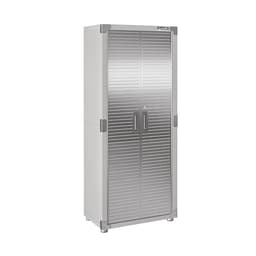
600 lb across the cabinet and 150 lb per shelf, in a footprint 18 inches deep. The depth is the reason it works in a garage where a 24 in cabinet would eat the walkway.
Published specs
- Dimensions
- 30 in W x 18 in D x 72 in H
- Total capacity
- 600 lb
- Capacity per shelf
- 150 lb
- Body
- Steel, lockable
Figures are the manufacturer's, from Seville Classics published specifications; the UltraHD 30 in cabinet (SKU UHD20162B) re-read 2026-09-12. We have not verified them by testing and do not imply that we have.
Our scoring
- Published capacity
- 7.5
- Footprint efficiency
- 9.0
- Build
- 8.5
- Security
- 8.5
- Tote fit
- 4.5
What works
- 18 in depth keeps the walkway usable in a single-car garage
- Steel body and lockable doors, which matters if the garage is also where the chemicals live
- 150 lb per shelf is enough for anything that belongs behind a door
- Doors mean the contents stay out of sight, which is most of what a garage tidy actually is
What doesn't
- 600 lb total is modest next to open shelving of the same size
- 18 in depth will not take a 27-gallon tote across the depth
- Steel cabinets in an unheated garage will sweat in a humidity swing
Skip this one if what you are storing is bins. A 27-gallon tote is over 19 in wide and this cabinet is 18 in deep — you would be buying doors you cannot close.
#2 · Best rolling storage
Seville Classics UltraHD Rolling Workstation, 36 x 24 in
Seville Classics
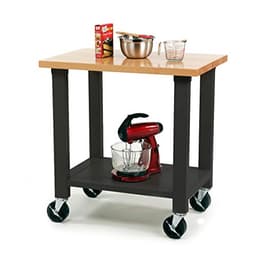
500 lb on four 5 in locking casters under a 1.5 in solid wood top. It is the rare garage product that is both a work surface and a way to move the work to where the car is not.
Published specs
- Model
- UHD20183B
- Dimensions
- 36 in W x 24 in D x 37.5 in H
- Total capacity
- 500 lb
- Top
- Solid polyurethane-coated wood, 1.5 in thick
- Casters
- Four 5 in heavy-duty locking wheels
Figures are the manufacturer's, from the Seville Classics UltraHD Rolling Workstation page (SKU UHD20183B) on sevilleclassics.com, read 2026-09-13. We have not verified them by testing and do not imply that we have.
Our scoring
- Published capacity
- 8.5
- Mobility
- 9.5
- Work surface
- 8.5
- Rigidity
- 6.5
- Footprint efficiency
- 7.5
What works
- 500 lb published on a unit you can push, which is unusual — most mobile storage trades capacity for wheels
- 5 in casters clear a garage floor's cracks and the lip at the door; small casters do not
- Locking wheels, so it becomes a stable bench when you need one
- 1.5 in solid wood top takes a clamp and a dropped wrench
What doesn't
- Wheels mean it is never quite as rigid as a bolted bench, and a heavy hammer blow will tell you so
- 500 lb is the whole unit, not per shelf — Seville does not publish a per-shelf figure
- 37.5 in high suits standing work; it is the wrong height to sit at
Skip this one if it is never actually going to move. A fixed bench of the same size costs less and is more rigid, and the casters are only worth paying for if you will use them.
#3 · Best heavy-duty shelving
Husky 4-Tier Welded Steel Rack, 77 x 78 x 24 in
Husky
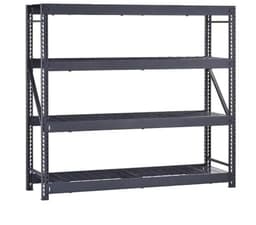
2,500 lb per shelf and 10,000 lb across the unit. That is not a garage number, it is a warehouse number, and it means this is the last shelving you buy for that wall.
Published specs
- Model
- HBR782478W4R
- Dimensions
- 77 in W x 78 in H x 24 in D
- Capacity per shelf
- 2,500 lb, evenly distributed
- Total capacity
- 10,000 lb
- Adjustment
- Shelves adjust in 3 in increments
- Warranty
- Lifetime
Figures are the manufacturer's, from the Home Depot listing for Husky HBR782478W4R, read 2026-09-01. We have not verified them by testing and do not imply that we have.
Our scoring
- Published capacity
- 10.0
- Build
- 9.5
- Tote fit
- 9.0
- Footprint efficiency
- 7.0
- Warranty
- 9.5
What works
- 2,500 lb per shelf is far beyond what a garage will ever ask of it, which is exactly why it never sags
- Welded construction rather than bolt-together, so it does not develop a wobble over years
- 24 in depth swallows a 27-gallon tote sideways with room to spare
- Lifetime warranty
What doesn't
- 77 in wide is a lot of wall. In a single-car garage this is a real commitment
- Welded means it arrives heavy and assembles in one configuration
- Only 3 in adjustment increments, so a tall item may cost you a whole shelf of headroom
Skip this one if you are storing light bulk — holiday bins, sleeping bags, empty coolers. You are paying for steel you will never load, and the same money buys twice the shelf area in a lighter unit.
#4 · Best for mixed hardware sizes
Akro-Mils 10124 24-Drawer Storage Cabinet
Akro-Mils
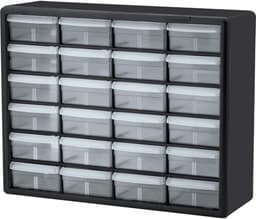
Same cabinet footprint as the 64-drawer, 24 larger drawers instead. This is the one most garages actually want, because most garage hardware is bigger than a wood screw.
Published specs
- Model
- 10124
- Outside dimensions
- 20 x 6-3/8 x 15-13/16 in
- Drawers
- 24
- Drawer inside size
- 6 x 4-9/16 x 2-3/16 in
- Mounting
- Wall mountable via keyhole slots
- Stacking
- Cabinets stack securely
Figures are the manufacturer's, from the Akro-Mils product pages on akro-mils.com, read 2026-09-06. We have not verified them by testing and do not imply that we have.
Our scoring
- Sorting density
- 7.5
- Findability
- 9.0
- Space efficiency
- 9.5
- Capacity per drawer
- 7.5
- Published data
- 6.0
What works
- Drawer inside height of 2-3/16 in takes bolts, couplers and hose fittings that will not go in the 64-drawer
- Identical outside footprint to the 10164, so the two stack and line up on the same wall
- Clear drawers, keyhole wall mounting, finger-grip pulls
- 24 categories is a realistic number to actually maintain
What doesn't
- 24 drawers means broader categories, so you still sort by hand inside a drawer
- No published load rating from Akro-Mils
- Same plastic rails as the 64-drawer, with more weight per drawer riding on them
Skip this one if you genuinely have hundreds of distinct fastener sizes. At that point the 64-drawer is the right cabinet and this one just re-creates the coffee can in 24 larger pieces.
Questions people actually ask
How should I store power tools in a garage?
On shelves or in a cabinet, in their cases, with a dedicated charging shelf near an outlet. Power tools are too heavy for pegboard hooks — Wall Control publishes 10 to 15 lb per two-slot hook — and they arrive as rectangular boxes, which is a shelf shape rather than a wall shape.
Is it bad to store power tool batteries in a cold garage?
Lithium batteries have published operating and storage temperature ranges and a deep-winter unheated garage can fall outside them. Check the range your battery platform publishes; for very cold garages the practical answer is that batteries come indoors and the tools stay out.
Should power tools go in a cabinet or on open shelving?
Shelving by default — it is cheaper per case and a 24 in deep shelf takes most tool cases flat. Choose a cabinet when sawdust is in the air or when something should be locked away; Seville publishes 150 lb per shelf and a lockable steel body on the 30 in UltraHD.
Where should the battery charging station go?
On an open shelf at chest height beside an outlet, not inside a closed cabinet — chargers generate heat and most want airflow. Keep it off the bench you work on, or the cables end up in your workspace.
Sources
- Wall Control published per-hook guidance — 10 to 15 lb per two-slot hookChecked September 13, 2026
- Seville Classics UltraHD storage cabinet 30 x 18 x 72 in (SKU UHD20162B) — 600 lb total, 150 lb per shelf, lockable steel bodyChecked September 13, 2026
- Seville Classics UltraHD Rolling Workstation (UHD20183B) — 500 lb total, four 5 in locking castersChecked September 13, 2026
- Akro-Mils 10124 — 24 drawers, large drawer inside 6 x 4-9/16 x 2-3/16 inChecked September 13, 2026
Manufacturer documentation, manuals, warranty terms and exact product models reviewed September 13, 2026.
Read next
- Where the tools goTools in a bin become a search. The wall is the answer, and the hook limits decide what goes where.
- The best garage storage cabinetsCabinets ranked on published capacity and the depth question that decides whether your bins fit.
- The best garage storage shelvesFive shelving units ranked on published per-shelf capacity and whether the depth takes a standard tote.
- The best small parts organizers for a garageDrawer cabinets, a louvered bin wall and a sealed portable case, ranked on sorting density and drawer size.
- The best rolling garage storageGarage storage on wheels ranked on published capacity, caster size and whether it locks.