Cabinets
Garage cabinets vs shelves
Shelving holds more for less. Cabinets hide, lock and keep dust off. The honest answer for most garages is some of each, in a specific ratio.
Disclosure: Rail & Rafter earns a commission on qualifying purchases made through links on this page, at no cost to you. Commission does not decide what we recommend — our criteria do, and here is how we are funded.

Put the two side by side and shelving wins on almost every measurable axis. It holds more, it costs less, you can see what is in it, and you can reach it in one motion instead of two.
Cabinets win on exactly three things, and all three are real. The question is how much of your garage genuinely needs them.
The verdict, first
Build mostly shelving, with one cabinet for the things that genuinely need doors. In most garages that is one cabinet against a wall of shelving — roughly 20 percent of your storage, not 80.
Buying a wall of cabinets is the expensive mistake in this category. It looks like a finished garage in a photograph and costs several times what the same capacity in shelving costs, for storage that is harder to see into and slower to use.
Head to head on published numbers
| Seville UltraHD cabinet | Husky 4-tier welded shelving | |
|---|---|---|
| Dimensions | 36" W x 18" D x 72" H | 77" W x 78" H x 24" D |
| Total capacity | 600 lb | 10,000 lb |
| Per shelf | 150 lb | 2,500 lb |
| Takes a 27 gal tote | No — 18 in deep | Yes |
| Contents visible | No | Yes |
| Lockable | Yes | No |
| Dust protection | Yes | No |
The capacity comparison is not close, and it is not a fair fight — these are different sizes of object. But the ratio holds at any size: open shelving carries far more per dollar and per square foot of floor than a cabinet does, because a cabinet spends structure on doors, sides and a back that a shelving unit does not have.
What doors actually buy you
1. Security, and this is the strongest case
Paint, solvents, fuel, pesticides and sharp or powered tools in a garage that children use — that is a safety requirement, not a preference, and a lockable steel cabinet is the correct answer to it. If this describes your garage, buy the cabinet and stop reading the cost-per-cubic-foot argument.
2. Dust
A garage where you cut, sand or grind puts fine dust on every open surface in the room. Anything with a fine mechanism, any finishing supply, and anything you want clean when you pick it up benefits from a door.
3. The visual mess you cannot solve
Some categories will never look tidy on an open shelf. Half-used consumables, mismatched packaging, the miscellaneous drawer of the garage. A door is a legitimate answer to that and there is no reason to feel bad about using one.
What doors cost you, beyond money
- You cannot see in. A garage is where things go to be forgotten, and a closed door accelerates that considerably. Anything in a cabinet needs a labeling discipline that open shelving does not.
- Two motions instead of one. Open, take, close. It sounds trivial and it is the reason cabinet doors end up left open.
- Doors need swing room. A 30 in cabinet needs its doors to open, which means clearance in front that a shelving unit does not require.
- Damp gets trapped. An unheated garage swings through humidity, and a closed steel box does not dry as fast as an open wire shelf.
The hybrid that actually works
The layout most garages should build, in order of what goes where:
- One cabinet — chemicals, anything locked, dust-sensitive supplies. Against a wall, near the bench.
- Open shelving for the bulk — bins, seasonal storage, tools in bins. 24 in deep so the totes fit, per garage shelving that fits totes.
- A wall system for the hanging things — bikes, ladders, hand tools. None of that belongs in either a cabinet or on a shelf.
- Overhead for the seasonal bulk — the bins you touch twice a year.
That combination stores more, costs less, and each part is doing the job it is good at. Planning a run of cabinets specifically is on how to plan a cabinet wall.
Who should buy which
Buy cabinets if the garage has children in it and there are chemicals or power tools to lock away, if you generate a lot of dust, or if the garage is visible from the house and you want it to read as finished.
Buy shelving if you are storing bins, seasonal goods, sports gear, or anything bulky. Which is most of what is in a garage.
Buy neither if the problem is that there is no floor left. Both stand on the ground. That is what overhead racks and wall systems are for, and it is the first question worth asking.
What we would buy for this
Every pick carries the manufacturer's published specs, our scoring against stated criteria, and a reason you might want to skip it.
#1 · Best all-steel cabinet
Seville Classics UltraHD Storage Cabinet, 30 x 18 x 72 in
Seville Classics
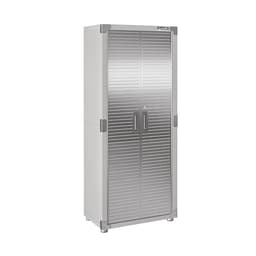
600 lb across the cabinet and 150 lb per shelf, in a footprint 18 inches deep. The depth is the reason it works in a garage where a 24 in cabinet would eat the walkway.
Published specs
- Dimensions
- 30 in W x 18 in D x 72 in H
- Total capacity
- 600 lb
- Capacity per shelf
- 150 lb
- Body
- Steel, lockable
Figures are the manufacturer's, from Seville Classics published specifications; the UltraHD 30 in cabinet (SKU UHD20162B) re-read 2026-09-12. We have not verified them by testing and do not imply that we have.
Our scoring
- Published capacity
- 7.5
- Footprint efficiency
- 9.0
- Build
- 8.5
- Security
- 8.5
- Tote fit
- 4.5
What works
- 18 in depth keeps the walkway usable in a single-car garage
- Steel body and lockable doors, which matters if the garage is also where the chemicals live
- 150 lb per shelf is enough for anything that belongs behind a door
- Doors mean the contents stay out of sight, which is most of what a garage tidy actually is
What doesn't
- 600 lb total is modest next to open shelving of the same size
- 18 in depth will not take a 27-gallon tote across the depth
- Steel cabinets in an unheated garage will sweat in a humidity swing
Skip this one if what you are storing is bins. A 27-gallon tote is over 19 in wide and this cabinet is 18 in deep — you would be buying doors you cannot close.
#2 · Best heavy-duty shelving
Husky 4-Tier Welded Steel Rack, 77 x 78 x 24 in
Husky
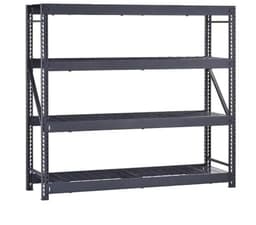
2,500 lb per shelf and 10,000 lb across the unit. That is not a garage number, it is a warehouse number, and it means this is the last shelving you buy for that wall.
Published specs
- Model
- HBR782478W4R
- Dimensions
- 77 in W x 78 in H x 24 in D
- Capacity per shelf
- 2,500 lb, evenly distributed
- Total capacity
- 10,000 lb
- Adjustment
- Shelves adjust in 3 in increments
- Warranty
- Lifetime
Figures are the manufacturer's, from the Home Depot listing for Husky HBR782478W4R, read 2026-09-01. We have not verified them by testing and do not imply that we have.
Our scoring
- Published capacity
- 10.0
- Build
- 9.5
- Tote fit
- 9.0
- Footprint efficiency
- 7.0
- Warranty
- 9.5
What works
- 2,500 lb per shelf is far beyond what a garage will ever ask of it, which is exactly why it never sags
- Welded construction rather than bolt-together, so it does not develop a wobble over years
- 24 in depth swallows a 27-gallon tote sideways with room to spare
- Lifetime warranty
What doesn't
- 77 in wide is a lot of wall. In a single-car garage this is a real commitment
- Welded means it arrives heavy and assembles in one configuration
- Only 3 in adjustment increments, so a tall item may cost you a whole shelf of headroom
Skip this one if you are storing light bulk — holiday bins, sleeping bags, empty coolers. You are paying for steel you will never load, and the same money buys twice the shelf area in a lighter unit.
Questions people actually ask
Are garage cabinets better than shelves?
Only for what needs doors: chemicals, anything lockable, and dust-sensitive supplies. Shelving carries far more per dollar and per square foot, and you can see what is in it. Most garages want mostly shelving with one cabinet.
How much more do cabinets hold than shelves?
Considerably less, not more. A representative 30 in cabinet publishes 600 lb total; a representative 77 in welded shelving unit publishes 10,000 lb. A cabinet spends structure on doors, sides and a back that shelving does not have.
What percentage of my garage should be cabinets?
Roughly the proportion of your storage that genuinely needs to be locked or dust-free — in most garages, one cabinet against a wall of shelving. A wall of cabinets looks finished in a photograph and costs several times what the same capacity in shelving costs.
Do cabinet doors need clearance?
Yes, and it is easy to forget. Doors need room to swing in front of the cabinet, which is clearance a shelving unit does not require — worth measuring if the cabinet is going opposite a parked car.
Sources
- Seville Classics UltraHD cabinet — published total and per-shelf capacityChecked September 1, 2026
- Husky HBR782478W4R — 2,500 lb per shelf, 10,000 lb total, 24 in depthChecked September 1, 2026
Manufacturer documentation, manuals, warranty terms and exact product models reviewed September 1, 2026.
Read next
- The best garage storage cabinetsCabinets ranked on published capacity and the depth question that decides whether your bins fit.
- Garage cabinets with doorsWhich garage contents genuinely need doors, and what to look for if safety is the reason.
- The best garage storage shelvesFive shelving units ranked on published per-shelf capacity and whether the depth takes a standard tote.
- The best heavy-duty garage shelvingHeavy-duty shelving on published load figures, plus when you are buying steel you will never load.
- Where the tools goTools in a bin become a search. The wall is the answer, and the hook limits decide what goes where.
- How to plan a garage cabinet wallSix measurements and an order of operations for the most expensive wall in the garage.
- Metal or wood garage cabinets?Published capacity against material tolerance, and the honest case for each in a real garage.