Shelving
How to plan garage shelving
Six measurements, in order. Take them before you look at a product page and you will eliminate most of the market in twenty minutes — including the units that would not have fit.
Disclosure: Rail & Rafter earns a commission on qualifying purchases made through links on this page, at no cost to you. Commission does not decide what we recommend — our criteria do, and here is how we are funded.
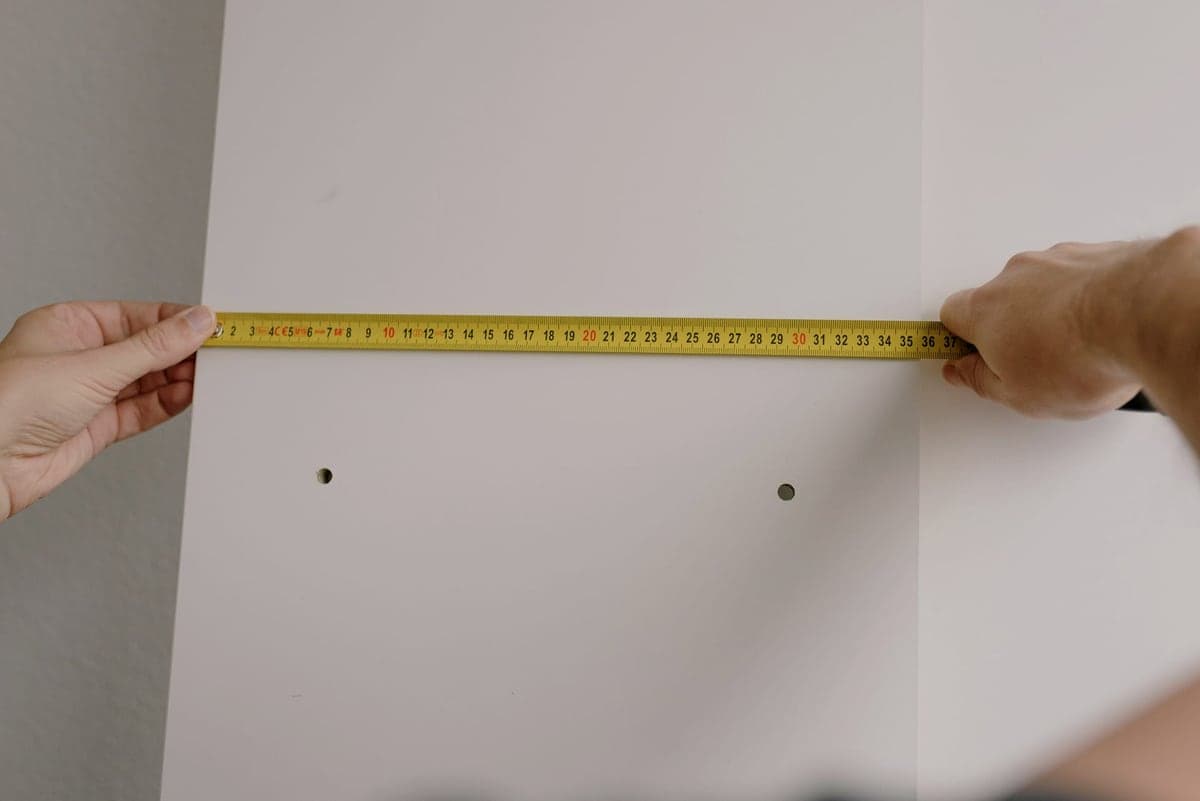
Most bad garage shelving purchases are measuring failures, not product failures. The unit is fine; it is just too deep, or too wide, or it blocks a car door, or the bins hang off the front of it. All of that is preventable with a tape measure and twenty minutes.
Take these six measurements, in this order. Each one narrows the field, and the order matters because the early ones eliminate more.
1. The run — how much wall you actually have
Not the length of the wall. The length of the wall minus everything in the way: the electrical panel, the water heater, the door swing, the window, the light switch you need to reach.
Measure the clear run between obstructions, in inches, and write it down. This single number decides whether you are looking at a 77 in unit, a 60 in unit, a 48 in unit, or two smaller units with a gap.
The common mistake
People measure the wall, buy shelving that matches, and then discover the unit cannot go where the panel is. Measure the clear run, not the wall.
2. The depth — decided by your bins, not your preference
This is the measurement that most often goes wrong, and it is decided for you rather than by you.
| Tote | Width | Fits an 18" shelf? | Fits a 24" shelf? |
|---|---|---|---|
| HDX 27 gal Tough Tote | 19.61" | No — overhangs 1.6 in | Yes |
| Sterilite 27 gal Industrial | 19.63" | No — overhangs 1.6 in | Yes |
| Sterilite 27 gal Stacker | 18.38" | Marginal | Yes |
If you store standard totes, 24 in is the answer. Choose 18 in only for a specific reason — nearly always that a car parks alongside and the walkway is worth more than the depth. That trade is worked through on garage shelving that fits totes.
3. The car door check
This is the measurement almost nobody takes and almost everybody wishes they had.
- Park the car exactly where it normally sits.
- Open the door on the shelving side fully.
- Measure from the wall to the outermost point of the open door.
That distance is your absolute maximum shelf depth on that wall, regardless of what your bins want. If it comes in under 18 inches, the answer on that wall is not shelving at all — it is a wall system, which projects a few inches rather than eighteen.
4. Tier heights — measure your tallest thing
Shelf count is a marketing number; clearance per tier is the useful one. Five shelves in the same height as four means less headroom on each, and the shop vac does not care how many shelves you bought.
List the tallest items going on the shelves and measure them. A shop vac, a leaf blower, a stack of folding chairs, a 5-gallon bucket with a lid. Then check the unit's adjustment increments — the Husky welded rack adjusts in 3 in steps, which means a 20 in item may cost you 21 in of height.
The practical layout that comes out of this nearly every time:
- Bottom shelf: tall and heavy. Buckets, fluids, the wet vac. Low center of gravity, and the bottom shelf is usually the strongest one.
- Middle two shelves: what you use. Between knee and shoulder is the zone you actually reach into without thinking.
- Top shelf: light and seasonal. Anything you need a step for should be something you rarely need and can lift one-handed.
5. The floor
Garage slabs slope toward the door for drainage. That is by design, and it means a tall shelving unit on a slab is not plumb by default.
Check whether the unit has adjustable feet. It matters twice: an out-of- plumb unit racks and wobbles, and on wire shelving the published capacity is frequently quoted for the leveling-feet configuration specifically — the Seville UltraDurable 800 lb figure is stated that way.
Also worth knowing: if the slab gets wet near the door, anything on the bottom shelf in cardboard will find out. That is an argument for bins over boxes generally, and it is covered on best garage storage bins.
6. Anchoring and what is behind the wall
Tall shelving loaded top-heavy tips. Manufacturers frequently supply anti-tip hardware and the instructions frequently say to use it, and it is one of the most commonly ignored instructions in the category.
Find your studs before you commit to a position — same tool and same five-minute job as finding studs for a wall system. Anchoring into drywall alone is not anchoring.
Putting it together
With those six numbers written down, the shortlist mostly assembles itself: the run gives you the width, the car-door check and your bins give you the depth, your tallest item gives you the tier count, and the load gives you the capacity class. The units that come out of it are on the best garage storage shelves, and if the answer is heavy, on best heavy-duty garage shelving.
If you have not yet worked out what is going on the shelves at all, that is a different and earlier problem, and it starts at the mess.
What we would buy for this
Every pick carries the manufacturer's published specs, our scoring against stated criteria, and a reason you might want to skip it.
#1 · Best heavy-duty shelving
Husky 4-Tier Welded Steel Rack, 77 x 78 x 24 in
Husky
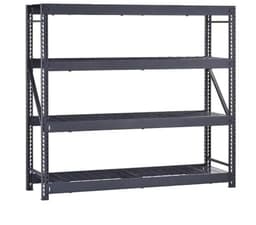
2,500 lb per shelf and 10,000 lb across the unit. That is not a garage number, it is a warehouse number, and it means this is the last shelving you buy for that wall.
Published specs
- Model
- HBR782478W4R
- Dimensions
- 77 in W x 78 in H x 24 in D
- Capacity per shelf
- 2,500 lb, evenly distributed
- Total capacity
- 10,000 lb
- Adjustment
- Shelves adjust in 3 in increments
- Warranty
- Lifetime
Figures are the manufacturer's, from the Home Depot listing for Husky HBR782478W4R, read 2026-09-01. We have not verified them by testing and do not imply that we have.
Our scoring
- Published capacity
- 10.0
- Build
- 9.5
- Tote fit
- 9.0
- Footprint efficiency
- 7.0
- Warranty
- 9.5
What works
- 2,500 lb per shelf is far beyond what a garage will ever ask of it, which is exactly why it never sags
- Welded construction rather than bolt-together, so it does not develop a wobble over years
- 24 in depth swallows a 27-gallon tote sideways with room to spare
- Lifetime warranty
What doesn't
- 77 in wide is a lot of wall. In a single-car garage this is a real commitment
- Welded means it arrives heavy and assembles in one configuration
- Only 3 in adjustment increments, so a tall item may cost you a whole shelf of headroom
Skip this one if you are storing light bulk — holiday bins, sleeping bags, empty coolers. You are paying for steel you will never load, and the same money buys twice the shelf area in a lighter unit.
#2 · Best for a narrow wall
Gladiator 48 in EZ Connect Rack, five 24 in shelves
Gladiator GarageWorks
Five shelves in 48 inches of wall. In a single-car garage where the only free wall is four feet wide, shelf count per foot is the number that actually matters.
Published specs
- Model
- GARK485XGG
- Width
- 48 in
- Shelves
- Five, 24 in deep
Figures are the manufacturer's, from the Gladiator GarageWorks catalog, read 2026-09-01. We have not verified them by testing and do not imply that we have.
Our scoring
- Published capacity
- 6.5
- Build
- 8.0
- Tote fit
- 8.5
- Footprint efficiency
- 9.5
- Warranty
- 7.5
What works
- Five shelves rather than four, so more tiers in less wall
- 48 in is the width that fits between a garage door track and a corner in a lot of single-car garages
- Connects to further units, so the wall can grow later
What doesn't
- Five shelves in the same height means less clearance per tier — measure your tallest item first
- No prominently published per-shelf capacity
Skip this one if you store tall things — a shop vac, a leaf blower, stacked folding chairs. Five tiers buys you shelves at the cost of the headroom those items need.
#3 · Best shallow-depth rack
Gladiator 60 in Heavy Duty Rack, four 18 in shelves
Gladiator GarageWorks
18 inches deep rather than 24. In a garage where the shelving runs down the side of a parked car, six inches is the whole argument.
Published specs
- Model
- GARS604TEG
- Width
- 60 in
- Shelves
- Four, 18 in deep
Figures are the manufacturer's, from the Gladiator GarageWorks catalog, read 2026-09-01. We have not verified them by testing and do not imply that we have.
Our scoring
- Published capacity
- 6.5
- Footprint efficiency
- 9.0
- Build
- 8.5
- System fit
- 9.0
- Tote fit
- 4.5
What works
- 18 in depth leaves the walkway alongside a car intact
- Matches the rest of the Gladiator system if the wall is going to grow
- 60 in width fits between common obstructions
What doesn't
- 18 in will not take a 27-gallon tote across the depth
- No prominently published per-shelf capacity
Skip this one if you are storing standard totes. Measure first: the common 27-gallon totes are about 19.6 in wide, so an 18 in shelf leaves them overhanging.
Questions people actually ask
How deep should garage shelves be?
24 inches if you store standard totes — the common 27-gallon totes are about 19.6 in wide and an 18 in shelf leaves them overhanging by an inch and a half. Go to 18 in only when a car door or a walkway makes the extra six inches impossible.
How high should the bottom shelf be off the floor?
High enough to clear anything that runs across the slab when the garage gets wet, and high enough to sweep under. Beyond that, the bottom shelf is usually the strongest, so it is where the heavy and tall items belong.
Should garage shelving be anchored to the wall?
Follow the manufacturer's instructions for the specific unit. Tall freestanding shelving loaded top-heavy is a tipping risk whatever its rated capacity, and anti-tip hardware is usually supplied and usually ignored. Anchor into studs, not into drywall alone.
Does it matter that my garage floor slopes?
Yes. Slabs slope toward the door by design, so a tall unit will not be plumb without adjustable feet. It also matters for capacity: wire shelving figures are often published for the leveling-feet configuration specifically.
How many shelves should I get?
Fewer than the maximum, usually. Shelf count is a marketing number and clearance per tier is the useful one — five shelves in the same height as four means every tier loses headroom, and the shop vac does not care how many shelves you bought.
Sources
- Husky HBR782478W4R — 3 in shelf adjustment increments, dimensionsChecked September 1, 2026
- Sterilite published tote exterior dimensionsChecked September 1, 2026
- Seville Classics UltraDurable — capacity quoted on leveling feetChecked September 1, 2026
Manufacturer documentation, manuals, warranty terms and exact product models reviewed September 1, 2026.
Read next
- The best garage storage shelvesFive shelving units ranked on published per-shelf capacity and whether the depth takes a standard tote.
- Garage shelving that actually fits your totes27-gallon totes are 19.6 in wide. Which shelf depths take them, and what to do when you cannot fit 24 inches.
- The best heavy-duty garage shelvingHeavy-duty shelving on published load figures, plus when you are buying steel you will never load.
- Your garage is full. Start here.Four passes that turn a full garage into a list of piles, each with a system that fits it.
- A small garage, on a budgetOrder matters more than budget. Four purchases in sequence, and the expensive ones to skip.
- How to plan a garage cabinet wallSix measurements and an order of operations for the most expensive wall in the garage.
- How deep should garage shelves be?24 in for totes, 18 in beside a car, 12 in for cans. The one measurement that decides shelf depth.
- The best wall-mounted garage shelvesWall shelves ranked on published capacity, depth and what they ask of the wall behind them.
- Garage corner shelving, and whether your corner is freeWhat fits in a garage corner, the three things that usually block it, and the shelving built for the shape.