Overhead
The best overhead garage storage racks
Four racks, ranked on the three numbers that decide whether one works in your garage: rated capacity, ceiling drop, and what your joists are actually spaced at.
Disclosure: Rail & Rafter earns a commission on qualifying purchases made through links on this page, at no cost to you. Commission does not decide what we recommend — our criteria do, and here is how we are funded.

Quick picks
Our ranking, verdict first. Every row links to the full write-up below, and every price cell goes straight to Amazon. Scores follow the criteria on our methodology page.
| # | Product | Best for | Score | Price |
|---|---|---|---|---|
| 1 |  SafeRacks 4 x 8 Overhead RackA 12 to 45 inch drop range is the widest published in this category, which makes it the rack that fits both a 7 ft ceiling and a cathedral one. The limited lifetime warranty is the other reason it is here. SafeRacks 4 x 8 Overhead RackA 12 to 45 inch drop range is the widest published in this category, which makes it the rack that fits both a 7 ft ceiling and a cathedral one. The limited lifetime warranty is the other reason it is here. | Best drop range and warranty | 9.1 | $199.98View on AmazonPrice as of October 17, 2026. #ad how this is funded |
| 2 |  FlexiMounts GR48F 4 x 8 Overhead RackThe widest useful drop range in its class and the only major rack that publishes what happens when your joists are further apart than 24 inches. That second fact is why it goes first. FlexiMounts GR48F 4 x 8 Overhead RackThe widest useful drop range in its class and the only major rack that publishes what happens when your joists are further apart than 24 inches. That second fact is why it goes first. | Best overall overhead rack | 8.8 | $145.98View on Amazon |
| 3 |  MonsterRax 4 x 8 Overhead Rack500 lb rather than 600, which matters less than you would think: almost nobody fills a 4x8 rack with 500 lb of anything. The 18 in minimum drop is the number to look at. MonsterRax 4 x 8 Overhead Rack500 lb rather than 600, which matters less than you would think: almost nobody fills a 4x8 rack with 500 lb of anything. The 18 in minimum drop is the number to look at. | Best when the load is light and bulky | 8.0 | $125.98View on Amazon |
| 4 |  FlexiMounts GL1 Lifting RackA lifting rack solves the one real problem with overhead storage: you stop using it. The trade is capacity — the published safe load is 350 lb, not the 600 lb a fixed rack of the same size carries. FlexiMounts GL1 Lifting RackA lifting rack solves the one real problem with overhead storage: you stop using it. The trade is capacity — the published safe load is 350 lb, not the 600 lb a fixed rack of the same size carries. | Best if you need the load to come down | 7.9 | $189.99View on Amazon |
Scores are our editorial assessment against the criteria on how we pick. They are not test results and are not marked up as review ratings.
An overhead rack buys back more floor per dollar than anything else in a garage. It is also the easiest thing in the garage to get wrong, and the way people get it wrong is nearly always the same: they buy on the capacity number printed on the box and never check the two numbers that actually govern.
Those two are ceiling drop and joist spacing. Drop decides whether you can still walk under the rack. Joist spacing decides whether the rack can be mounted the way the manufacturer intended. Get either wrong and the rated capacity is irrelevant, because the rack either does not go up or it goes up wrong.
Everything below is ranked on those three numbers together. Our criteria and what we do and do not do are set out on how we pick. Short version: we read the manufacturer's manuals and published specifications, we do the arithmetic, and we have not tested any of these racks — we say so rather than implying otherwise.
Read this first
The rack's rating and your ceiling's capacity are two different numbers, and the smaller one governs. A 600 lb rack bolted to a ceiling that was framed to carry 10 lb per square foot is a 600 lb rack on a ceiling that cannot take 600 lb. Almost nobody in this category says this out loud. Run the arithmetic on how much weight a garage ceiling holds before you order anything.
How we ranked these
Five criteria, applied the same way to every rack. Each is scored out of 10 and shown on the card, so you can disagree with a weighting rather than with a black box.
- Published capacity — the manufacturer's stated rating, and whether it is stated with the conditions attached.
- Fit range — how much of the drop range is usable, and whether the range is sold as one product or several.
- Mounting honesty — whether the brand publishes what happens at non-standard joist spacings and on non-timber ceilings. This is the criterion that separates the field.
- Low-ceiling suitability — the minimum drop, which is the number that decides whether a 4x8 rack fits an 8 ft garage at all.
- Documentation — whether the specs you need are in the manual or only in the marketing copy.
The three numbers side by side
| Rack | Rated capacity | Drop range | Mounting note |
|---|---|---|---|
| SafeRacks 4x8 | 600 lb | 12" to 45" | 27 in brackets span two joists; wood joists only |
| FlexiMounts GR48F 4x8 | 600 lb with 3/8 in ply | 22" to 40" | Joists up to 24" o.c., or exactly 48" |
| MonsterRax 4x8 | 500 lb | 18" to 45" | Two drop ranges sold separately |
| FlexiMounts GL1 lifting rack | 350 lb safe load | Varies by install | Tested to 600 lb total |
The table is worth a minute because it contains the single most useful fact in this article: SafeRacks drops to 12 inches and FlexiMounts stops at 22. If you have an 8 ft garage ceiling that is not a preference, it is the entire decision. Ten inches of headroom is the difference between walking under a rack and ducking under it for the next decade.
The two 4x8 racks that come down to a coin flip most often are compared directly on SafeRacks against MonsterRax, where the drop range rather than the capacity turns out to decide it. And if you are weighing a rack against a shelving unit rather than against another rack, FlexiMounts against Husky works through the floor cost and the tote count on both.
Buying by brand instead? Both ranges get a page of their own: our FlexiMounts review and our SafeRacks review.
The joist question nobody asks until they are on the ladder
Standard framing is 16 inches on center. Plenty of garages are not standard. Detached garages, older builds, converted structures and anything with engineered joists can run 19.2, 24, or something else entirely — and the bracket you just bought was designed to span two of them.
FlexiMounts is the only brand here that publishes an explicit answer: the GR48F fits any spacing up to 24 inches, and at wider spacings it fits 48 inches exactly. That is a real, checkable statement, and it also quietly tells you what happens at 32 or 36 inches — it does not fit, and you would be loading a single joist per bracket.
SafeRacks approaches it from the other side, with 27 inch brackets designed to span two joists, and an explicit instruction not to install into I-beams, steel joists, or concrete. That instruction is easy to skim past and it is not decoration. If your garage ceiling is an engineered floor system under a room above, you are outside what these racks are designed for.
Do this before you order
Find a joist with a stud finder, mark it, then find the next one and measure between the marks. Do it in two places. Two minutes with a tape measure decides which rack you can buy, and it is the step everybody skips.
The clearance arithmetic
Here is the calculation to run before you buy, out loud, because it is the one that decides whether you like the rack in a year:
Ceiling height − rack drop − bin height = what you can walk under.
Worked through with real numbers: an 8 ft (96 in) ceiling, a SafeRacks rack set at its 12 in minimum drop, and a 27-gallon HDX tote at 15.27 in tall. That is 96 − 12 − 15.27 = 68.7 inches of clearance, or about 5 ft 9 in. You will hit your head.
Move the same rack against the back wall where nobody walks and the number stops mattering. That is usually the answer for an 8 ft ceiling: not a shorter rack, but a rack somewhere you do not walk. The tote dimensions that feed this calculation are collected on bin sizes that fit overhead racks, and the full treatment of tight ceilings is on low ceiling garage storage.
Who should skip overhead racks entirely
Three groups, and it is worth being direct about them because a rack sold to any of them is a bad purchase:
- Anyone whose garage ceiling is not timber. Concrete, steel joist and engineered I-beam ceilings are outside what every rack here is designed for. That is not a limitation to engineer around at home.
- Anyone storing things they need weekly. Overhead storage is where seasonal things go. If it comes down more than a few times a year, it belongs on shelving or a wall system, and you will stop climbing for it by about week three.
- Anyone renting. These racks lag into joists. That is a lot of holes in somebody else's ceiling.
What actually belongs up there
The rack is only half the decision — the other half is what you are putting on it, which is where most garages go wrong in the opposite direction. Overhead is for seasonal and bulky-but-light: holiday decorations, bins and totes, camping gear, the spare car seat.
It is not for tools, and it is not for anything dense. A rack full of hardware bins hits its rating far faster than it looks like it should, and it puts that weight in the worst place — spread across joists that were probably never designed to carry it.
The picks in full
Every pick carries the manufacturer's published specs, our scoring against stated criteria, and a reason you might want to skip it.
#1 · Best drop range and warranty
SafeRacks 4 x 8 Overhead Rack
SafeRacks
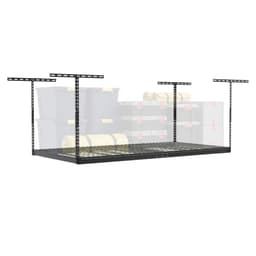
A 12 to 45 inch drop range is the widest published in this category, which makes it the rack that fits both a 7 ft ceiling and a cathedral one. The limited lifetime warranty is the other reason it is here.
Published specs
- Size
- 4 ft x 8 ft
- Rated capacity
- 600 lb total, evenly distributed
- Ceiling drop
- 12 in to 45 in, adjustable
- Brackets
- Patented 27 in brackets spanning two wood joists
- Warranty
- Limited lifetime
- Included
- 8 accessory hooks
Figures are the manufacturer's, from the SafeRacks 4x8 product page, read 2026-09-01. We have not verified them by testing and do not imply that we have.
Our scoring
- Published capacity
- 9.0
- Fit range
- 9.5
- Mounting honesty
- 9.0
- Low-ceiling suitability
- 9.5
- Documentation
- 8.5
What works
- 12 in minimum drop is the shortest published in the mainstream field — this is the low-ceiling answer
- Brackets are designed to span two joists rather than load one
- Limited lifetime warranty, which almost nobody else in the category offers
- Accessory hooks included rather than sold separately
What doesn't
- Wood joists only. The instructions explicitly rule out I-beams, steel joists and concrete ceilings
- The 12 to 24 in and 24 to 45 in drop ranges are separate purchases, so you have to measure before you order rather than after
- 600 lb assumes even distribution; a concentrated load in one corner is not the rated case
Skip this one if your garage ceiling is concrete, steel joist, or an engineered I-beam floor system. SafeRacks says in writing not to install into any of those, and that is not a warning to work around.
#2 · Best overall overhead rack
FlexiMounts GR48F 4 x 8 Overhead Rack
FlexiMounts
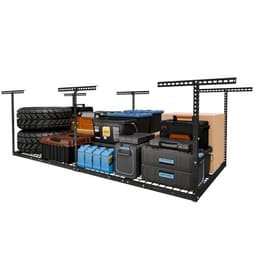
The widest useful drop range in its class and the only major rack that publishes what happens when your joists are further apart than 24 inches. That second fact is why it goes first.
Published specs
- Size
- 4 ft x 8 ft
- Rated capacity
- 600 lb, with 3/8 in plywood decking or thicker
- Ceiling drop
- 22 in to 40 in, adjustable
- Volume
- Up to 105 cu ft
- Joist spacing
- Any spacing up to 24 in; at wider spacing, fits 48 in exactly
Figures are the manufacturer's, from the FlexiMounts product page for the GR48F, read 2026-09-01. We have not verified them by testing and do not imply that we have.
Our scoring
- Published capacity
- 9.0
- Fit range
- 8.5
- Mounting honesty
- 9.5
- Low-ceiling suitability
- 7.0
- Documentation
- 9.0
What works
- 600 lb rating is at the top of the mainstream 4x8 field
- Publishes an explicit answer for joists wider than 24 in on center, which most brands leave you to discover on the ladder
- 22 in minimum drop is short enough for a lot of 8 ft ceilings
- Decking is your own plywood, so you can replace a sagging panel for the price of a sheet
What doesn't
- The 600 lb rating is conditional on you supplying 3/8 in plywood or thicker; the frame alone is not the rated system
- 22 in is still a real drop; under a 7 ft ceiling it leaves very little headroom
- Plywood is not included, so the real cost is the rack plus a sheet
Skip this one if your joists are 32 in or 36 in on center. The published fit is up to 24 in, or exactly 48 in — the in-between spacings mean mounting into a single joist per bracket, and that is how ceilings crack.
#3 · Best when the load is light and bulky
MonsterRax 4 x 8 Overhead Rack
MonsterRax
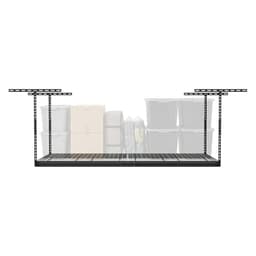
500 lb rather than 600, which matters less than you would think: almost nobody fills a 4x8 rack with 500 lb of anything. The 18 in minimum drop is the number to look at.
Published specs
- Size
- 4 ft x 8 ft
- Model
- MR-48-24H
- Rated capacity
- 500 lb
- Ceiling drop
- 18 in to 45 in, adjustable
- Drop options
- Sold in 12 to 21 in and 24 to 45 in ranges
Figures are the manufacturer's, from the MonsterRax 4x8 product page (SKU MR-48-24H), read 2026-09-01. We have not verified them by testing and do not imply that we have.
Our scoring
- Published capacity
- 7.5
- Fit range
- 9.0
- Mounting honesty
- 7.5
- Low-ceiling suitability
- 8.5
- Documentation
- 7.0
What works
- 18 in minimum drop clears more 8 ft ceilings than a 22 in minimum does
- 45 in maximum reaches down into a high or vaulted garage ceiling
- Two published drop ranges means you buy the one that fits rather than adjusting into the wrong end of a range
What doesn't
- 500 lb rating is the lowest of the three mainstream 4x8 racks here
- Fewer published mounting details than FlexiMounts or SafeRacks give you
Skip this one if you are storing dense weight — tools, tile, paint, engine parts. 500 lb sounds like a lot until you stack six full 27-gallon totes of hardware on it. Buy capacity you will not think about.
#4 · Best if you need the load to come down
FlexiMounts GL1 Lifting Rack
FlexiMounts
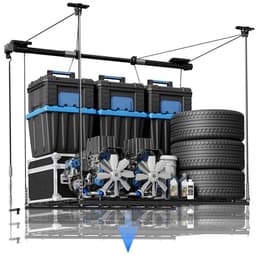
A lifting rack solves the one real problem with overhead storage: you stop using it. The trade is capacity — the published safe load is 350 lb, not the 600 lb a fixed rack of the same size carries.
Published specs
- Type
- Lifting / lowering overhead rack
- Safe load capacity
- 350 lb
- Tested to
- 600 lb total
Figures are the manufacturer's, from the FlexiMounts product page for the GR48F, read 2026-09-01. We have not verified them by testing and do not imply that we have.
Our scoring
- Published capacity
- 6.0
- Access
- 9.5
- Mounting honesty
- 8.5
- Low-ceiling suitability
- 7.5
- Documentation
- 8.0
What works
- The load comes to you instead of you going up a ladder, which is the difference between storage you use and storage you forget
- Published safe load and tested load are stated as two separate numbers, which is more transparency than most of this category offers
What doesn't
- 350 lb safe load is roughly half a comparable fixed rack
- More moving parts than a fixed rack, and every moving part is a thing that can seize or need service
- Costs substantially more per square foot of storage than a fixed rack
Skip this one if the things going up there are genuinely seasonal — holiday bins, camping gear, the spare bedding. Twice a year with a ladder is not a hardship, and a fixed rack gives you more capacity for less money.
Questions people actually ask
How much weight can an overhead garage rack actually hold?
The rack's rating is one number and your ceiling's capacity is another, and the smaller one governs. Mainstream 4x8 racks publish 500 to 600 lb. Whether your ceiling can carry that depends on the joist size, species, span and spacing — worked through with the published span tables on how much weight a garage ceiling holds.
Will an overhead rack fit an 8 foot garage ceiling?
Only if the drop is short enough. SafeRacks publishes a 12 in minimum drop, MonsterRax 18 in and FlexiMounts 22 in. On a 96 in ceiling, a 12 in drop plus a 15 in tote leaves about 69 in of clearance, which is below head height for most adults. The usual answer is to put the rack where you do not walk rather than to buy a shorter one.
What if my ceiling joists are 24 inches apart?
FlexiMounts publishes fit for any spacing up to 24 in, so 24 in is covered. SafeRacks brackets are 27 in and designed to span two joists. The spacings that cause real trouble are the in-between ones — 32 or 36 in — where a bracket lands on one joist rather than two. Measure between two marked joists in two places before ordering.
Can I install an overhead rack into a concrete or steel ceiling?
Not with these racks. SafeRacks states explicitly that installation into I-beams, steel joists, concrete ceilings or other non-traditional materials is not supported. Anything outside timber joists is a question for a structural engineer, not a question for a garage storage site.
Do I need to add plywood decking?
For the FlexiMounts GR48F, yes — its 600 lb rating is published as conditional on 3/8 in plywood or thicker. Budget for a sheet when you budget for the rack. The upside is that a sagging panel costs a sheet of ply to replace rather than a whole rack.
Is a motorized lifting rack worth it?
It depends entirely on how often the load comes down. The published safe load on the FlexiMounts GL1 is 350 lb against 600 lb for a fixed rack the same size, and it costs considerably more. For genuinely seasonal storage a ladder twice a year is not a hardship. Full comparison on fixed rack versus motorized lift.
Sources
- FlexiMounts GR48F 4x8 product page — capacity, drop range, joist spacingChecked September 1, 2026
- SafeRacks 4x8 product page — capacity, drop range, bracket span, warrantyChecked September 1, 2026
- MonsterRax 4x8 product page — capacity and adjustable height rangeChecked September 1, 2026
- IRC Table R802.5.1(1) and R802.5.1(2), ceiling joist spans, via UpCodesChecked September 1, 2026
Manufacturer documentation, manuals, warranty terms and exact product models reviewed September 1, 2026.
Read next
- How much weight can a garage ceiling hold?The complete 2x4 to 2x10 joist span tables at four spacings, and the arithmetic for your own ceiling.
- Garage storage for a low ceilingThe clearance arithmetic for a 7 or 8 ft ceiling, and the two places a rack still works.
- FlexiMounts vs SafeRacksTwo 600 lb racks compared on drop range, bracket span and warranty. The verdict names a loser.
- Which bins actually fit an overhead rackPublished tote dimensions against published rack drops, with the clearance arithmetic run for you.
- Where the bins and totes goThe easiest pile in the garage to fix. Where totes go, how many fit, and the labeling that works.
- Where the holiday decorations goThe textbook overhead case. Six bins on one rack, how to label them, and what a garage breaks.
- SafeRacks or MonsterRax: the 4x8 overhead rack, comparedPublished capacity, drop range, bracket span and warranty on the two 4x8 racks, and which number actually decides it.
- FlexiMounts or Husky: the ceiling or the floor?Ceiling rack against welded shelving on published capacity, floor cost and how many totes each actually holds.
- FlexiMounts: an honest look at what it publishesWhat FlexiMounts publishes across racks, lifts and wall shelves — including the conditions on its capacity ratings.
- SafeRacks: what the 12 inch drop is really worthThe 12 in minimum drop, the two-joist bracket span, the lifetime warranty — and the ceilings SafeRacks rules out in writing.
- Garage rafter storage, and what your roof can actually takeRafters or trusses? The code test that decides whether your roof space is storage at all, and what to do when it is not.
- The best ceiling bike hoistsBike hoists on published capacity, pulley ratio and ceiling height — and when a wall rack beats all of them.