Walls
Slatwall or a French cleat wall?
One arrives with a published pounds-per-square-foot rating. The other is plywood you cut yourself, and its capacity is whatever your fasteners and your studs allow.
Disclosure: Rail & Rafter earns a commission on qualifying purchases made through links on this page, at no cost to you. Commission does not decide what we recommend — our criteria do, and here is how we are funded.

The honest framing of this comparison is not "which is stronger". It is: manufactured slatwall publishes a load rating and a French cleat wall does not, because a French cleat wall is a thing you build. Proslat states 75 lb per square foot for its classic PVC slatwall. Gladiator states 50 lb per square foot for GearWall. Nobody publishes a figure for a cleat you cut on a table saw, and nobody can.
That does not make the cleat wall worse. It makes it a different kind of purchase, with the engineering moved from the manufacturer to you. Which one you should build depends on what you are hanging and how much you enjoy the building. The rest of the category is compared in the garage wall systems hub, and our criteria are on how we pick.
What each one actually is
Slatwall
Horizontal slatted panels that screw to the studs and cover the wall. The slots take proprietary hooks, baskets and shelves, and the whole surface becomes hangable. Proslat's classic line is PVC; Gladiator GearWall is a full-height slatted panel system. Both mount into wood studs, and Gladiator's instructions cover fixing through drywall into the stud behind.
French cleat
A strip of plywood or solid stock ripped at 45 degrees and screwed to the wall, bevel up. Anything you want to hang gets a matching bevel-down cleat on its back and drops into place. It is a woodworking technique rather than a product, which is exactly the source of both its advantages and its problems.
The published numbers, and the missing one
| System | Published rating | Mounting | Who publishes it |
|---|---|---|---|
| Proslat classic PVC slatwall | 75 lb per square foot | 16" studs | Proslat |
| Proslat heavy-duty line | Patented aluminum core rated to 200 lb | 16" studs | Proslat |
| Gladiator GearWall | 50 lb per square foot | Wood studs, through drywall | Gladiator |
| Wall Control metal pegboard | 200 lb per panel into studs; 100 lb into drywall anchors | Studs preferred | Wall Control |
| French cleat | None — shop-built, no manufacturer | Into studs | Nobody |
That last row is the whole argument. A French cleat's capacity is set by the plywood you chose, the screws you used, whether you hit the stud, and the bevel angle you actually cut. Those are all real engineering variables and they are all yours. Anyone who quotes you a single pounds-per-foot number for a French cleat has made it up.
Both systems bottom out at the same place
Whatever the panel is rated for, the load ultimately goes into the studs and the fasteners. A 75 lb per square foot panel screwed into drywall with no stud behind it is not a 75 lb per square foot wall. Work out what your wall can carry first, in how much weight a garage wall can hold, then pick the surface that goes on it.
Where the French cleat genuinely wins
- Odd-shaped things. A cleat holder can be any shape you like, because you make it. Cordless drill cradles, chisel racks, a holder shaped exactly around the router — none of that exists as a slatwall accessory, and building it is a genuinely satisfying afternoon.
- Cost per square foot of wall. Plywood and screws are cheaper than any panel system. If the wall is large and the budget is small, the cleat wall is the only one of these that scales down.
- Rearranging. Both systems rearrange easily, but the cleat wall rearranges in whole assemblies — you lift off a loaded tool holder and hang it two feet left, still loaded.
- You already have the tools. If a table saw and a sheet of ply are already in the garage, the marginal cost is close to nothing.
Where slatwall wins
- It publishes a number. 75 lb per square foot from Proslat, 50 from Gladiator. You can plan a wall against a published figure rather than a guess, and for anything heavy that is worth real money.
- It arrives finished. No table saw, no bevel, no sheet goods in the car. For most people the cleat wall is a project that stays a project.
- Accessory ecosystem. Baskets, shelves, bike hooks and racks all exist, all fit, and all can be bought on a Tuesday. Every cleat accessory has to be built.
- Damp tolerance. Proslat's PVC does not care about a damp unheated garage. Plywood does — a shop-built cleat wall in a wet garage wants sealing, and that is another job on the list.
The honest problems with each
French cleat, honestly
You have to cut accurate 45 degree bevels, repeatedly, and an inaccurate bevel is a holder that rocks or drops. The wall eats depth — the cleat plus the holder plus the tool puts things further off the wall than a slatwall hook does. And in a damp garage, untreated plywood is a consumable.
The biggest one: it is never finished. Every new tool needs a new holder. That is the appeal for some people and a permanent chore for everybody else.
Slatwall, honestly
Cost per square foot is the real objection — covering a full garage wall in panels is a significant spend, and the accessories are priced as a system on top. Installation into 16 in studs means finding and marking every stud across the run. And you are locked into one manufacturer's accessory profile: Proslat hooks and Gladiator hooks are not interchangeable.
If neither of those sits well, metal pegboard is the cheap middle. Wall Control publishes 200 lb per panel into studs, 100 lb into drywall anchors, and 10 to 15 lb per two-slot hook — low per-hook figures, but published ones. The three-way comparison is in pegboard against slatwall against track.
What building a cleat wall actually involves
Worth setting out plainly, because "just rip some plywood" hides a few decisions that matter.
- Rip the cleats at 45 degrees. A table saw with the blade tilted, or a track saw. The angle has to be consistent across every cleat or the holders sit at different distances from the wall.
- Find every stud across the run and mark them on the floor before the first cleat goes up. Once the cleat is on the wall the marks are behind it.
- Level the first cleat and work from it. Everything after references the first one, so an out-of-level first cleat is an out-of-level wall.
- Fasten into studs, not into drywall. This is where the capacity comes from, and it is the same requirement the panel systems have.
- Seal the plywood if the garage is unheated. Untreated sheet goods in a damp garage are a consumable.
Spacing is a judgment call rather than a rule: closer rows mean more places to hang things and more plywood, wider rows mean the opposite. Most people end up somewhere between 8 and 12 inches on center and adjust once they have lived with it, which is the honest advantage of a system you build.
The projection problem nobody mentions
A cleat wall pushes everything further into the room than a panel wall does, and in a single-car garage that is a real cost.
The stack is: wall, then the mounted cleat, then the holder's cleat, then the holder itself, then the tool. A slatwall hook goes into a slot that is cut into the panel, so the panel contributes almost nothing to depth. If the wall you are treating is the one you squeeze past to get to the car door, measure the projection before you commit — the same measurement discipline that decides shelf depth in how deep garage shelves should be.
Which to build
Build the French cleat wall if you own a table saw, you enjoy the making, and what is going on the wall is hand tools and shop fixtures in odd shapes. It is the cheapest large wall and the most personal one.
Buy Proslat if the garage is damp or unheated, or if you want a published capacity to plan against. PVC with a lifetime warranty and 75 lb per square foot is the strongest combination of published number and material tolerance in this comparison.
Buy Gladiator GearWall if the wall is going to become a matched system with Gladiator cabinets and workbench. 50 lb per square foot is the lower published figure of the two panel systems, so weigh that against the system fit — the fuller argument is on the wall storage systems roundup.
Do neither if what is going on the wall is bikes, ladders and a wheelbarrow. Heavy awkward items want track fixed directly into studs, not a panel surface — and the layout question comes first, in how to organize a garage wall.
What we would buy for this
Every pick carries the manufacturer's published specs, our scoring against stated criteria, and a reason you might want to skip it.
#1 · Best in a damp or unheated garage
Proslat PVC Slatwall
Proslat
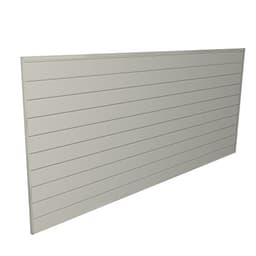
PVC rather than MDF or steel, rated to 75 lb per square foot and backed by a lifetime warranty. In a garage that gets damp, the material is the whole argument.
Published specs
- Rated capacity
- 75 lb per square foot
- Heavy-duty line
- Patented aluminum core rated to 200 lb
- Mounting
- 16 in studs
- Material
- PVC
- Warranty
- Lifetime
Figures are the manufacturer's, from the Proslat PVC slatwall collection page, read 2026-09-01. We have not verified them by testing and do not imply that we have.
Our scoring
- Published capacity
- 9.0
- Coverage per dollar
- 7.0
- Damp tolerance
- 9.5
- Install simplicity
- 7.5
- Documentation
- 8.5
What works
- PVC does not swell, rot or rust, which is the failure mode of MDF slatwall in an unheated garage
- 75 lb per sq ft is higher than Gladiator's panel rating
- Lifetime warranty
- The heavy-duty aluminum-core line is there when 75 lb per sq ft is not enough
What doesn't
- Published for 16 in stud spacing — a 24 in stud wall needs checking before you order
- Full-wall coverage is expensive, same as any panel system
- PVC has a plastic look that some people dislike next to steel cabinets
Skip this one if your studs are 24 in on center. The published mounting is 16 in, and stretching a panel system across wider studs is exactly the shortcut that ends with a panel pulling off the wall.
#2 · Best full-wall panel system
Gladiator GearWall Panels
Gladiator GarageWorks
50 lb per square foot across a whole panel, which is a different kind of number from GearTrack's per-foot rating: it buys you the freedom to hang anything anywhere rather than only on a line.
Published specs
- Rated capacity
- 50 lb per square foot
- Mounting
- Into wood studs, including through drywall
- Format
- Full-height slatted panels
Figures are the manufacturer's, from Gladiator installation instructions W11087876 Rev A, read 2026-09-01. We have not verified them by testing and do not imply that we have.
Our scoring
- Published capacity
- 8.5
- Coverage per dollar
- 6.5
- Accessory range
- 9.0
- Install simplicity
- 7.0
- Documentation
- 9.5
What works
- Hang anything at any height rather than only where a track run happens to be
- 50 lb per sq ft across a full panel is a large total load
- Shares the Gladiator accessory range with GearTrack
What doesn't
- Covering a whole wall in panels costs several times what two track runs cost
- It is a wall finish as much as a storage system, so it is a bigger commitment to undo
- Per-square-foot ratings are harder to reason about than per-foot ones — a single 60 lb item is not the rated case
Skip this one if you know exactly what is going on that wall and it is six things. Two runs of track will hold them for a fraction of the cost, and the wall stays a wall.
#3 · Best for hand tools
Wall Control Metal Pegboard
Wall Control
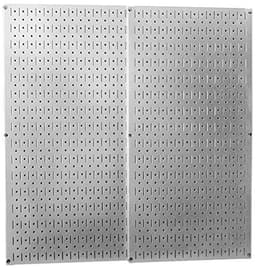
20-gauge steel pegboard with published per-panel and per-hook limits, which is more honesty about capacity than the entire hardboard-pegboard category offers combined.
Published specs
- Material
- 20-gauge galvanized steel
- Into studs
- Up to 200 lb per panel
- Into drywall anchors
- Up to 100 lb per panel
- Per hook, two slots
- 10 to 15 lb
- Per hook, one slot
- 5 to 10 lb
- Per shelf assembly
- 10 to 20 lb, evenly distributed
Figures are the manufacturer's, from Wall Control's published capacity guidance, read 2026-09-01. We have not verified them by testing and do not imply that we have.
Our scoring
- Published capacity
- 6.5
- Coverage per dollar
- 9.5
- Accessory range
- 9.0
- Install simplicity
- 8.0
- Documentation
- 10.0
What works
- Steel rather than hardboard, so the holes do not blow out and the board does not bow
- Publishes limits per panel, per hook AND per shelf — nobody else in pegboard does this
- Takes both round-hole and slotted accessories, so most existing pegboard hooks still work
- Cheapest way to get a lot of small tools off a bench and onto a wall
What doesn't
- Per-hook limits are genuinely low; this is a hand-tool wall, not a ladder-and-bike wall
- 100 lb per panel into drywall anchors is much less than 200 lb into studs, and most people install into drywall
- Panels are small, so a full wall is a lot of panels and a lot of alignment
Skip this one if what you need on the wall is bikes, ladders, or a wheelbarrow. A 10 to 15 lb hook limit is not a suggestion, and the right answer for those is track or heavy-duty hooks into studs.
Questions people actually ask
Is a French cleat stronger than slatwall?
There is no published figure for a French cleat, because it is shop-built: its capacity depends on your plywood, your screws and whether you hit the stud. Slatwall publishes ratings — 75 lb per square foot for Proslat's classic PVC, 50 lb per square foot for Gladiator GearWall. A well-built cleat into studs can carry a great deal; it just cannot be specified in advance.
What angle is a French cleat cut at?
45 degrees is the standard bevel, with the wall-side cleat mounted bevel up and the matching cleat on the item bevel down. The accuracy of that cut is what makes the difference between a holder that sits flat and one that rocks.
Is slatwall worth it in a garage?
If you want a published load rating and an accessory range you can buy rather than build, yes. The objection is cost per square foot of wall covered, plus being tied to one manufacturer's hook profile. In a damp garage, PVC slatwall has a real material advantage over shop-built plywood.
Can I mix a French cleat wall and slatwall?
Yes, and it is often the sensible answer: panels across the main run where you want bought accessories, and a cleat section where the odd-shaped shop fixtures live. Both fasten into the same studs, so the wall behind does not care which one is where.
Sources
- Proslat PVC slatwall collection — 75 lb per square foot, heavy-duty aluminum-core line rated to 200 lb, 16 in stud mounting, lifetime warrantyChecked September 6, 2026
- Gladiator installation instructions W11087876 Rev A — GearWall 50 lb per square foot, GearTrack 75 lb per linear foot, stud mountingChecked September 6, 2026
- Wall Control published capacity guidance — 200 lb per panel into studs, 100 lb into drywall anchors, per-hook figuresChecked September 6, 2026
Manufacturer documentation, manuals, warranty terms and exact product models reviewed September 6, 2026.
Read next
- The best garage wall storage systemsTrack, slatwall, panels and metal pegboard on published load ratings, converted into one comparable question.
- Pegboard vs slatwall vs trackThree formats for three jobs. Which one you need is decided by what you are hanging, not by budget.
- How much weight can a garage wall hold?The fixing decides it, not the wall. Published stud-versus-drywall figures and how to find your studs.
- How to organize a garage wallThree height bands, four walls, and the order to install in so you do not do it twice.
- The best garage slatwall panelsFive slatwall systems on published ratings from 50 to 300 lb per sq ft, and the mounting condition behind each number.
- Where the tools goTools in a bin become a search. The wall is the answer, and the hook limits decide what goes where.