Shelving
Wall-mounted or freestanding garage shelves?
Wall-mounted if the thing you are short of is floor and your walls have timber studs — the FlexiMounts WR24 pair publishes 600 lb and takes no floor at all. Freestanding if you need more than that, cannot find a stud, or will move house.
Disclosure: Rail & Rafter earns a commission on qualifying purchases made through links on this page, at no cost to you. Commission does not decide what we recommend — our criteria do, and here is how we are funded.
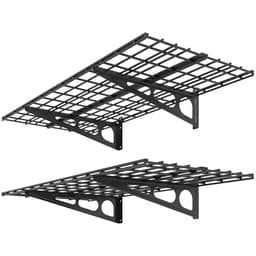
Go wall-mounted if the thing your garage is short of is floor and the walls have timber studs behind the drywall: the FlexiMounts WR24 pair publishes 600 lb across two 2 x 4 ft shelves and takes no floor area at all. Go freestanding if you need more than about 600 lb on that wall, if you cannot find a stud, or if you expect to move — the Husky welded rack publishes 2,500 lb per shelf, which no wall shelf in this category comes close to.
Most comparisons of these two argue about strength. That is the wrong axis. The real difference is where the weight ends up: a wall shelf transfers everything into four or six fasteners in your studs, and a freestanding rack transfers everything into the slab it is standing on. The slab does not care. The studs very much do.
We have not tested these. This is published specifications read against each other — the method is on how we pick, and the rest of the category is in the shelving hub.
How we judged it
- Published capacity, and how it is published. Per shelf, per pair and per unit are three different numbers and makers mix them.
- Where the load goes. Studs and fasteners, or the floor.
- Floor area consumed. The only currency a full garage has left.
- What the wall has to be made of. This rules out more garages than people expect.
- Whether you can change your mind. Adjustability, and whether it comes with you.
- Honest cons on both sides.
What each side actually publishes
| Unit | Mounting | Published capacity | Floor used | Depth |
|---|---|---|---|---|
| FlexiMounts WR24 (2-pack) | Wall studs or solid concrete | 600 lb total for the pair | None | 24 in |
| FlexiMounts WRC24B corner (2-pack) | 16 in wood studs/joists or concrete | 660 lb total; 330 lb per shelf | None | 24.4 in |
| Husky 4-Tier Welded | Floor | 2,500 lb per shelf, 10,000 lb total | 77 x 24 in | 24 in |
| SafeRacks 24 x 92 x 84 | Floor | 2,000 lb total; no per-shelf figure published | 92 x 24 in | 24 in |
| Sterilite 5 Shelf Unit | Floor | 150 lb per shelf, 750 lb total | 36 x 18 in | 18 in |
The gap is not subtle. The strongest wall shelf here publishes 600 lb for a pair; the strongest freestanding rack publishes 2,500 lb for one shelf. If what you are storing is engine parts, paint by the case, tile or books, that settles it before any of the other arguments start.
Notice the other thing in that table, though: the corner unit is the only wall-mounted product in the FlexiMounts range that publishes a per-shelf figure rather than a pair total. That is more disclosure, not more strength, and it is worth preferring when two products are otherwise close.
Where the weight actually ends up
A freestanding rack is a load path with no interesting parts. Whatever you put on it goes down four legs into a concrete slab that is already carrying a car. Nothing about your house limits it, and the only number that matters is the rack's own rating.
A wall shelf is a different structure. Everything on it is cantilevered off fasteners in timber, and the further out the load sits from the wall, the harder it pulls on them. FlexiMounts' own specification for the corner unit makes the point in reverse: its published capacity is 330 lb per shelf — but storeWALL, on the panel side of the same problem, publishes 300 lb per square foot at the panel face and 165 lb at four inches out from the wall. Distance from the wall halves it.
Which means the real constraint on a wall shelf is not the shelf. It is the wall, and that is a separate calculation we do in how much weight a garage wall can hold.
The check that decides this, before you buy either
Find out what your garage walls are made of. Timber studs at 16 or 24 in centers: both options are open. Metal studs, hollow block, or drywall over nothing solid: the wall shelves are out, and FlexiMounts says so in writing for the corner unit. Freestanding is then the only answer, and it is a perfectly good one.
Floor area is the currency
In a single-car garage where you still park the car, floor is the thing you have none of. This is the entire argument for the wall, and it is a strong one.
The arithmetic is worth doing properly. A Husky welded rack takes 77 by 24 inches — about 12.8 square feet — out of the room. A SafeRacks 92 in rack takes about 15.3 square feet. The FlexiMounts WR24 pair takes none. In a 20 x 10 single bay with a car in it, 13 square feet is a meaningful fraction of what is left to walk in.
But read the depth column again, because that is where the floor argument gets qualified. A 24 in wall shelf still projects 24 inches into the room — it just does it at head height instead of at floor height. If the shelving runs down the side you open the car door on, the shelf being on the wall does not help you as much as the floor figure suggests. The depth guide is the one to read before committing to 24 inches anywhere.
Both have to pass the tote test
The dimension that quietly decides more of these purchases than capacity is 19.6 inches — the width of a standard 27-gallon tote.
An 18 in shelf leaves one overhanging. A 24 in shelf takes one across the depth with room to spare. On that test the FlexiMounts WR24 at 24 in and the corner unit at 24.4 in both pass, the Husky and SafeRacks racks at 24 in both pass, and the Sterilite resin unit at 18 in does not — which is a reason to buy it for boxes rather than bins. The sizes are in storage bin sizes and the shelving implications in garage shelving that fits your totes.
Whether you can change your mind later
Wall shelves: one height, permanently
A wall shelf is at the height you drilled it at. Moving it means new holes, and in a garage with drywall that means patching. FlexiMounts does not publish an adjustment range for the WR24 because there is not one — it is fixed once installed.
It also does not come with you. Four to eight holes in the studs of a house you are selling is a small thing, but the shelf itself is now a fixture-shaped decision rather than a piece of furniture.
Freestanding: adjustable, and it moves
Boltless steel adjusts in increments and knocks down flat. The Husky welded rack does neither — it is one rigid 77 in object with shelves that adjust in 3 in steps — which is why it is the pick for a garage you are staying in and the wrong pick for a rented storage unit or a basement with a stair.
The honest answer for most garages is both
Not as a compromise — because they solve different halves of the problem.
The pattern that works is heavy and bulky on the floor, light and seldom-used on the wall above it. A freestanding rack takes the engine parts, the paint and the tote run at waist height where you can lift them. Wall shelves go above the bench, above the garage door, and in the corner — the three places a floor-standing rack physically cannot go.
That split also respects the capacity gap. You are putting the 600 lb-class products where the loads are naturally light, and the 2,500 lb-class products where they are not. The corner is the clearest case of all, and it has its own page in garage corner shelving.
Height decides which one you want where
Once you accept that most garages want both, the question becomes which goes at what height — and that has a clean answer, because the two formats are good at opposite ends of the wall.
| Height band | What goes there | Better format | Why |
|---|---|---|---|
| Floor to 24 in | Heavy, dense, awkward — parts, paint, tile, jacks | Freestanding | No wall shelf should carry this, and you lift it from a squat anyway |
| 24 to 60 in | Everything you reach for weekly | Freestanding | This is the band a rack gives you for free; wall shelves here collide with the bench |
| 60 to 84 in | Totes, seasonal bins, light bulk | Either | The contested band — this is where the comparison actually matters |
| Above 84 in | Twice-a-year items only | Wall-mounted, or overhead | Nothing freestanding reaches usefully up here, and the load is light by definition |
Read the bottom row, because it points at the thing neither side of this comparison mentions. Above about seven feet, the honest competitor to a wall shelf is not a freestanding rack — it is the ceiling. An overhead rack publishes 600 lb for a 4 x 8, takes no floor and no wall, and lives in the one part of a garage that is otherwise completely unused. If the thing going up there is holiday bins, the comparison on this page is the wrong one and the overhead racks are the right answer.
The check that overrides both
Before any of this: open the car door fully and measure from the wall to the edge of it. Whatever that number is, it is the maximum depth you can put on that wall at door height, wall-mounted or freestanding.
A 24 in shelf is 24 inches into the room whether a leg holds it up or a stud does. This is the measurement that sends people to the 18 in options, and it is why the shallow-depth racks exist at all — the full set of six measurements is in how to plan garage shelving.
What we could not verify
- A per-shelf figure for the FlexiMounts WR24. FlexiMounts publishes 600 lb as a total for the 2-pack. Plan against the pair.
- A per-shelf figure for the SafeRacks 92 in rack. SafeRacks publishes a 2,000 lb total only.
- Fastener specifications. Neither wall product publishes the screw size, embedment depth or pull-out figure its rating assumes, which is the number that would actually let you check a wall.
- Capacity at a stated distance from the wall for either FlexiMounts shelf. The 165 lb-at-four-inches figure quoted above is storeWALL's, for a slatwall panel, and is cited to show the shape of the effect rather than to describe these shelves.
Who should buy which
Buy the FlexiMounts WR24 pair if floor is what you are short of, your walls have timber studs or solid concrete, and the load is under 600 lb across the two shelves. Takes nothing off the floor and 24 in takes a tote.
Buy the FlexiMounts WRC24B corner pair if the free wall is already used and the corner is not. 330 lb per shelf, published per shelf, in the one place nothing else fits.
Buy the Husky welded rack if the load is genuinely heavy and you are staying put. 2,500 lb a shelf and a lifetime warranty, at the cost of 12.8 square feet of floor and no way to move it.
Buy the SafeRacks 24 x 92 x 84 if you want steel capacity on a long wall with adjustable tiers and the option to take it apart. 2,000 lb across four tiers.
Buy the Sterilite 5 Shelf Unit if the garage is damp, the loads are domestic and you want it up without tools. 150 lb a shelf and it cannot rust — but 18 in will not take a tote across the depth.
What we would buy for this
Every pick carries the manufacturer's published specs, our scoring against stated criteria, and a reason you might want to skip it.
#1 · Best wall-mounted shelf
FlexiMounts WR24 2 x 4 ft Wall Shelf (2-pack)
FlexiMounts
600 lb across the pair, published, on a shelf that takes no floor at all. If the floor is the thing you are short of, this is the shelving that does not cost you any of it.
Published specs
- Model
- WR24
- Shelf size
- 2 ft x 4 ft each
- Published capacity
- 600 lb total for the 2-pack
- Material
- Heavy gauge steel
- Mounting
- Wall studs or solid concrete
Figures are the manufacturer's, from the FlexiMounts WR24 product page on fleximounts.com, read 2026-09-13. We have not verified them by testing and do not imply that we have.
Our scoring
- Published capacity
- 8.5
- Floor saved
- 10.0
- Tote fit
- 8.5
- Install simplicity
- 7.0
- Adjustability
- 5.0
What works
- Takes zero floor area, which is the whole point of a wall shelf
- 600 lb published across the pair is a real, checkable number in a category where most sellers publish nothing
- 24 in depth takes a 27-gallon tote across the shelf
- Mounts to studs or solid concrete, so a block-wall garage is not ruled out
What doesn't
- FlexiMounts publishes the capacity as a total for the 2-pack rather than per shelf, so plan against the pair
- Everything it holds is transferred into the wall, so the wall and the fasteners are the real limit
- One fixed height per shelf once installed — no adjustment without re-drilling
Skip this one if your garage walls are metal-framed or hollow block with nothing solid to hit. A wall shelf is only ever as good as what is behind the drywall, and this one needs timber studs or solid concrete.
#2 · Best heavy-duty shelving
Husky 4-Tier Welded Steel Rack, 77 x 78 x 24 in
Husky
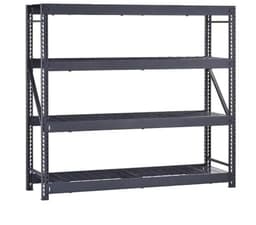
2,500 lb per shelf and 10,000 lb across the unit. That is not a garage number, it is a warehouse number, and it means this is the last shelving you buy for that wall.
Published specs
- Model
- HBR782478W4R
- Dimensions
- 77 in W x 78 in H x 24 in D
- Capacity per shelf
- 2,500 lb, evenly distributed
- Total capacity
- 10,000 lb
- Adjustment
- Shelves adjust in 3 in increments
- Warranty
- Lifetime
Figures are the manufacturer's, from the Home Depot listing for Husky HBR782478W4R, read 2026-09-01. We have not verified them by testing and do not imply that we have.
Our scoring
- Published capacity
- 10.0
- Build
- 9.5
- Tote fit
- 9.0
- Footprint efficiency
- 7.0
- Warranty
- 9.5
What works
- 2,500 lb per shelf is far beyond what a garage will ever ask of it, which is exactly why it never sags
- Welded construction rather than bolt-together, so it does not develop a wobble over years
- 24 in depth swallows a 27-gallon tote sideways with room to spare
- Lifetime warranty
What doesn't
- 77 in wide is a lot of wall. In a single-car garage this is a real commitment
- Welded means it arrives heavy and assembles in one configuration
- Only 3 in adjustment increments, so a tall item may cost you a whole shelf of headroom
Skip this one if you are storing light bulk — holiday bins, sleeping bags, empty coolers. You are paying for steel you will never load, and the same money buys twice the shelf area in a lighter unit.
#3 · Best boltless steel rack
SafeRacks Heavy-Duty Garage Shelving, 24 x 92 x 84 in
SafeRacks
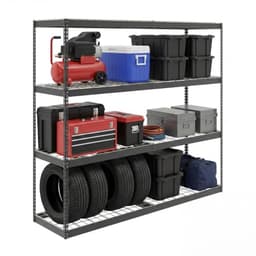
2,000 lb across four adjustable tiers, with an assembly SafeRacks describes as fast and easy and a limited lifetime warranty behind it. It knocks down flat, which is why it goes anywhere a welded rack cannot.
Published specs
- Dimensions
- 24 in D x 92 in W x 84 in H
- Total capacity
- 2,000 lb
- Tiers
- Four, heights adjustable
- Construction
- Heavy-duty steel
- Warranty
- Limited lifetime
Figures are the manufacturer's, from the SafeRacks product page for the 24 x 92 x 84 in Heavy-Duty Garage Shelving, read 2026-10-18. We have not verified them by testing and do not imply that we have.
Our scoring
- Published capacity
- 7.5
- Knock-down portability
- 9.5
- Adjustability
- 8.5
- Tote fit
- 9.0
- Published data
- 6.0
What works
- Knocks down to flat parts, so it goes down a basement stair and into a storage unit a welded rack will not
- Shelf heights adjust, which fixed-tier plastic shelving cannot do
- Limited lifetime warranty, published, which is rare below the commercial tier
- 24 in deep takes a 27-gallon tote across the shelf
- 92 in of run in one unit, so a long wall is covered in a single purchase
What doesn't
- SafeRacks publishes a 2,000 lb total but no per-shelf figure on its own product page, so you are planning against a whole-unit number
- 92 in wide is more than seven and a half feet of wall and will not fit a short run
- Bare steel in a damp basement or an unheated unit will eventually surface-rust at the cut edges
- Boltless means it can be racked out of square if the floor is uneven, and storage-unit floors often are
Skip this one if the wall is shorter than eight feet. There are 48 in and 72 in versions of the same rack, and buying 92 inches for a 60 inch wall is a problem you cannot assemble your way out of.
#4 · Best corner shelf
FlexiMounts WRC24B Corner Wall Shelving (2-pack)
FlexiMounts
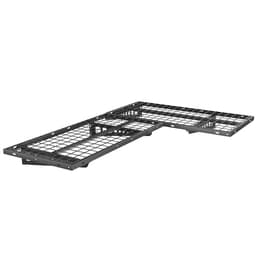
330 lb per shelf, published per shelf rather than as a pair, built to turn the one piece of wall nobody uses into storage. The corner is free real estate and this is the only product here designed for it.
Published specs
- Model
- WRC24B
- Dimensions
- 47.8 in L x 24.4 in W x 6.9 in H
- Published capacity
- 660 lb total; 330 lb per shelf
- Material
- Heavy-duty steel, integrated grid
- Mounting
- 16 in wood studs/joists or concrete
Figures are the manufacturer's, from the FlexiMounts WRC24B product page on fleximounts.com, read 2026-09-13. We have not verified them by testing and do not imply that we have.
Our scoring
- Published capacity
- 9.0
- Floor saved
- 10.0
- Space efficiency
- 9.5
- Reach
- 5.5
- Install simplicity
- 6.5
What works
- 330 lb PER SHELF is published, which is more disclosure than the flat-wall version gives you
- Uses the corner, which is dead space in almost every garage
- 24.4 in depth takes a standard tote
- Integrated grid rather than multi-piece assembly, so there is less to get out of square
What doesn't
- Specified for 16 in stud spacing; a wall on other centers is more work
- A corner shelf is awkward to reach into at the back — the deepest point is the hardest to see
- Cannot be mounted to metal walls, which FlexiMounts states explicitly
Skip this one if the corner you had in mind is where the garage door track or the water heater lives. Measure the actual clear corner before ordering — this is the product most often bought for a corner that turns out to be occupied.
#5 · Best plastic shelving overall
Sterilite 5 Shelf Unit, 75 x 36 x 18 in
Sterilite
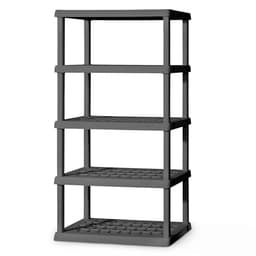
150 lb per shelf and 750 lb across the unit, in plastic that cannot rust and assembles without tools. The only plastic shelving here with a per-shelf rating that competes with entry-level steel.
Published specs
- Dimensions
- 75 1/4 in H x 36 in W x 18 in D
- Capacity per shelf
- 150 lb
- Total capacity
- 750 lb across five shelves
- Shelf clearance
- 15.77 in between shelves
- Assembly
- Tool-free
Figures are the manufacturer's, from Sterilite's own product pages for the 5 Shelf Unit (0155) and 4 Shelf Cabinet (0142), read 2026-09-21. We have not verified them by testing and do not imply that we have.
Our scoring
- Published capacity
- 7.0
- Damp tolerance
- 9.5
- Assembly
- 9.5
- Tote fit
- 8.5
- Adjustability
- 4.0
What works
- 150 lb per shelf is far above the rest of the plastic category
- Will not rust, dent or peel, which is the whole argument for plastic in a damp garage
- Tool-free assembly and light enough to move alone
- 18 in depth takes a 27-gallon tote across the shelf
What doesn't
- Shelves are fixed, so tall items have to fit the 15.77 in gap or go on top
- 750 lb total is a fraction of what a welded steel rack of the same footprint publishes
- Plastic flexes visibly under a heavy, concentrated load even within the rating
- Ventilated shelves let small parts and dust fall through to the shelf below
Skip this one if you are storing engine parts, paint by the case or anything else that concentrates weight. Steel publishes several times this per shelf for similar money.
Questions people actually ask
Are wall-mounted garage shelves stronger than freestanding ones?
No — not in published terms, and not by a small margin. The strongest mainstream wall shelf here publishes 600 lb for a pair of 2 x 4 ft shelves, while a welded freestanding rack publishes 2,500 lb per shelf. Wall shelves win on floor area, not on capacity.
How do wall-mounted and freestanding garage shelving compare on cost?
Both categories span a wide range and prices move, so the live figures on each pick above are the ones to compare rather than any number we could type here. The durable difference is what you pay for: with a wall shelf you are buying floor area back, and with a freestanding rack you are buying capacity.
Can you put wall-mounted shelves on a garage without studs?
Not safely. FlexiMounts specifies wood studs or solid concrete for the WR24 and states explicitly that the corner unit cannot be mounted to metal walls. If your garage is metal-framed, hollow block, or drywall with nothing solid behind it, freestanding is the answer.
Do garage wall shelves damage the wall?
They put four to eight fasteners into studs, which is a patchable hole rather than damage — but they are a fixed installation. The shelf stays at the height you drilled it, it does not come with you when you move, and the load is carried by the wall rather than the floor.
Which is better for a small single-car garage?
Wall-mounted, if the walls allow it. A 77 in freestanding rack takes about 12.8 square feet of a bay you are also parking in, and in a single-car garage that is usually the difference between walking past the car and turning sideways. Check the shelf depth against the car door arc before you drill.
Sources
- FlexiMounts WR24 2 x 4 ft wall shelf (2-pack) — 600 lb total published for the pair, heavy gauge steel, mounts to wall studs or solid concreteChecked September 13, 2026
- FlexiMounts WRC24B corner wall shelving (2-pack) — 660 lb total, 330 lb per shelf, 47.8 x 24.4 x 6.9 in, 16 in wood studs/joists or concrete, cannot be mounted to metal wallsChecked September 13, 2026
- Home Depot listing for Husky HBR782478W4R — 2,500 lb per shelf evenly distributed, 10,000 lb total, 77 x 78 x 24 in, welded, 3 in shelf adjustment, lifetime warrantyChecked September 1, 2026
- SafeRacks Heavy-Duty Garage Shelving 24 x 92 x 84 in — 2,000 lb total, four adjustable tiers, limited lifetime warranty; no per-shelf figure publishedChecked October 18, 2026
- storeWALL heavy duty slatwall — 300 lb per sq ft at the panel surface with HD InstallStrips, 165 lb at 4 in from the wall; cited for the distance-from-wall effect onlyChecked September 27, 2026
Manufacturer documentation, manuals, warranty terms and exact product models reviewed October 18, 2026.
Read next
- The best wall-mounted garage shelvesWall shelves ranked on published capacity, depth and what they ask of the wall behind them.
- The best garage storage shelvesFive shelving units ranked on published per-shelf capacity and whether the depth takes a standard tote.
- How much weight can a garage wall hold?The fixing decides it, not the wall. Published stud-versus-drywall figures and how to find your studs.
- The best heavy-duty garage shelvingHeavy-duty shelving on published load figures, plus when you are buying steel you will never load.
- Garage corner shelving, and whether your corner is freeWhat fits in a garage corner, the three things that usually block it, and the shelving built for the shape.
- The best shelving for a storage unitFreestanding shelving for a rented unit: nothing fixed to the building, everything knocks down for move-out.