Bins
Storage bin sizes, in real dimensions
Bins are sold by volume and used by dimension. A 27-gallon tote is 19.6 inches wide, and that number decides more purchases than the gallons ever will.
Disclosure: Rail & Rafter earns a commission on qualifying purchases made through links on this page, at no cost to you. Commission does not decide what we recommend — our criteria do, and here is how we are funded.

Storage bins are sold in gallons and quarts. Garages are built in inches. Nearly every bin problem in a garage comes from that mismatch: the tote that will not fit the cabinet, the stack that overhangs the rack, the shelf that holds four bins when you measured for five.
This page is the conversion. Every dimension below is the manufacturer's published figure, read on the verification date, with no estimates. The rest of the category is in the bins hub.
The dimensions chart
| Size | Outside (L x W x H) | Inside at base | Best use in a garage |
|---|---|---|---|
| 20 qt storage box | 16 1/2 x 11 1/4 x 9 in | 13 3/4 x 9 x 8 3/8 in | Shelf-top sorting, small parts, car care |
| 50 qt ShelfTote | 19 7/8 x 15 1/2 x 14 3/4 in | 14 7/8 x 12 1/2 x 14 1/8 in | Sized for shelving units |
| 18 gal latch tote | 23 5/8 x 18 5/8 x 13 5/8 in | 17 1/2 x 15 5/8 x 13 1/8 in | The size most people can still carry full |
| 27 gal industrial tote | 28 1/2 x 19 5/8 x 15 1/2 in | 23 3/8 x 14 5/8 x 14 3/4 in | The garage default — and the awkward one |
| 27 gal stacker tote | 25 3/4 x 18 3/8 x 19 3/8 in | 20 1/8 x 14 1/8 x 18 7/8 in | Same volume, taller and narrower |
| 50 gal stacker tote | 39 3/4 x 21 1/2 x 17 7/8 in | 34 1/4 x 18 x 17 3/8 in | Bulky light goods only |
The row that causes the trouble is the fourth one. A 27-gallon tote is 19 5/8 inches wide — call it 19.6 — and that single figure is the reason so much garage storage does not fit together.
Why 19.6 inches matters so much
The 27-gallon tote became the default garage bin, so the rest of the garage gets measured against it whether the manufacturers intended that or not.
| Where | Typical depth | Fits? |
|---|---|---|
| 18 in deep shelf | 18 in | Yes, with a small overhang |
| 24 in deep shelf or rack | 24 in | Yes, comfortably |
| 14 in deep plastic shelving | 14 in | No |
| 18 in deep steel cabinet | 18 in exterior | No — the doors will not close |
| Resin cabinet, 17.25 in interior | 17.25 in | No |
| 24 in deep cabinet | 24 in | Yes |
The cabinet rows are the expensive lesson. A cabinet is measured on the outside and loaded on the inside, and an 18 in cabinet has perhaps 17 in inside once you allow for the door and back panel. It cannot take a bin that is 19.6 in wide, and no amount of pressing on the door changes that. The depth argument in full is in garage cabinets with doors.
Volume is not the useful number — weight is
A 50-gallon tote holds nearly twice what a 27 holds. What that means in practice is that you will fill it, and then you will not be able to move it.
| Size | Filled with clothes or decorations | Filled with tools or hardware |
|---|---|---|
| 20 qt | About 5 to 10 lb | Up to 25 lb |
| 18 gal | About 15 to 25 lb | 40 lb and up |
| 27 gal | About 25 to 40 lb | 60 lb and up |
| 50 gal | About 45 to 70 lb | Beyond a one-person lift |
The practical rule most people arrive at eventually: big bins for light bulky things, small bins for heavy dense things. Holiday decorations and camping bedding go in the 50; bolts, hand tools and paint go in the 18 or smaller. Getting that backwards is how a bin ends up permanently on the floor because nobody can lift it back up.
Stacking: shared lids are the hidden spec
Sterilite publishes something buyers rarely look for and should: which sizes share a lid. The 12 qt and 20 qt use the same lid. The 26 qt and 50 qt ShelfTotes share one. The 12, 18 and 26 gal Latch and Carry sizes all share a lid, and the 50 gal stacker shares with the 200 qt.
That matters because a shared lid means the two sizes stack in the same footprint — a small bin sits square on a big one instead of balancing on a ridge. If you are buying bins in more than one size, buying within one lid family is the difference between a stable column and a leaning one.
The stacking rule every manufacturer states
Heaviest bin at the bottom. Sterilite publishes it on every product page we read, and it is the one instruction people ignore when they are unloading a car in the rain.
Stacks also make the bottom bin unreachable, which is why bins on shelves beat bins in towers. That argument is in how to organize garage bins.
Matching bins to shelving
Two figures decide whether a bin works on a shelf: the shelf depth against the bin width, and the shelf clearance against the bin height.
Sterilite's 5 Shelf Unit publishes 15.77 in between shelves. Against that clearance:
- 27 gal industrial tote (15 1/2 in tall) — fits, with about a quarter inch to spare. Tight enough to be annoying if the lid is domed.
- 27 gal stacker tote (19 3/8 in tall) — does not fit. Same gallons, four inches taller.
- 50 qt ShelfTote (14 3/4 in tall) — fits, and Sterilite states it is designed to.
- 18 gal latch tote (13 5/8 in tall) — fits with room over.
That is the whole trap in one list: two bins with identical stated volume can differ by four inches in height. Buy by dimension, then check the gallons. The shelving side of this is in garage shelving that fits your totes.
Matching bins to overhead racks
Overhead racks are usually 24 in or 48 in deep, so the width of a tote is rarely the problem. The constraint is the drop height — the gap between the rack deck and the ceiling — and the height of the bin plus its lid.
A 27 gal industrial tote at 15 1/2 in tall clears a 12 in drop rack only if the bins sit below the deck rather than on it. The full fit table for common rack drops is in which bins fit an overhead rack.
How many bins fit a shelf
This is the arithmetic people do in the aisle and get wrong, because they divide by the gallons instead of the inches. Take a common 36 in wide by 18 in deep shelf:
| Bin | Footprint | Across the width | Fits the depth? |
|---|---|---|---|
| 20 qt storage box | 16 1/2 x 11 1/4 in | Two side by side, long edge out | Yes |
| 50 qt ShelfTote | 19 7/8 x 15 1/2 in | Two, turned 15 1/2 in face out | Yes |
| 18 gal latch tote | 23 5/8 x 18 5/8 in | One, plus a gap | Just — 18 5/8 in against 18 in |
| 27 gal industrial tote | 28 1/2 x 19 5/8 in | One, with the long side across | Overhangs by about 1 5/8 in |
| 50 gal stacker tote | 39 3/4 x 21 1/2 in | None — it is wider than the shelf | No |
Two things fall out of that table. First, the biggest bin is often the least efficient — a 50 gal tote does not fit a standard shelf at all, so it ends up on the floor, which is where bins go to be forgotten.
Second, turning a bin changes everything. The 50 qt ShelfTote is 19 7/8 in on its long side and 15 1/2 in on its short one; turned short-side out, two fit a 36 in shelf with room, and the depth is comfortable. Sterilite designed that size around shelving and it shows.
Lid type matters more than the bin
Bins fail at the lid far more often than at the box, and there are three kinds in a garage:
- Recessed lids — the lid sits down inside a lip so the bin above locates on it. This is what makes a stack stable, and it is why Sterilite publishes which sizes share a lid.
- Latching lids — clips at the ends. Worth it for anything that gets carried, and essential for anything you do not want opened by a curious child or a rodent.
- Loose or domed lids — the cheapest, and the reason a stack leans. A domed lid also steals shelf clearance you measured for.
One more consideration nobody mentions on the box: a bin stored under an overhead rack or on a top shelf collects dust on the lid, and that dust arrives inside the bin the moment you open it. Latching lids with a gasket help; a sheet of cardboard over a run of bins helps more and costs nothing.
Clear or opaque
Clear bins let you see the contents, which sounds decisive until you have a shelf of them. In practice, clear works for the bins you open often and matters very little for the ones you open twice a year — those need a label, not a window.
Two honest downsides to clear: it shows the mess inside, so a wall of clear bins never looks tidy, and translucent plastic passes light onto whatever is inside. In a garage with a window, that matters for anything that fades or degrades in UV. Opaque with a good label is the better default for long-term storage, and the labeling system that survives is in labeling a garage bin system.
Which size to actually buy
Most garages need two sizes, not five. A workable default:
- 27 gal industrial totes as the main unit, because they fit an 18 in shelf, they fit a 24 in rack, and the garage world is built around them.
- 18 gal or 50 qt totes for anything heavy, because you can still carry one down a ladder.
- 20 qt boxes for the sorted small stuff that would otherwise rattle around the bottom of a big bin.
Buy one size family at a time and buy several of the same one. Mixed bins do not stack, do not line up, and turn a shelf into a puzzle. The picks themselves are ranked in the best garage storage bins, and the labeling system that keeps any of it working is in labeling a garage bin system.
What we could not verify
- Load ratings for bins. No manufacturer here publishes a maximum contents weight or a stacking load limit, which is a real gap when the instruction is "heaviest at the bottom".
- Filled weights. The weight table is planning arithmetic, not measurement.
- Lid height above the rim. Published heights generally include the lid, but the pages we read do not always state it explicitly, so allow a little clearance when a fit is close.
- Cold-weather brittleness. Plastic gets brittle in hard frost and nobody publishes a temperature range for these bins.
What we would buy for this
Every pick carries the manufacturer's published specs, our scoring against stated criteria, and a reason you might want to skip it.
#1 · Best on shelving
Sterilite 27 Gallon Industrial Tote (4-pack)
Sterilite
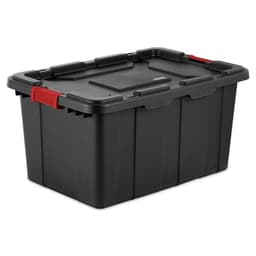
Practically the same footprint as the HDX at 28.5 by 19.625 inches, but with 14.75 in of usable interior height at the base rather than 13 in. Nearly two more inches of what you actually load.
Published specs
- Capacity
- 27 gallons
- Exterior
- 28.5 in L x 19.625 in W x 15.5 in H
- Interior at base
- 23.375 in L x 14.625 in W x 14.75 in H
Figures are the manufacturer's, from the Sterilite product pages, read 2026-09-01. We have not verified them by testing and do not imply that we have.
Our scoring
- Overhead rack fit
- 8.5
- Stackability
- 9.0
- Durability
- 8.5
- Findability
- 5.5
- Availability
- 9.5
What works
- 14.75 in interior height at the base is nearly two inches more usable depth than the comparable HDX
- Same exterior footprint, so the two mix on the same shelf without a stepped run
- Industrial line is thicker-walled than the standard Sterilite totes
What doesn't
- 15.5 in exterior height is a quarter-inch taller than the HDX, which matters under a tight rack
- Snap-on lid, not a latching one
- No handles on some colorways
Skip this one if your overhead rack drop leaves you less than 16 in of clearance. A quarter-inch sounds like nothing until the lid catches on the joist every time.
#2 · Best overhead-rack tote
HDX 27 Gallon Tough Tote (4-pack)
HDX
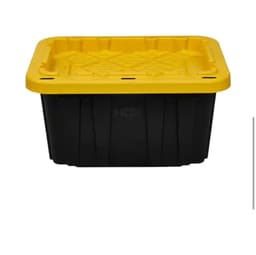
28.55 by 19.61 by 15.27 inches. Those three numbers are why it is here: two of them fit across a 4 ft rack, and the 15.27 in height clears the drop on most overhead racks.
Published specs
- Capacity
- 27 gallons
- Exterior
- 28.55 in L x 19.61 in W x 15.27 in H
- Interior at base
- 23.5 in L x 14.5 in W x 13 in H
- Material
- Polypropylene
Figures are the manufacturer's, from the HDX Tough Tote listing, read 2026-09-01. We have not verified them by testing and do not imply that we have.
Our scoring
- Overhead rack fit
- 9.5
- Stackability
- 8.5
- Durability
- 8.0
- Findability
- 5.5
- Availability
- 9.5
What works
- 15.27 in tall is short enough to clear the drop on most overhead racks
- Two fit across the 48 in width of a standard 4x8 rack
- Opaque, so contents do not degrade in the light through a garage window
- Sold everywhere, so matching more later is easy
What doesn't
- Opaque means you cannot see what is in it without a label
- Snap-on lids are not weathertight
- Polypropylene gets brittle in a cold garage over years
Skip this one if you need to see the contents. In a garage you will not remember what is in bin four, and an opaque tote without a labeling system is a box you open every time.
#3 · Best for stacking on the floor
Sterilite 27 Gallon Stacker Tote (4-pack)
Sterilite
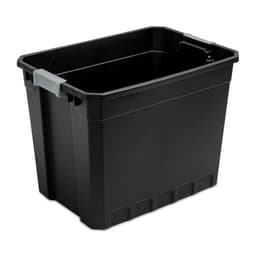
A completely different shape: 25.75 by 18.375 by 19.375 inches. Taller and narrower, with 18.875 in of interior height — it is a floor-stacking bin, and it will not fit most overhead racks.
Published specs
- Capacity
- 27 gallons
- Exterior
- 25.75 in L x 18.375 in W x 19.375 in H
- Interior at base
- 20.125 in L x 14.125 in W x 18.875 in H
Figures are the manufacturer's, from the Sterilite product pages, read 2026-09-01. We have not verified them by testing and do not imply that we have.
Our scoring
- Overhead rack fit
- 3.0
- Stackability
- 9.5
- Durability
- 8.0
- Findability
- 5.5
- Availability
- 9.0
What works
- 18.875 in of interior height swallows tall awkward things a flat tote cannot
- Smaller footprint means more bins per square foot of floor
- Designed to stack, so a column of them stays a column
What doesn't
- 19.375 in tall will not clear the drop on most overhead racks
- Taller stacks are less stable and harder to get the bottom bin out of
- The narrower base means less shelf contact
Skip this one if these are going on an overhead rack. At 19.375 in tall they need more clearance than most rack drops leave, and you will find that out on the ladder.
Questions people actually ask
What are the dimensions of a 27 gallon storage tote?
Sterilite publishes 28 1/2 x 19 5/8 x 15 1/2 in outside for its 27 gal Industrial Tote, with an inside base of 23 3/8 x 14 5/8 x 14 3/4 in. The 19 5/8 in width is the figure that decides whether it fits your shelving.
What are standard storage bin sizes?
The common ladder runs roughly 20 qt, 50 qt, 18 gal, 27 gal and 50 gal. A 20 qt box is about 16 1/2 x 11 1/4 x 9 in; a 50 gal stacker is about 39 3/4 x 21 1/2 x 17 7/8 in.
Will a 27 gallon tote fit on an 18 inch shelf?
Yes, with a small overhang — the tote is 19 5/8 in wide against an 18 in shelf. It will not fit inside an 18 in deep cabinet, because the interior is narrower than the outside.
Which storage bins stack together?
Bins that share a lid. Sterilite publishes shared lids for its 12 and 20 qt boxes, its 26 and 50 qt ShelfTotes, and its 12, 18 and 26 gal Latch and Carry totes — those pairs stack in the same footprint.
What size storage bin is best for a garage?
27 gallon for general storage, because it fits 18 in shelves and 24 in overhead racks. Drop to 18 gallon or 50 quart for anything heavy, since a full 27 gal tote of tools is past a comfortable one-person lift.
Sources
- Sterilite 20 Qt Storage Box — 16 1/2 x 11 1/4 x 9 in outside, 13 3/4 x 9 x 8 3/8 in inside; shares a lid with the 12 qtChecked September 21, 2026
- Sterilite 50 Qt ShelfTotes — 19 7/8 x 15 1/2 x 14 3/4 in outside, 14 7/8 x 12 1/2 x 14 1/8 in inside; designed to fit shelving units; shares a lid with the 26 qtChecked September 21, 2026
- Sterilite 18 Gal Latch and Carry — 23 5/8 x 18 5/8 x 13 5/8 in outside, 17 1/2 x 15 5/8 x 13 1/8 in inside; 12, 18 and 26 gal share a lidChecked September 21, 2026
- Sterilite 27 Gal Industrial Tote — 28 1/2 x 19 5/8 x 15 1/2 in outside, 23 3/8 x 14 5/8 x 14 3/4 in insideChecked September 21, 2026
- Sterilite 27 Gal Stacker Tote — 25 3/4 x 18 3/8 x 19 3/8 in outside, 20 1/8 x 14 1/8 x 18 7/8 in insideChecked September 1, 2026
- Sterilite 50 Gal Stacker Tote — 39 3/4 x 21 1/2 x 17 7/8 in outside, 34 1/4 x 18 x 17 3/8 in inside; shares a lid with the 200 qt; keep heaviest bin at the bottomChecked September 21, 2026
- Sterilite 5 Shelf Unit — 15.77 in between shelves, used here for the shelf-clearance comparisonChecked September 21, 2026
- HDX 27 Gal Tough Tote — 28.55 x 19.61 x 15.27 in outside, 23.5 x 14.5 x 13 in insideChecked September 1, 2026
Manufacturer documentation, manuals, warranty terms and exact product models reviewed September 21, 2026.
Read next
- The best garage storage binsThree 27-gallon totes on published exterior dimensions, and where each one actually fits.
- Which bins actually fit an overhead rackPublished tote dimensions against published rack drops, with the clearance arithmetic run for you.
- Garage shelving that actually fits your totes27-gallon totes are 19.6 in wide. Which shelf depths take them, and what to do when you cannot fit 24 inches.
- How to organize garage binsA labeling system that survives a decade, and the sorting rule for what belongs in a bin at all.
- How deep should garage shelves be?24 in for totes, 18 in beside a car, 12 in for cans. The one measurement that decides shelf depth.
- Plastic totes or cardboard boxes in a garage?What humidity does to corrugated, what it does not do to polypropylene, and the two cases where cardboard still wins.