Shelving
How deep should garage shelves be?
24 inches if totes are going on them, 18 if a car door says otherwise, 12 if it is cans and bottles. One measurement decides it, and it is not the shelf.
Disclosure: Rail & Rafter earns a commission on qualifying purchases made through links on this page, at no cost to you. Commission does not decide what we recommend — our criteria do, and here is how we are funded.

24 inches if you are storing standard totes. 18 inches if a car door, a walkway or a doorway makes 24 impossible. 12 inches if what is going up there is cans, bottles, jars and boxes of screws — and that shallow shelf will serve you better than a deep one, which is the part nobody says out loud.
The measurement that decides it is not on the shelf. It is on the thing you are putting on the shelf, and for most garages that thing is a 27-gallon tote. The rest of this page is that arithmetic, plus the three constraints that override it. The wider category is in the garage shelving hub, and the six measurements to take before you buy anything are in how to plan garage shelving.
The number that rules out half the market
The common 27-gallon totes are about 19.6 inches wide. Sterilite publishes 19.625 in for the exterior width of its 27-gallon Industrial Tote. That single figure decides shelf depth for most people, and it takes ten seconds to check against any product page.
| Shelf depth | What the tote does | Verdict |
|---|---|---|
| 12" | Overhangs by about 7.6 in | Not a tote shelf. Cans, bottles, jars, small boxes. |
| 16" | Overhangs by about 3.6 in | The awkward middle. Avoid if totes are the plan. |
| 18" | Overhangs by about 1.6 in | Works only if a car door forces it, and it will annoy you. |
| 24" | Fits with about 4.4 in to spare | The default when bins go on the shelf. |
The 18 inch row is the one that catches people. An inch and a half of overhang does not sound like much until it is on every shelf, on every tote, permanently — and until a tote catches on the way past and comes down. The full fit table, including which specific units are 24 inches deep, is on garage shelving that fits totes.
The three constraints that override the tote
1. The car door
This is the one that actually rules. Measure from the wall to the side of the parked car, then open the car door fully and measure again. Whatever is left is your maximum depth, and no amount of wanting 24 inches changes it.
In a lot of single-car garages the answer comes back at 18 inches or less. That is not a failure — it is the constraint, and the correct response is a shallow rack plus a different home for the totes rather than a deep rack you cannot walk past. The Gladiator 60 in rack publishes four 18 in shelves for exactly this case.
2. Reach
A 24 inch shelf at chest height is fine. A 24 inch shelf at shoulder height or above means the back six inches becomes a place things go to be forgotten, because you cannot see into it and you have to lean over the front row to get there.
Practical rule: deep shelves low, shallow shelves high. If your unit has adjustable shelves, this costs nothing and it is the single best thing you can do with them.
3. Walkway
A 24 inch shelf takes two feet out of the room, every foot along the wall. In a narrow garage that turns a comfortable walkway into a shuffle. Measure the clear floor you will have left, not the wall you are filling.
Depth is not the same as capacity
A deeper shelf is not automatically a stronger one, and the two figures are published separately for good reason. The Husky welded 4-tier is 24 in deep and publishes 2,500 lb per shelf. The Gladiator 60 in is 18 in deep and publishes no per-shelf capacity at all. Depth tells you what fits; capacity tells you what it holds. Check both.
Depth by what is actually going on the shelf
| What you are storing | Depth | Why |
|---|---|---|
| 27-gallon totes | 24" | The only depth that takes them flat with margin |
| Paint, solvents, spray cans | 12" | One row deep means you can read every label |
| Power tools in cases | 18-24" | Case footprints vary; measure your largest |
| Boxed hardware, small parts | 12" | Deeper just buries the back row |
| Camping and sports gear | 24" | Bulky, light, and awkward at any shallower depth |
| Automotive fluids and parts | 18" | Dense and heavy — keep it low and near an upright |
The pattern is worth naming: depth is for bulk, not for weight. Heavy things want to be low and close to an upright, not far back on a deep shelf where the span is working hardest. That is the same principle behind loading an overhead rack near a bearing wall.
Measuring the depth you actually have, in four steps
Do this before you look at a single product page. It takes about five minutes and it eliminates most of the market for you.
- Measure wall to car, with the car parked normally. Not where you would like it to sit — where it actually sits, with the mirrors where they end up.
- Open the car door fully and measure again. Wall to the outermost point of the open door. This number, minus the room you need to get out, is your hard maximum.
- Subtract the overhang of what you store. If bins are going on it, you need the shelf to be at least as deep as the bin is wide — 19.6 in for a standard 27-gallon tote, so 24 in of shelf.
- Check the height clearance separately for each tier. Depth and height are independent constraints, and a deep shelf you cannot see the back of is worse than a shallow one you can.
If step two comes back under 18 inches, the answer on that wall is not shelving at all. A wall system projects a few inches rather than eighteen, and the options are ranked in the wall storage systems roundup. The full six-measurement sequence is in how to plan garage shelving.
The layout most garages should actually build
The instinct is to pick one depth and run it along the wall. The better answer is usually two, because the constraints are different at different heights.
| Height | Depth | What lives there |
|---|---|---|
| Floor to knee | 24" | Buckets, fluids, wet vac, the heavy and the tall |
| Knee to shoulder | 24" | Totes and anything you reach for often |
| Shoulder to head | 18" | Boxed items you can see the front of |
| Above head | 12-18" | Light, seasonal, one row deep so nothing hides |
Two things follow from that table. First, a unit with adjustable shelves is worth more than a unit with more shelves — the Husky welded rack adjusts in 3 in increments, which is the feature that makes this layout possible on one unit. Second, if you are buying two units for one wall, buy the deep one for the section you stand in front of most.
What to buy at each depth
At 24 inches, the Husky welded 4-tier is the reference: 2,500 lb per shelf evenly distributed, 10,000 lb total, shelves adjusting in 3 in increments, and a lifetime warranty. The catch is width — 77 inches is a lot of wall, and if you do not have the run this is not your unit.
At 18 inches, the Gladiator 60 in rack is built for the car-door case and is honest about the trade: it will not take a 27-gallon tote across the depth, and Gladiator does not publish a per-shelf capacity. You are buying the footprint, not the numbers.
For a damp garage at any depth, Seville Classics UltraDurable wire shelving publishes 800 lb per shelf on leveling feet with an NSF certification, and the wire deck lets air move so a damp box dries instead of sitting in a puddle. Small loose items fall through, so plan on a tray or a bin for hardware.
Buy shallower than you think for the high shelves. The most common regret we see is not a shelf that was too small; it is 24 inches of depth at head height with an unreachable back row full of things nobody has seen in three years. If the wall is going to be a mix, the deeper units go at the bottom.
What we would buy for this
Every pick carries the manufacturer's published specs, our scoring against stated criteria, and a reason you might want to skip it.
#1 · Best heavy-duty shelving
Husky 4-Tier Welded Steel Rack, 77 x 78 x 24 in
Husky
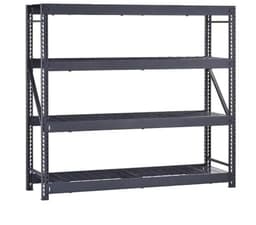
2,500 lb per shelf and 10,000 lb across the unit. That is not a garage number, it is a warehouse number, and it means this is the last shelving you buy for that wall.
Published specs
- Model
- HBR782478W4R
- Dimensions
- 77 in W x 78 in H x 24 in D
- Capacity per shelf
- 2,500 lb, evenly distributed
- Total capacity
- 10,000 lb
- Adjustment
- Shelves adjust in 3 in increments
- Warranty
- Lifetime
Figures are the manufacturer's, from the Home Depot listing for Husky HBR782478W4R, read 2026-09-01. We have not verified them by testing and do not imply that we have.
Our scoring
- Published capacity
- 10.0
- Build
- 9.5
- Tote fit
- 9.0
- Footprint efficiency
- 7.0
- Warranty
- 9.5
What works
- 2,500 lb per shelf is far beyond what a garage will ever ask of it, which is exactly why it never sags
- Welded construction rather than bolt-together, so it does not develop a wobble over years
- 24 in depth swallows a 27-gallon tote sideways with room to spare
- Lifetime warranty
What doesn't
- 77 in wide is a lot of wall. In a single-car garage this is a real commitment
- Welded means it arrives heavy and assembles in one configuration
- Only 3 in adjustment increments, so a tall item may cost you a whole shelf of headroom
Skip this one if you are storing light bulk — holiday bins, sleeping bags, empty coolers. You are paying for steel you will never load, and the same money buys twice the shelf area in a lighter unit.
#2 · Best shallow-depth rack
Gladiator 60 in Heavy Duty Rack, four 18 in shelves
Gladiator GarageWorks
18 inches deep rather than 24. In a garage where the shelving runs down the side of a parked car, six inches is the whole argument.
Published specs
- Model
- GARS604TEG
- Width
- 60 in
- Shelves
- Four, 18 in deep
Figures are the manufacturer's, from the Gladiator GarageWorks catalog, read 2026-09-01. We have not verified them by testing and do not imply that we have.
Our scoring
- Published capacity
- 6.5
- Footprint efficiency
- 9.0
- Build
- 8.5
- System fit
- 9.0
- Tote fit
- 4.5
What works
- 18 in depth leaves the walkway alongside a car intact
- Matches the rest of the Gladiator system if the wall is going to grow
- 60 in width fits between common obstructions
What doesn't
- 18 in will not take a 27-gallon tote across the depth
- No prominently published per-shelf capacity
Skip this one if you are storing standard totes. Measure first: the common 27-gallon totes are about 19.6 in wide, so an 18 in shelf leaves them overhanging.
#3 · Best wire shelving
Seville Classics UltraDurable NSF Wire Shelving
Seville Classics
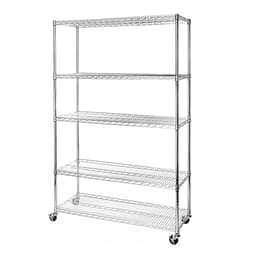
800 lb per shelf on the leveling feet and 4,000 lb across the unit, from a wire deck that lets you see what is in the back. In a damp garage the airflow is a feature, not a compromise.
Published specs
- Capacity per shelf
- 800 lb on leveling feet
- Total capacity
- 4,000 lb
- Certification
- NSF certified
- Deck
- Steel wire
Figures are the manufacturer's, from Seville Classics published specifications; the UltraHD 30 in cabinet (SKU UHD20162B) re-read 2026-09-12. We have not verified them by testing and do not imply that we have.
Our scoring
- Published capacity
- 9.0
- Build
- 8.5
- Tote fit
- 8.0
- Damp tolerance
- 9.5
- Warranty
- 7.5
What works
- 800 lb per shelf is genuinely heavy duty for a wire unit
- Wire deck means air moves and damp things dry rather than sitting in a puddle on a solid shelf
- NSF certification means it is built to a commercial standard, not a consumer one
- You can see into the back of the shelf, which is where garage items go to be forgotten
What doesn't
- Small items fall through the wire unless you sit them on a tray or in a bin
- The 800 lb figure is for the leveling-feet configuration; casters change the number
- Wire decks mark and scratch anything with a soft finish
Skip this one if you are storing loose small parts, hardware, or anything with a soft painted finish. Wire is the wrong deck for those and you will end up lining every shelf, which defeats the airflow you paid for.
Questions people actually ask
How deep should garage shelves be?
24 inches if you store standard 27-gallon totes — they are about 19.6 in wide, so 24 in takes them with roughly 4.4 in to spare. Drop to 18 in only when a car door or walkway makes the extra six inches impossible, and use 12 in for cans, bottles and boxed hardware where a single visible row beats a buried second one.
Are 18 inch garage shelves deep enough?
Not for standard totes — a 19.6 in tote overhangs an 18 in shelf by about 1.6 in, on every shelf, permanently. 18 in is the right depth when a parked car's door swing dictates it, or when what you store is tool cases and boxes rather than bins.
Is a deeper garage shelf stronger?
No. Depth and capacity are published separately and do not track each other. The Husky welded 4-tier is 24 in deep and publishes 2,500 lb per shelf; other 24 in units publish no per-shelf figure at all. Check the capacity number on its own.
What depth should the top shelf be?
Shallower than the ones below it. Above shoulder height you cannot see into the back of a 24 in shelf, so the rear six inches becomes dead storage. Deep shelves low, shallow shelves high — if your unit adjusts, this costs nothing.
Sources
- Sterilite 27 gal Industrial Tote — published exterior width 19.625 inChecked September 6, 2026
- Husky HBR782478W4R — 24 in depth, 2,500 lb per shelf, 3 in shelf increments, lifetime warrantyChecked September 6, 2026
- Gladiator GARS604TEG — 60 in wide, four 18 in deep shelvesChecked September 6, 2026
- Seville Classics UltraDurable — 800 lb per shelf on leveling feet, NSF certificationChecked September 6, 2026
Manufacturer documentation, manuals, warranty terms and exact product models reviewed September 6, 2026.
Read next
- How to plan garage shelvingThe six measurements that decide which shelving fits, in the order to take them.
- Garage shelving that actually fits your totes27-gallon totes are 19.6 in wide. Which shelf depths take them, and what to do when you cannot fit 24 inches.
- The best garage storage shelvesFive shelving units ranked on published per-shelf capacity and whether the depth takes a standard tote.
- IKEA garage storage, and what to buy when it does not fitThe IKEA depth and load figures that decide a garage, and what to buy on each one when they fall short.
- A small garage, on a budgetOrder matters more than budget. Four purchases in sequence, and the expensive ones to skip.
- The best wall-mounted garage shelvesWall shelves ranked on published capacity, depth and what they ask of the wall behind them.
- Garage corner shelving, and whether your corner is freeWhat fits in a garage corner, the three things that usually block it, and the shelving built for the shape.