Shelving
The best heavy-duty garage shelving
Ranked strictly on published per-shelf capacity, with an honest answer to the question nobody asks: whether you actually need it.
Disclosure: Rail & Rafter earns a commission on qualifying purchases made through links on this page, at no cost to you. Commission does not decide what we recommend — our criteria do, and here is how we are funded.
Quick picks
Our ranking, verdict first. Every row links to the full write-up below, and every price cell goes straight to Amazon. Scores follow the criteria on our methodology page.
| # | Product | Best for | Score | Price |
|---|---|---|---|---|
| 1 |  Husky 4-Tier Welded Steel Rack, 77 x 78 x 24 in2,500 lb per shelf and 10,000 lb across the unit. That is not a garage number, it is a warehouse number, and it means this is the last shelving you buy for that wall. Husky 4-Tier Welded Steel Rack, 77 x 78 x 24 in2,500 lb per shelf and 10,000 lb across the unit. That is not a garage number, it is a warehouse number, and it means this is the last shelving you buy for that wall. | Best heavy-duty shelving | 9.2 | $399.00View on AmazonPrice as of October 16, 2026. #ad how this is funded |
| 2 |  Seville Classics UltraDurable NSF Wire Shelving800 lb per shelf on the leveling feet and 4,000 lb across the unit, from a wire deck that lets you see what is in the back. In a damp garage the airflow is a feature, not a compromise. Seville Classics UltraDurable NSF Wire Shelving800 lb per shelf on the leveling feet and 4,000 lb across the unit, from a wire deck that lets you see what is in the back. In a damp garage the airflow is a feature, not a compromise. | Best wire shelving | 8.6 | $189.99View on AmazonPrice as of October 16, 2026. #ad how this is funded |
| 3 | Gladiator 77 in Heavy Duty Rack, four 24 in shelvesThe reason to buy Gladiator shelving is that it lines up with Gladiator cabinets, GearTrack and workbenches. On its own it is a good rack; as part of a wall it is the only one that matches. | Best if you are building a matched wall | 8.1 | Check price on Amazon#ad how this is funded |
Scores are our editorial assessment against the criteria on how we pick. They are not test results and are not marked up as review ratings.
"Heavy duty" is the least regulated phrase in this category. It appears on shelving rated at 350 lb per shelf and on shelving rated at 2,500, and the listing pages look about the same. The only way through is to rank on the published number and ignore the adjective.
That is what this page does. Every figure below is the manufacturer's own, read from their listing and recorded with its source. Where a brand does not publish a per-shelf figure we say so rather than estimating one — see how we pick.
Read this first
Most garages do not need heavy-duty shelving, and buying it anyway is a reasonable decision for a reason that is not capacity. Four full totes on a shelf is roughly 240 lb at the heavy end. A shelf rated at 2,500 lb is not ten times more useful — it is a shelf that never sags, never creeps, and never gets thought about again. Buy it for the not-thinking-about-it, not because you are going to load it.
What genuinely needs heavy-duty shelving
Four loads in a domestic garage actually justify the steel, and they are all dense rather than bulky:
- Tires. A set of four passenger tires on rims is substantial weight in a small footprint, and it lives on a shelf for six months at a time. This is the classic case — see tires and wheels.
- Tools and hardware in bins. Dense, concentrated, and the reason a cheap shelf develops a smile in the middle.
- Paint, fluids and bulk consumables. Liquid is heavy and people underestimate it consistently.
- Anything you would otherwise put on the ceiling. If the joist arithmetic on how much weight a garage ceiling holds says no, heavy shelving is where that load goes instead — the slab carries it, and the slab does not care.
Ranked on published capacity
| Unit | Per shelf | Total | Construction |
|---|---|---|---|
| Husky 4-tier, 77 x 78 x 24 in | 2,500 lb | 10,000 lb | Welded steel |
| Seville UltraDurable wire | 800 lb on leveling feet | 4,000 lb | NSF steel wire |
| Gladiator 77 in, four 24 in shelves | Not published prominently | Not published prominently | Steel |
The Husky figure is not a typo. 2,500 lb per shelf and 10,000 lb across the unit is a warehouse specification that happens to be sold at a home improvement store, and it comes with a lifetime warranty. If one wall of your garage is going to hold everything heavy, this is the unit.
The catch with the Husky
It is 77 inches wide and 24 inches deep. In a single-car garage that is a serious commitment of wall and floor, and it arrives welded — so it goes together one way and it is heavy to move.
If the wall you have is narrower, the Gladiator 48 in EZ Connect gets five shelves into four feet, at the cost of clearance per tier. If the walkway alongside a car matters more than depth, the Gladiator 60 in unit is 18 in deep — but note that 18 in does not take a standard tote, which is worked through on garage shelving that fits totes.
The word doing the work: "evenly distributed"
Husky publishes 2,500 lb per shelf evenly distributed, and Seville publishes 800 lb on leveling feet. Both qualifiers are load-bearing, and both are the kind of thing people skim.
Evenly distributed means spread across the shelf, not concentrated in the middle or at one end. A single dense object in the center of a shelf is a point load, and a point load is a different engineering case from a distributed one. In practice: put the heavy thing near an upright, not in the middle of the span. It is free and it is the same principle as putting an overhead rack near a bearing wall.
"On leveling feet" matters because casters change the load path and therefore the number. If you buy the wheeled configuration, you are not buying the 800 lb figure.
When you actually want racking, not shelving
There is a point where the right answer stops being a shelving unit and becomes industrial pallet racking — genuinely different hardware with genuinely different capacities and a different set of risks. Where that line sits, and why most garages should not cross it, is on shelving vs racking.
Who should skip heavy-duty entirely
- Anyone storing light bulk. Holiday bins, sleeping bags, camping chairs, empty coolers. You are paying for steel you will never load, and the same money buys roughly twice the shelf area in a lighter unit — or an overhead rack, which gets it off the floor entirely.
- Anyone with a narrow garage. 77 in wide by 24 in deep is often the difference between opening the car door and not.
- Anyone who moves house often. Welded shelving is heavy, awkward, and does not flat-pack.
The picks in full
Every pick carries the manufacturer's published specs, our scoring against stated criteria, and a reason you might want to skip it.
#1 · Best heavy-duty shelving
Husky 4-Tier Welded Steel Rack, 77 x 78 x 24 in
Husky
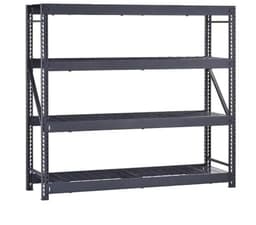
2,500 lb per shelf and 10,000 lb across the unit. That is not a garage number, it is a warehouse number, and it means this is the last shelving you buy for that wall.
Published specs
- Model
- HBR782478W4R
- Dimensions
- 77 in W x 78 in H x 24 in D
- Capacity per shelf
- 2,500 lb, evenly distributed
- Total capacity
- 10,000 lb
- Adjustment
- Shelves adjust in 3 in increments
- Warranty
- Lifetime
Figures are the manufacturer's, from the Home Depot listing for Husky HBR782478W4R, read 2026-09-01. We have not verified them by testing and do not imply that we have.
Our scoring
- Published capacity
- 10.0
- Build
- 9.5
- Tote fit
- 9.0
- Footprint efficiency
- 7.0
- Warranty
- 9.5
What works
- 2,500 lb per shelf is far beyond what a garage will ever ask of it, which is exactly why it never sags
- Welded construction rather than bolt-together, so it does not develop a wobble over years
- 24 in depth swallows a 27-gallon tote sideways with room to spare
- Lifetime warranty
What doesn't
- 77 in wide is a lot of wall. In a single-car garage this is a real commitment
- Welded means it arrives heavy and assembles in one configuration
- Only 3 in adjustment increments, so a tall item may cost you a whole shelf of headroom
Skip this one if you are storing light bulk — holiday bins, sleeping bags, empty coolers. You are paying for steel you will never load, and the same money buys twice the shelf area in a lighter unit.
#2 · Best wire shelving
Seville Classics UltraDurable NSF Wire Shelving
Seville Classics
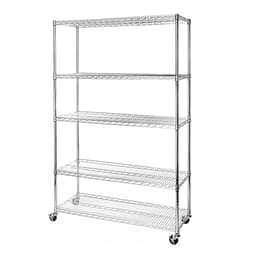
800 lb per shelf on the leveling feet and 4,000 lb across the unit, from a wire deck that lets you see what is in the back. In a damp garage the airflow is a feature, not a compromise.
Published specs
- Capacity per shelf
- 800 lb on leveling feet
- Total capacity
- 4,000 lb
- Certification
- NSF certified
- Deck
- Steel wire
Figures are the manufacturer's, from Seville Classics published specifications; the UltraHD 30 in cabinet (SKU UHD20162B) re-read 2026-09-12. We have not verified them by testing and do not imply that we have.
Our scoring
- Published capacity
- 9.0
- Build
- 8.5
- Tote fit
- 8.0
- Damp tolerance
- 9.5
- Warranty
- 7.5
What works
- 800 lb per shelf is genuinely heavy duty for a wire unit
- Wire deck means air moves and damp things dry rather than sitting in a puddle on a solid shelf
- NSF certification means it is built to a commercial standard, not a consumer one
- You can see into the back of the shelf, which is where garage items go to be forgotten
What doesn't
- Small items fall through the wire unless you sit them on a tray or in a bin
- The 800 lb figure is for the leveling-feet configuration; casters change the number
- Wire decks mark and scratch anything with a soft finish
Skip this one if you are storing loose small parts, hardware, or anything with a soft painted finish. Wire is the wrong deck for those and you will end up lining every shelf, which defeats the airflow you paid for.
#3 · Best if you are building a matched wall
Gladiator 77 in Heavy Duty Rack, four 24 in shelves
Gladiator GarageWorks
The reason to buy Gladiator shelving is that it lines up with Gladiator cabinets, GearTrack and workbenches. On its own it is a good rack; as part of a wall it is the only one that matches.
Published specs
- Model
- GARS774XEG
- Width
- 77 in
- Shelves
- Four, 24 in deep
Figures are the manufacturer's, from the Gladiator GarageWorks catalog, read 2026-09-01. We have not verified them by testing and do not imply that we have.
Our scoring
- Published capacity
- 6.5
- Build
- 8.5
- Tote fit
- 9.0
- System fit
- 9.5
- Warranty
- 7.5
What works
- 24 in deep shelves take a 27-gallon tote across the depth
- Visually and dimensionally matched to the rest of the Gladiator system, which matters if the wall is going to be cabinets plus shelving plus track
- Sold through mainstream retail, so replacement parts and extra units stay available
What doesn't
- Gladiator does not publish a per-shelf capacity as prominently as Husky does, so you are buying with less information
- Priced as part of a system, not as a commodity rack
Skip this one if this is a standalone rack in the corner of the garage. You are paying a system premium for a unit that is not part of a system.
Questions people actually ask
How much weight can heavy-duty garage shelving hold?
The Husky welded 4-tier publishes 2,500 lb per shelf evenly distributed and 10,000 lb total. Seville Classics UltraDurable wire shelving publishes 800 lb per shelf on leveling feet and 4,000 lb total. Both qualifiers matter — casters change the Seville figure, and concentrated loads change the Husky one.
What does 'evenly distributed' actually mean?
Spread across the shelf rather than concentrated in one spot. A single dense object in the middle of a span is a point load and is a different case from the rated distributed one. Put heavy items near an upright rather than mid-shelf — it costs nothing and it is the same principle as placing an overhead rack near a bearing wall.
Do I really need 2,500 lb per shelf in a garage?
Almost certainly not for the load. Four full totes is around 240 lb at the heavy end. What the rating actually buys is a shelf that never sags or creeps over a decade, which is a legitimate thing to pay for — just not for the reason the number suggests.
Is welded shelving worth the extra over bolt-together?
If it is going against a wall and staying there, yes. Bolted joints work loose under a load that shifts every time you take a bin off, and that is where the eventual wobble comes from. Bolt-together only wins if you genuinely expect to reconfigure it.
Sources
- Husky HBR782478W4R listing — per-shelf and total capacity, adjustment increments, warrantyChecked September 1, 2026
- Seville Classics UltraDurable published capacity figuresChecked September 1, 2026
- Gladiator GarageWorks heavy duty rack catalogChecked September 1, 2026
Manufacturer documentation, manuals, warranty terms and exact product models reviewed September 1, 2026.
Read next
- The best garage storage shelvesFive shelving units ranked on published per-shelf capacity and whether the depth takes a standard tote.
- Shelving vs rackingRacking is for forklifts and pallets, shelving is for hands and boxes. Where the line sits.
- Where the lumber and plywood goOffcuts and sheet goods are two problems. Where each goes, and why leaning plywood warps.
- Where the tires goDense weight in a small footprint, sitting for six months. A shelving problem, not a ceiling one.
- Where the tools goTools in a bin become a search. The wall is the answer, and the hook limits decide what goes where.
- The best garage storage cabinetsCabinets ranked on published capacity and the depth question that decides whether your bins fit.
- Husky or Seville Classics: welded steel against wireWelded solid deck against NSF wire, on published capacity, damp tolerance and the width you actually have.
- The best plastic garage shelvingPlastic shelving on published per-shelf ratings from 40 to 150 lb, and when steel is the better buy.
- The best tire storage racksWall-mount tire racks on published capacity, adjustable width and depth — and when a shelf beats all of them.