Shelving
Garage corner shelving, and whether your corner is free
Every garage has two to four unused corners. Most of them are not actually free, and the ten minutes you spend checking is what decides whether this works.
Disclosure: Rail & Rafter earns a commission on qualifying purchases made through links on this page, at no cost to you. Commission does not decide what we recommend — our criteria do, and here is how we are funded.
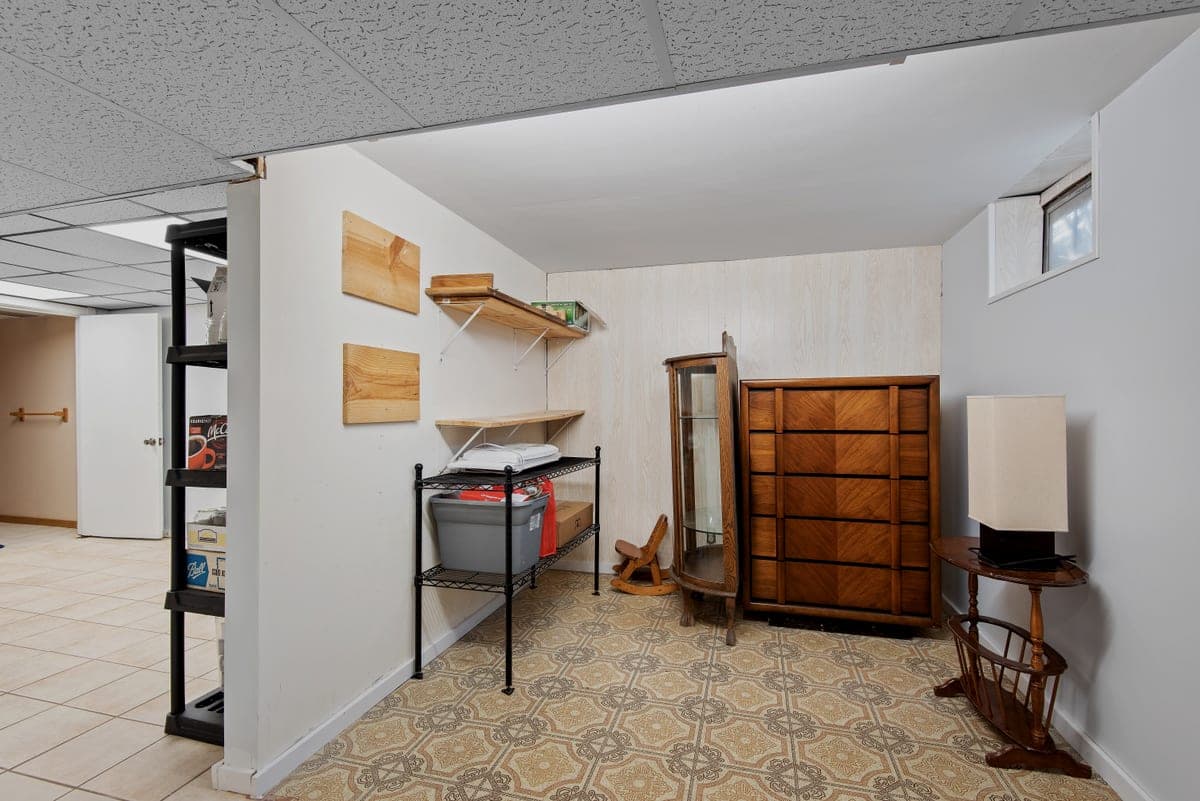
A corner is the one place in a garage where two walls meet and neither gets used. Standard shelving runs along a wall and stops short of the corner, leaving a column of dead space from floor to ceiling that nothing is designed for.
Corner shelving fixes that — when the corner is genuinely free, which is less often than people assume. This guide is the check to run first, then the products built for the shape. The wider category is in the shelving hub, and our criteria are on how we pick.
The three things that are usually in your corner
Before you measure anything, walk to the corner you had in mind and check for these. In our experience at least one of them is there.
1. The garage door track
The horizontal track runs back from the door along the ceiling and terminates in a rear support — very often in or near a corner. It is easy to miss because it sits high, and it is not negotiable.
Check with the door fully open, not closed. The door panels themselves stack into that space when open and they are the part people forget.
2. Services
Water heaters, furnaces, electrical panels, sump pumps and gas meters cluster in corners because that is where builders put them. Several of these have legally required clearances around them — an electrical panel needs working space in front of it, and blocking it is both a safety problem and a code one.
If the corner has a panel in it, stop. That corner is not storage, regardless of what fits.
3. The car door
The same check that decides every shelf depth on this site. Park normally, open the door fully, and measure what is left. A corner behind the swing of an open car door is a corner you will resent.
How to measure a corner properly
Corners are rarely square and garage walls are rarely straight, so measure rather than assume.
- Measure each wall separately from the internal angle outward, and write both numbers down. A corner shelf needs a run on both walls, and they are often different.
- Find the studs on both walls before you commit. The FlexiMounts corner unit specifies 16 in stud spacing; if one wall is on 24 in centers you will know before ordering rather than after.
- Check the internal angle with a square. An out-of-square corner means a rigid corner shelf will not sit flat against both walls, and packing it out is a job.
- Measure the height to the lowest obstruction — track, lighting, opener rail — not to the ceiling.
The reach problem nobody mentions
A corner shelf's deepest point is the internal angle, and it is the hardest part of any shelf in the garage to see into or reach. Put things you need rarely at the back of the angle and things you use at the outer ends — or you will end up unloading the front to reach the back, which is how corner storage stops being used.
What actually belongs in a corner
| What it is | Corner? | Why |
|---|---|---|
| Seasonal bins | Yes | Rarely accessed, so the reach problem does not bite |
| Paint and solvents | Yes | Small footprint, one visible row, out of the traffic path |
| Long items — lumber, trim, poles | Yes | A corner is the natural place for anything that leans |
| Hand tools in daily use | No | You cannot see into a corner at a glance; that is a wall job |
| Anything heavy you lift often | No | The awkward reach and the weight are a bad combination |
The pattern: corners suit the rarely-touched and the awkwardly long. They are the worst place in the garage for anything you need in a hurry.
What to put there
The FlexiMounts WRC24B corner shelving is the only product we track that is actually designed for the shape. It publishes 660 lb total and 330 lb per shelf at 47.8 x 24.4 x 6.9 in, in heavy-duty steel, mounting to 16 in wood studs or concrete. Per-shelf disclosure on a wall product is unusual and it is the reason this is the pick.
The honest cons: 16 in stud spacing is specified rather than suggested, FlexiMounts rules out metal walls explicitly, and the reach problem above applies to every corner shelf ever made.
The FlexiMounts WR24 flat wall shelf is the alternative if your corner turns out to be occupied — run two of them along the walls approaching the corner and accept the gap. 600 lb published across the pair, 24 in deep, studs or solid concrete. The full ranking is in the wall-mounted shelving roundup.
Seville Classics UltraDurable wire shelving is the floor-standing answer when the walls will not take a fixing at all. Two units meeting at right angles fill a corner perfectly well, publish 800 lb per shelf on leveling feet, and the wire deck lets air move — which matters because corners are where damp air sits.
The corner is two walls, and they are rarely equal
A corner shelf loads into two walls at once, which is an advantage and a trap in the same move.
The advantage: the load spreads across two stud bays on two different walls, so no single bay carries what it would under a straight run of shelving.
The trap: the two walls are often not the same construction. Garages frequently have one framed wall shared with the house and one external wall that is block, brick or poured concrete. A fixing that works beautifully in a timber stud does nothing in block, and the reverse is also true.
Check each wall separately before you buy fixings
- Tap and probe both walls. A stud finder reading nothing on one side usually means masonry rather than a missing stud.
- Buy fixings for the wall you actually have. FlexiMounts states the WRC24B suits 16 in wood studs or concrete and rules out metal walls — the middle case, hollow block, needs fixings rated specifically for it.
- Do not mix a strong fixing with a weak one. A corner shelf fixed properly on one side and into bare drywall on the other fails at the weak side, and the published capacity assumes both.
How high, and what goes above
Corners run floor to ceiling, so the temptation is to stack shelves the whole way up. Two things argue against filling the top.
First, the reach problem gets worse with height: a corner shelf above shoulder level has a back point you can neither see nor reach without a step. Second, corners are where garage door tracks and opener rails terminate, so the top of a corner is the likeliest place to foul something.
The layout that works: heavy and bulky at the bottom, the things you reach for at chest height, and either nothing above head height or one shelf of genuinely light seasonal items. The general depth-by-height logic is in how deep garage shelves should be.
Why corners are damper than the rest of the garage
Air moves least where two walls meet, and an external corner has cold on two sides rather than one. That combination is why corners are where you find the mildew, and it has two practical consequences.
- Cardboard in a corner fails first. Corrugated loses compressive strength as it takes up moisture, so the least-ventilated spot in the garage is the worst place for boxes — the material argument is in plastic totes against cardboard boxes.
- Leave a gap behind the shelf where the product allows it. Anything that lets air move across the back of the corner helps.
The short version
Check the corner before you buy anything. Door track with the door open, services and their clearances, car door swing. One of those three takes the corner out of play more often than not.
If it is free, the corner is genuinely free storage — it is the only wall in the garage that costs you nothing to use, because nothing else wants it. Put the seasonal bins and the long awkward things there, and keep the daily items on wall you can see at a glance.
If it is not free, do not force it. A shelf that fouls a door track is a shelf you will take down. The measuring sequence that prevents this across the whole garage is in how to plan garage shelving.
What we would buy for this
Every pick carries the manufacturer's published specs, our scoring against stated criteria, and a reason you might want to skip it.
#1 · Best corner shelf
FlexiMounts WRC24B Corner Wall Shelving (2-pack)
FlexiMounts
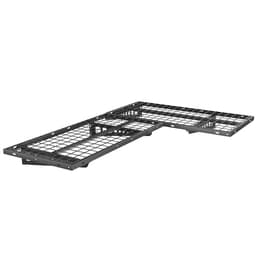
330 lb per shelf, published per shelf rather than as a pair, built to turn the one piece of wall nobody uses into storage. The corner is free real estate and this is the only product here designed for it.
Published specs
- Model
- WRC24B
- Dimensions
- 47.8 in L x 24.4 in W x 6.9 in H
- Published capacity
- 660 lb total; 330 lb per shelf
- Material
- Heavy-duty steel, integrated grid
- Mounting
- 16 in wood studs/joists or concrete
Figures are the manufacturer's, from the FlexiMounts WRC24B product page on fleximounts.com, read 2026-09-13. We have not verified them by testing and do not imply that we have.
Our scoring
- Published capacity
- 9.0
- Floor saved
- 10.0
- Space efficiency
- 9.5
- Reach
- 5.5
- Install simplicity
- 6.5
What works
- 330 lb PER SHELF is published, which is more disclosure than the flat-wall version gives you
- Uses the corner, which is dead space in almost every garage
- 24.4 in depth takes a standard tote
- Integrated grid rather than multi-piece assembly, so there is less to get out of square
What doesn't
- Specified for 16 in stud spacing; a wall on other centers is more work
- A corner shelf is awkward to reach into at the back — the deepest point is the hardest to see
- Cannot be mounted to metal walls, which FlexiMounts states explicitly
Skip this one if the corner you had in mind is where the garage door track or the water heater lives. Measure the actual clear corner before ordering — this is the product most often bought for a corner that turns out to be occupied.
#2 · Best wall-mounted shelf
FlexiMounts WR24 2 x 4 ft Wall Shelf (2-pack)
FlexiMounts
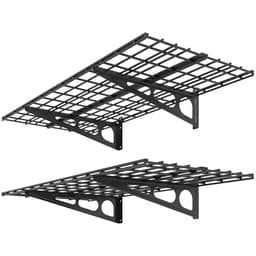
600 lb across the pair, published, on a shelf that takes no floor at all. If the floor is the thing you are short of, this is the shelving that does not cost you any of it.
Published specs
- Model
- WR24
- Shelf size
- 2 ft x 4 ft each
- Published capacity
- 600 lb total for the 2-pack
- Material
- Heavy gauge steel
- Mounting
- Wall studs or solid concrete
Figures are the manufacturer's, from the FlexiMounts WR24 product page on fleximounts.com, read 2026-09-13. We have not verified them by testing and do not imply that we have.
Our scoring
- Published capacity
- 8.5
- Floor saved
- 10.0
- Tote fit
- 8.5
- Install simplicity
- 7.0
- Adjustability
- 5.0
What works
- Takes zero floor area, which is the whole point of a wall shelf
- 600 lb published across the pair is a real, checkable number in a category where most sellers publish nothing
- 24 in depth takes a 27-gallon tote across the shelf
- Mounts to studs or solid concrete, so a block-wall garage is not ruled out
What doesn't
- FlexiMounts publishes the capacity as a total for the 2-pack rather than per shelf, so plan against the pair
- Everything it holds is transferred into the wall, so the wall and the fasteners are the real limit
- One fixed height per shelf once installed — no adjustment without re-drilling
Skip this one if your garage walls are metal-framed or hollow block with nothing solid to hit. A wall shelf is only ever as good as what is behind the drywall, and this one needs timber studs or solid concrete.
#3 · Best wire shelving
Seville Classics UltraDurable NSF Wire Shelving
Seville Classics
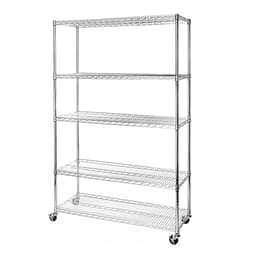
800 lb per shelf on the leveling feet and 4,000 lb across the unit, from a wire deck that lets you see what is in the back. In a damp garage the airflow is a feature, not a compromise.
Published specs
- Capacity per shelf
- 800 lb on leveling feet
- Total capacity
- 4,000 lb
- Certification
- NSF certified
- Deck
- Steel wire
Figures are the manufacturer's, from Seville Classics published specifications; the UltraHD 30 in cabinet (SKU UHD20162B) re-read 2026-09-12. We have not verified them by testing and do not imply that we have.
Our scoring
- Published capacity
- 9.0
- Build
- 8.5
- Tote fit
- 8.0
- Damp tolerance
- 9.5
- Warranty
- 7.5
What works
- 800 lb per shelf is genuinely heavy duty for a wire unit
- Wire deck means air moves and damp things dry rather than sitting in a puddle on a solid shelf
- NSF certification means it is built to a commercial standard, not a consumer one
- You can see into the back of the shelf, which is where garage items go to be forgotten
What doesn't
- Small items fall through the wire unless you sit them on a tray or in a bin
- The 800 lb figure is for the leveling-feet configuration; casters change the number
- Wire decks mark and scratch anything with a soft finish
Skip this one if you are storing loose small parts, hardware, or anything with a soft painted finish. Wire is the wrong deck for those and you will end up lining every shelf, which defeats the airflow you paid for.
Questions people actually ask
How much weight can corner garage shelving hold?
FlexiMounts publishes 660 lb total and 330 lb per shelf for the WRC24B corner unit, mounted into 16 in wood studs or concrete. As with any wall-mounted product, that figure assumes correct fixing — the wall and the fasteners are the real limit rather than the shelf.
Is corner shelving worth it in a garage?
When the corner is genuinely free, yes — it is the only wall space in a garage that nothing else competes for. The catch is that garage door tracks, water heaters and electrical panels occupy corners more often than people expect, so check before buying.
What should I store on garage corner shelves?
Seasonal bins, paint and solvents, and long items that lean. Avoid anything you reach for daily — the deepest point of a corner shelf is the hardest place in the garage to see into, so frequently used items end up buried.
Can I put corner shelving over an electrical panel?
No. Electrical panels require clear working space in front of them, and blocking one is a safety and code problem rather than a storage decision. If the corner has a panel in it, use a different corner.
Sources
- FlexiMounts WRC24B corner wall shelving — 47.8 x 24.4 x 6.9 in, 660 lb total, 330 lb per shelf, 16 in studs or concrete, not metal wallsChecked September 13, 2026
- FlexiMounts WR24 2x4 wall shelving — 600 lb total for the 2-pack, studs or solid concreteChecked September 13, 2026
- Seville Classics UltraDurable — 800 lb per shelf on leveling feet, NSF certifiedChecked September 13, 2026
Manufacturer documentation, manuals, warranty terms and exact product models reviewed September 13, 2026.
Read next
- The best wall-mounted garage shelvesWall shelves ranked on published capacity, depth and what they ask of the wall behind them.
- How deep should garage shelves be?24 in for totes, 18 in beside a car, 12 in for cans. The one measurement that decides shelf depth.
- How to plan garage shelvingThe six measurements that decide which shelving fits, in the order to take them.
- How much weight can a garage wall hold?The fixing decides it, not the wall. Published stud-versus-drywall figures and how to find your studs.
- A small garage, on a budgetOrder matters more than budget. Four purchases in sequence, and the expensive ones to skip.