Walls
The best ladder storage racks
A ladder is the heaviest thing most people hang on a garage wall, and almost nothing in this category publishes a capacity. Here is what does.
Disclosure: Rail & Rafter earns a commission on qualifying purchases made through links on this page, at no cost to you. Commission does not decide what we recommend — our criteria do, and here is how we are funded.

Quick picks
Our ranking, verdict first. Every row links to the full write-up below, and every price cell goes straight to Amazon. Scores follow the criteria on our methodology page.
| # | Product | Best for | Score | Price |
|---|---|---|---|---|
| 1 |  Little Giant Ladder Rack, wall mount (15097)75 lb, mounted into studs at 16 in centers, from the company that makes the ladders. The only ladder storage here with a capacity figure from the ladder manufacturer. Little Giant Ladder Rack, wall mount (15097)75 lb, mounted into studs at 16 in centers, from the company that makes the ladders. The only ladder storage here with a capacity figure from the ladder manufacturer. | Best published ladder rack | 7.9 | $29.94View on AmazonPrice as of September 21, 2026. #ad how this is funded |
| 2 |  Rubbermaid FastTrack Ladder HookThe ladder hook for the FastTrack rail, which publishes 1,750 lb across 48 inches. The rail is the rated part; the hook, as ever with FastTrack, is not. Rubbermaid FastTrack Ladder HookThe ladder hook for the FastTrack rail, which publishes 1,750 lb across 48 inches. The rail is the rated part; the hook, as ever with FastTrack, is not. | Best if you already have a rail | 7.4 | $13.31View on AmazonPrice as of September 21, 2026. #ad how this is funded |
| 3 |  Rubbermaid FastTrack 48 in Rail (2-pack)Rubbermaid publishes 1,750 lb per 48 in rail and a fit on both 16 in and 24 in stud spacing. The stud-spacing flexibility is the practical advantage; the rail rating is a number you will never approach, because the hooks decide it. Rubbermaid FastTrack 48 in Rail (2-pack)Rubbermaid publishes 1,750 lb per 48 in rail and a fit on both 16 in and 24 in stud spacing. The stud-spacing flexibility is the practical advantage; the rail rating is a number you will never approach, because the hooks decide it. | Best rail for mixed stud spacing | 8.3 | $64.12View on AmazonPrice as of September 21, 2026. #ad how this is funded |
| 4 |  Gladiator GearTrack Channels75 lb per linear foot, published in the installation manual rather than buried in marketing copy. Track beats full-panel systems when what you are hanging is heavy and few rather than light and many. Gladiator GearTrack Channels75 lb per linear foot, published in the installation manual rather than buried in marketing copy. Track beats full-panel systems when what you are hanging is heavy and few rather than light and many. | Best track system | 8.8 | $29.99View on AmazonPrice as of September 21, 2026. #ad how this is funded |
Scores are our editorial assessment against the criteria on how we pick. They are not test results and are not marked up as review ratings.
A step ladder leaning in the corner is the single most common piece of garage clutter, and the reason it stays there is that hanging it feels risky. It is heavy, it is awkward, and the hooks on the shelf at the hardware store rarely say what they hold.
That last part is the real problem with this category. Most ladder hooks publish no capacity at all. This page ranks what does publish a figure, says plainly where a figure is missing, and checks both against what ladders actually weigh.
We have not tested these. This is published specifications read against real loads — the method is on how we pick, and the rest of the category is in the walls hub.
How we picked
- A published capacity, from the manufacturer. Where there is none, the pick says so rather than implying a number.
- A published stud requirement. A ladder on drywall anchors is a ladder on the floor with extra steps.
- Whether the mount cradles or hooks. Two cradles under both rails behave differently from one hook through a rung.
- Position flexibility. Studs are every 16 or 24 inches; ladders are not.
- Honest cons on every pick.
First, weigh the ladder
Every decision here starts with a number most people have never looked up.
| Ladder | Rough weight | Inside 75 lb? |
|---|---|---|
| 4 ft aluminum step ladder | 10 to 14 lb | Easily |
| 6 ft aluminum step ladder | 14 to 20 lb | Easily |
| 6 ft fiberglass step ladder | 20 to 28 lb | Easily |
| 8 ft fiberglass step ladder | 30 to 40 lb | Yes, with margin |
| 16 ft aluminum extension ladder | 25 to 35 lb | Yes |
| 24 ft fiberglass extension ladder | 50 to 70 lb | Close to the limit |
| 28 ft fiberglass extension ladder | 70 to 90 lb | Often over |
The useful conclusion: a published 75 lb rack covers almost every domestic ladder, and stops covering things exactly where you would expect — at the big fiberglass extension ladders that professionals own.
What each option publishes
| Mount | Published capacity | Fixing | Position |
|---|---|---|---|
| Little Giant Ladder Rack | Up to 75 lb | Studs at 16 in centers, screws included | Fixed at the studs |
| Rubbermaid FastTrack ladder hook | Not published per hook | Clips into a FastTrack rail | Anywhere along the rail |
| Rubbermaid FastTrack 48 in rail | Up to 1,750 lb per rail | 16 in or 24 in studs | n/a — it is the rail |
| Gladiator GearTrack channel | 75 lb per linear foot | Wood studs through drywall | Anywhere along the channel |
Read the second and third rows together, because they are the interesting pair. The FastTrack rail publishes a very large number — 1,750 lb across 48 inches — and the hook that clips into it publishes nothing at all. The rail is not the limit on your wall. The hook is, and nobody will tell you what it is.
That is not a reason to avoid the system. It is a reason to keep loads sensible, and it is the same caveat we flag in the garage hooks guide and in FastTrack against GearTrack.
Rails or fixed brackets
Fixed brackets: cheapest, and tied to your studs
A pair of brackets screwed into studs is the cheapest secure answer, and the Little Giant rack is the one here that publishes both a capacity and the stud spacing it assumes. The limitation is geometry: brackets land where the studs are, at 16 in centers, and your ladder is whatever length it is. Sometimes that is fine. Sometimes it puts a bracket two inches from where the ladder balances.
Rails: dearer up front, then flexible forever
A horizontal rail spreads its load across multiple studs and lets the hooks slide anywhere along it. For a wall that also has to hold a wheelbarrow, a bike and a hose reel, that flexibility is worth more than the per-item rating — and it is why both rail systems are on this list. The full comparison of the two is in FastTrack against GearTrack.
How to hang a ladder so it stays hung
- Support both rails, not one rung. Two cradles under the rails spread the load and stop the ladder rotating. A single hook through a rung concentrates everything on one point and lets the ladder swing.
- Put the supports inside the ends, not at them. Roughly a quarter of the length in from each end balances an extension ladder and stops it tipping when you lift one end off.
- Hang it high enough to walk under, low enough to lift down. Shoulder height for the lower rail is the usual compromise. Above head height, taking a 40 lb ladder down becomes a two-person job.
- Keep it off the car's door arc. Measure with the door fully open. A ladder is exactly the wrong height to discover this later.
- Into studs, always. No drywall anchor is the right answer for a ladder. What a wall can take, and why, is in how much weight a garage wall can hold.
Horizontal or vertical?
Horizontal is better for extension ladders: the load splits between two supports and nothing rests on the floor. It costs you a long run of wall at one height.
Vertical suits step ladders in a narrow garage — the ladder stands against the wall and a single hook or strap stops it falling. It uses almost no wall, and the ladder still takes floor.
Step ladders and extension ladders are different problems
Step ladders: the awkward shape
A step ladder is short, wide at the base and heavier at the bottom than the top. Hung horizontally it sticks out further from the wall than an extension ladder does, because the A-frame has depth even when folded.
That depth is the figure to measure before buying: a folded 6 ft step ladder is commonly 6 to 8 in thick at the base, and two brackets plus the ladder can take 10 in out of a walkway. In a single-car garage that is the difference between walking past it and turning sideways.
Extension ladders: the long problem
An extension ladder is thinner but much longer, and it is the one that genuinely needs two supports spread wide. Nested, a 24 ft extension ladder is about 13 ft long — longer than many garage walls have clear, once you allow for the door opening and the corner.
Measure the clear wall run before ordering anything. If it does not fit horizontally on one wall, the options are a diagonal run across a corner, the ceiling, or storing it outside under cover.
The ceiling option, and when it wins
A ladder is one of the few things that stores as well overhead as on a wall. If your garage walls are already full — and in most garages they are — a ceiling hoist or a pair of joist-mounted cradles puts the ladder in dead space above the car.
The trade is the same as with bikes: retrieval takes longer, and the fixings concentrate into joists rather than spreading across studs. The hoist options are in the best ceiling bike hoists — the same hardware handles ladders — and the space above the door is covered in storage above the garage door.
What we could not verify
- Rubbermaid's per-hook capacity. Not published for any FastTrack hook, including the ladder hook. The rail figure is published; the hook figure is not, and we will not infer one.
- Little Giant's warranty. The product page we read lists none for the rack.
- Whether the Little Giant rack suits 24 in stud spacing. The published mounting is 16 in centers; nothing states an alternative.
- Screw specification. Little Giant includes screws but does not publish size or embedment depth.
- Real ladder weights. The table above is planning arithmetic. Your ladder carries its own weight on its label, and that is the number that counts.
Who should buy which
Buy the Little Giant rack if you want the cheapest mount with a published number behind it, your studs are at 16 in, and the ladder is a domestic step or a light extension.
Buy the FastTrack ladder hook if you already run FastTrack, or the wall has to hold several awkward things and you want to slide them around later.
Buy the FastTrack rail itself if you are starting from bare drywall and the ladder is the first of many things going up. 1,750 lb across 48 inches, on 16 or 24 in studs.
Buy GearTrack instead if you want a published per-foot figure — 75 lb per linear foot — and you are already in the Gladiator accessory range.
Put it on the ceiling instead if the walls are full and the ladder comes down twice a year. It is the least contested space in the garage.
The picks in full
Every pick carries the manufacturer's published specs, our scoring against stated criteria, and a reason you might want to skip it.
#1 · Best published ladder rack
Little Giant Ladder Rack, wall mount (15097)
Little Giant Ladders
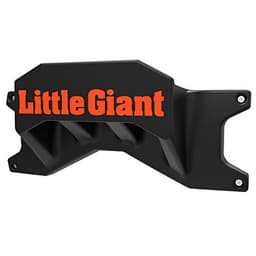
75 lb, mounted into studs at 16 in centers, from the company that makes the ladders. The only ladder storage here with a capacity figure from the ladder manufacturer.
Published specs
- Rated capacity
- Up to 75 lb
- Mounting
- Into wall studs at 16 in centers
- Material
- Plastic
- Included
- Mounting screws
Figures are the manufacturer's, from the Little Giant Ladder Rack product page on littlegiantladders.com, read 2026-09-21. We have not verified them by testing and do not imply that we have.
Our scoring
- Published capacity
- 7.5
- Documentation
- 8.0
- Install simplicity
- 8.5
- Build
- 6.5
- Value
- 9.0
What works
- A published 75 lb rating, which almost nothing else in ladder storage offers
- Made by a ladder manufacturer, so the cradle shape suits ladder rails
- Screws included and the stud spacing is stated rather than implied
- Cheap enough that a second set for a different wall is not a decision
What doesn't
- 75 lb is enough for most domestic ladders but not for a heavy extension ladder
- Plastic rather than steel, and it is holding something that hurts when it falls
- No warranty is published on the product page
- 16 in stud spacing is stated — a 24 in stud wall needs a different answer
Skip this one if the ladder is a heavy fiberglass extension type. Weigh it first; 75 lb goes quickly with a two-section ladder.
#2 · Best if you already have a rail
Rubbermaid FastTrack Ladder Hook
Rubbermaid
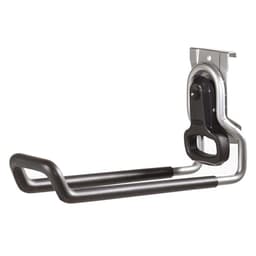
The ladder hook for the FastTrack rail, which publishes 1,750 lb across 48 inches. The rail is the rated part; the hook, as ever with FastTrack, is not.
Published specs
- System
- Rubbermaid FastTrack rail
- Rail capacity
- Up to 1,750 lb per 48 in rail
- Per-hook rating
- Not published by Rubbermaid
- Position
- Slides anywhere along the rail
Figures are the manufacturer's, from Rubbermaid's own FastTrack rail listing and the True Value listing for the 48 in rail, read 2026-09-16. We have not verified them by testing and do not imply that we have.
Our scoring
- Published capacity
- 4.0
- Documentation
- 5.0
- Install simplicity
- 9.0
- Flexibility
- 9.5
- Value
- 8.0
What works
- Slides along the rail, so the ladder position is not fixed by where a stud happens to be
- Shares the rail with every other FastTrack hook, basket and shelf
- The rail itself carries a published 1,750 lb figure across 48 in
- Takes the ladder off the floor in the one move, with no separate fixings
What doesn't
- Rubbermaid publishes no per-hook capacity, so the hook is the unrated link
- Only makes sense if you are buying or already own the FastTrack rail
- A hook holds the ladder by one point rather than cradling both rails
Skip this one if you have no rail and no plan to fit one. On its own this is an expensive way to hang one ladder.
#3 · Best rail for mixed stud spacing
Rubbermaid FastTrack 48 in Rail (2-pack)
Rubbermaid
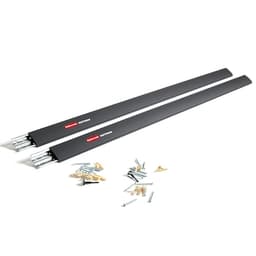
Rubbermaid publishes 1,750 lb per 48 in rail and a fit on both 16 in and 24 in stud spacing. The stud-spacing flexibility is the practical advantage; the rail rating is a number you will never approach, because the hooks decide it.
Published specs
- Rail length
- 48 in
- Published capacity
- Up to 1,750 lb per rail
- Stud spacing
- Works with 16 in or 24 in
- Material
- Steel
Figures are the manufacturer's, from Rubbermaid's own FastTrack rail listing and the True Value listing for the 48 in rail, read 2026-09-16. We have not verified them by testing and do not imply that we have.
Our scoring
- Published capacity
- 8.5
- Fit range
- 9.0
- Accessory range
- 8.5
- Install simplicity
- 8.5
- Documentation
- 6.5
What works
- Works with 16 in or 24 in stud spacing, so an older or non-standard garage wall is less likely to rule it out
- 1,750 lb per rail is published by Rubbermaid on its own listing — a real, checkable figure
- Sold widely enough that hooks and accessories stay easy to find
- Rails are cheap to add in bands, so a wall can be treated in stages
What doesn't
- The 1,750 lb rail figure is not the limit you will hit — individual hooks carry their own much lower ratings, and the kit listings we verified do not publish them
- Rubbermaid and Gladiator publish capacity in different ways, so the two rail figures are not directly comparable
- Accessories are FastTrack-profile only; they do not fit Gladiator or slatwall
Skip this one if the wall is becoming a matched system of cabinets, shelving and a workbench. FastTrack is a rail and hook system, and if the garage is going to look like one designed thing, the Gladiator range is the one built to line up.
#4 · Best track system
Gladiator GearTrack Channels
Gladiator GarageWorks
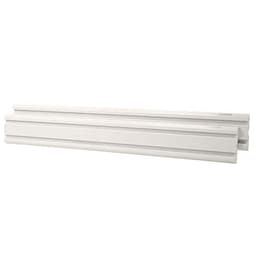
75 lb per linear foot, published in the installation manual rather than buried in marketing copy. Track beats full-panel systems when what you are hanging is heavy and few rather than light and many.
Published specs
- Rated capacity
- 75 lb per linear foot
- Mounting
- Into wood studs, including through drywall
- Format
- Horizontal channels, sold in packs
Figures are the manufacturer's, from Gladiator installation instructions W11087876 Rev A, read 2026-09-01. We have not verified them by testing and do not imply that we have.
Our scoring
- Published capacity
- 9.5
- Coverage per dollar
- 7.0
- Accessory range
- 9.0
- Install simplicity
- 8.5
- Documentation
- 9.5
What works
- 75 lb per linear foot is the highest published figure of the mainstream wall systems here
- Track means you only cover the strip of wall you need, not the whole thing
- Accessory range is broad and stays available
- The capacity figure is published in the installation instructions, which is where a figure you are going to rely on belongs
What doesn't
- Only holds things at the height of the track, so you are installing two or three runs to get real coverage
- The per-linear-foot rating assumes the track is fastened into studs, which caps you at where the studs are
- Accessories are proprietary
Skip this one if the wall is going to hold a lot of small light things — hand tools, spray cans, cordless batteries. That is pegboard's job, and pegboard does it for a fraction of the price.
Questions people actually ask
How much weight can a ladder rack hold?
Little Giant publishes up to 75 lb for its wall-mount ladder rack, which covers most domestic step and extension ladders. Rubbermaid publishes 1,750 lb for a 48 in FastTrack rail but no rating for the ladder hook that clips into it.
Should a ladder be stored horizontally or vertically?
Horizontally for extension ladders, because the weight splits between two supports and nothing rests on the floor. Vertically for step ladders in a narrow garage, where a single hook or strap uses almost no wall.
Can you hang a ladder on drywall?
No. Ladder mounts belong in studs. A 30 lb ladder on drywall anchors is a failure waiting for the first time someone pulls it down at an angle.
How high should a ladder be hung in a garage?
High enough to walk under and low enough to lift down safely — shoulder height for the lower support is the usual compromise. Check the car door arc with the door fully open before you drill.
Sources
- Little Giant Ladder Rack (15097) — rated to securely hold up to 75 lb, mounts to studs at 16 in centers, plastic, mounting screws provided, no warranty listedChecked September 21, 2026
- Rubbermaid FastTrack 48 in rail — up to 1,750 lb per rail, works with 16 in or 24 in stud spacingChecked September 16, 2026
- Gladiator installation instructions W11087876 Rev A — GearTrack 75 lb per linear foot, into wood studs through drywallChecked September 16, 2026
- StoreYourBoard Heavy Duty Bike Hoist — 70 lb, for the ceiling-storage comparisonChecked September 21, 2026
Manufacturer documentation, manuals, warranty terms and exact product models reviewed September 21, 2026.
Read next
- Where the ladder goesHorizontal, high, on two hooks into studs. Why leaning is the worst option for a ladder.
- Garage hooks: what the weight ratings actually meanWhat garage hook ratings really mean, and which wall system to hang heavy things from.
- How much weight can a garage wall hold?The fixing decides it, not the wall. Published stud-versus-drywall figures and how to find your studs.
- Rubbermaid FastTrack or Gladiator GearTrack?Published rail ratings, stud spacing and accessory systems on the two big garage wall rails — and why the rating gap misleads.
- The best garage wall storage systemsTrack, slatwall, panels and metal pegboard on published load ratings, converted into one comparable question.
- Storage above the garage doorThe most tempting dead space in the garage, and the door clearances that decide what can go there.