The Mess
Where the ladder goes
Leaning in the corner, in the way, falling over when anything touches it. A ladder wants to be horizontal, high, and on two hooks into studs.
Disclosure: Rail & Rafter earns a commission on qualifying purchases made through links on this page, at no cost to you. Commission does not decide what we recommend — our criteria do, and here is how we are funded.

The ladder is leaning against the back wall where it has been since you moved in. It falls over about twice a year. It blocks the shelf behind it, and every time you need something from that shelf the ladder has to move.
Ladders go horizontally, high on a wall, on two hooks into studs. That is the answer for almost every garage, and the reasons are worth spelling out because they are not obvious.
Why horizontal rather than vertical
The instinct is to stand a ladder up against a wall, because that is the smallest floor footprint. Three problems with it:
- It is unstable. A tall, narrow, top-heavy object leaning on a wall falls over. That is not a maintenance issue, it is physics, and in a garage with children in it, it is a hazard.
- It occupies the wall it leans on. A ladder standing against a wall makes that whole strip of wall unusable, which is the single most valuable surface in a garage.
- It is stored at the height you use. A ladder is used at floor level, so storing it at floor level puts it in the way of everything you do.
Horizontal, above 6 ft, fixes all three at once. The ladder is out of the way, the wall below it is still usable, and it is stable because it is supported at two points.
The two-hook rule
Two hooks, spread wide, into studs
Support a ladder at two points, spread as far apart along its length as the studs allow. Two reasons:
Load sharing. Two hooks into two different studs halve the load on each and spread it across more structure — the same principle as an overhead rack bracket spanning two joists rather than loading one.
Sag. An extension ladder supported at two points close together is cantilevered at both ends and sags over years. Spread the support and it stays straight, the same way lumber does.
Standard framing is 16 inches on center, so hooks two or three studs apart gives you 32 or 48 inches of spread. On a track system you have more freedom — Gladiator GearTrack publishes 75 lb per linear foot, so a 4 ft run carrying a ladder is nowhere near the limit.
The constraint: leverage, not weight
A step ladder is not heavy. An extension ladder is heavier but still not enormous. Weight is not what makes this a stud-fixing job.
Leverage is. A ladder hanging on hooks sits away from the wall, and the further out the load sits, the more force it applies to the fixing. Wall Control's published figures assume weight sits at the base of a hook rather than the tip, precisely because of this — and it publishes 200 lb per panel into studs against 100 lb into drywall anchors.
Find the studs. The five-minute method, and the full explanation of why the fixing rather than the wall is the limit, is on how much weight a garage wall holds.
Where exactly on the wall
Above 6 feet, per the height bands on how to organize a garage wall. A ladder is light, awkward and used a few times a year, which is exactly the profile for the high band.
Two specific spots worth considering:
- The long wall, above a track run. If you already have track up for bikes, the run above it is the natural home for the ladder and the long-handled tools.
- The strips either side of the garage door. Narrow vertical wall that most garages waste entirely. A folding step ladder stands there without going anywhere near the door mechanism — unlike the space above the door, which the door needs.
What it costs and how long it takes
If you already have a wall system, this is fifteen minutes and two hooks. If you do not, two heavy-duty hooks lagged into studs is the cheapest possible version and works perfectly well — a ladder does not need a full system.
Pre-drill before driving lag screws into dry timber. Driving one without a pilot hole splits the stud, and a split stud is not a stud.
What not to do
- Do not lean it. It falls over, it occupies a wall, and it is stored at the height it is in the way.
- Do not hang it on drywall anchors. A ladder on hooks is a leveraged load away from the wall — the exact case where anchors are at their worst.
- Do not support it at two points close together. Spread them as far as the studs allow, or the ladder sags over years.
- Do not hang it over where the car parks unless you have measured. A ladder coming off a hook onto a car roof is an expensive way to learn about hook depth.
- Do not fix anything to the garage door tracks or spring. Not structure, and the torsion spring stores a large amount of energy.
What we would buy for this
Every pick carries the manufacturer's published specs, our scoring against stated criteria, and a reason you might want to skip it.
#1 · Best track system
Gladiator GearTrack Channels
Gladiator GarageWorks
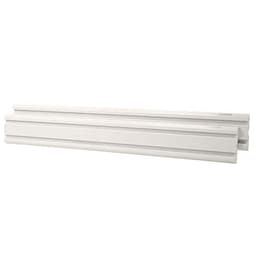
75 lb per linear foot, published in the installation manual rather than buried in marketing copy. Track beats full-panel systems when what you are hanging is heavy and few rather than light and many.
Published specs
- Rated capacity
- 75 lb per linear foot
- Mounting
- Into wood studs, including through drywall
- Format
- Horizontal channels, sold in packs
Figures are the manufacturer's, from Gladiator installation instructions W11087876 Rev A, read 2026-09-01. We have not verified them by testing and do not imply that we have.
Our scoring
- Published capacity
- 9.5
- Coverage per dollar
- 7.0
- Accessory range
- 9.0
- Install simplicity
- 8.5
- Documentation
- 9.5
What works
- 75 lb per linear foot is the highest published figure of the mainstream wall systems here
- Track means you only cover the strip of wall you need, not the whole thing
- Accessory range is broad and stays available
- The capacity figure is published in the installation instructions, which is where a figure you are going to rely on belongs
What doesn't
- Only holds things at the height of the track, so you are installing two or three runs to get real coverage
- The per-linear-foot rating assumes the track is fastened into studs, which caps you at where the studs are
- Accessories are proprietary
Skip this one if the wall is going to hold a lot of small light things — hand tools, spray cans, cordless batteries. That is pegboard's job, and pegboard does it for a fraction of the price.
#2 · Best full-wall panel system
Gladiator GearWall Panels
Gladiator GarageWorks
50 lb per square foot across a whole panel, which is a different kind of number from GearTrack's per-foot rating: it buys you the freedom to hang anything anywhere rather than only on a line.
Published specs
- Rated capacity
- 50 lb per square foot
- Mounting
- Into wood studs, including through drywall
- Format
- Full-height slatted panels
Figures are the manufacturer's, from Gladiator installation instructions W11087876 Rev A, read 2026-09-01. We have not verified them by testing and do not imply that we have.
Our scoring
- Published capacity
- 8.5
- Coverage per dollar
- 6.5
- Accessory range
- 9.0
- Install simplicity
- 7.0
- Documentation
- 9.5
What works
- Hang anything at any height rather than only where a track run happens to be
- 50 lb per sq ft across a full panel is a large total load
- Shares the Gladiator accessory range with GearTrack
What doesn't
- Covering a whole wall in panels costs several times what two track runs cost
- It is a wall finish as much as a storage system, so it is a bigger commitment to undo
- Per-square-foot ratings are harder to reason about than per-foot ones — a single 60 lb item is not the rated case
Skip this one if you know exactly what is going on that wall and it is six things. Two runs of track will hold them for a fraction of the cost, and the wall stays a wall.
Questions people actually ask
How should I store a ladder in a garage?
Horizontally, above 6 ft, on two hooks fixed into studs and spread as far apart along its length as the studs allow. That keeps it out of the way, keeps the wall below usable, and stops it sagging.
Why not just lean the ladder against the wall?
It falls over, it makes that whole strip of wall unusable, and it is stored at the height where it is in the way of everything else. Horizontal storage fixes all three at once.
Can I hang a ladder on drywall anchors?
No. A ladder on hooks sits away from the wall, which multiplies the force on the fixing — leverage rather than weight is what makes this a stud-fixing job. Published wall ratings halve when you move from studs to drywall anchors.
How far apart should ladder hooks be?
As far apart as the studs allow — two or three studs apart at standard 16 in framing gives 32 or 48 inches. Close-together hooks leave the ladder cantilevered at both ends and it sags over years.
Can I store a ladder above the garage door?
Not directly above the opening on a standard sectional door — the door travels up and back into that volume. The narrow strips of wall either side of the opening work well and have none of the clearance problems.
Sources
- Gladiator GearTrack installation instructions W11087876 Rev A — 75 lb per linear foot, stud mountingChecked September 1, 2026
- Wall Control published capacity guidance — stud versus drywall anchor, weight at the hook baseChecked September 1, 2026
Manufacturer documentation, manuals, warranty terms and exact product models reviewed September 1, 2026.
Read next
- The best garage wall storage systemsTrack, slatwall, panels and metal pegboard on published load ratings, converted into one comparable question.
- How much weight can a garage wall hold?The fixing decides it, not the wall. Published stud-versus-drywall figures and how to find your studs.
- Storage above the garage doorThe most tempting dead space in the garage, and the door clearances that decide what can go there.
- Where the lumber and plywood goOffcuts and sheet goods are two problems. Where each goes, and why leaning plywood warps.
- How to organize a garage wallThree height bands, four walls, and the order to install in so you do not do it twice.
- Your garage is full. Start here.Four passes that turn a full garage into a list of piles, each with a system that fits it.
- The best ladder storage racksLadder racks and hooks on published capacity and stud spacing, checked against what real ladders weigh.