Overhead
The best ceiling bike hoists
A hoist puts the bike where nothing else competes for the space. It also adds a minute to every ride, which is the real reason some of these end up unused.
Disclosure: Rail & Rafter earns a commission on qualifying purchases made through links on this page, at no cost to you. Commission does not decide what we recommend — our criteria do, and here is how we are funded.

Quick picks
Our ranking, verdict first. Every row links to the full write-up below, and every price cell goes straight to Amazon. Scores follow the criteria on our methodology page.
| # | Product | Best for | Score | Price |
|---|---|---|---|---|
| 1 |  StoreYourBoard Heavy Duty Bike Hoist70 lb on a 4:1 pulley, which the manufacturer says cuts the lifting effort by three quarters, plus straps that hold the top tube and front wheel instead of hooks that hold a rim. StoreYourBoard Heavy Duty Bike Hoist70 lb on a 4:1 pulley, which the manufacturer says cuts the lifting effort by three quarters, plus straps that hold the top tube and front wheel instead of hooks that hold a rim. | Best bike hoist overall | 8.4 | $99.99View on AmazonPrice as of September 21, 2026. #ad how this is funded |
| 2 |  RAD Sportz Bicycle Hoist, 2-pack100 lb per hoist on the listing, two in a box, for the price of a decent hook. The rope-and-pulley basics done cheaply, with all the compromises that implies. RAD Sportz Bicycle Hoist, 2-pack100 lb per hoist on the listing, two in a box, for the price of a decent hook. The rope-and-pulley basics done cheaply, with all the compromises that implies. | Best value hoist | 7.3 | $27.21View on AmazonPrice as of September 21, 2026. #ad how this is funded |
| 3 |  Steadyrack Classic Road Bike Rack77 lb per bike, published, on a rack that pivots flat against the wall so the bike stops being an obstacle when you are not riding it. That pivot is what you are paying for. Steadyrack Classic Road Bike Rack77 lb per bike, published, on a rack that pivots flat against the wall so the bike stops being an obstacle when you are not riding it. That pivot is what you are paying for. | Best wall-mounted bike rack | 8.6 | $91.99View on Amazon |
| 4 |  Delta Cycle Michelangelo 2-Bike Gravity StandTwo bikes, 80 lb total, and not a single hole in the wall. For a rented garage this is frequently the only bike storage you are allowed to install. Delta Cycle Michelangelo 2-Bike Gravity StandTwo bikes, 80 lb total, and not a single hole in the wall. For a rented garage this is frequently the only bike storage you are allowed to install. | Best if you cannot drill | 7.6 | $94.41View on Amazon |
Scores are our editorial assessment against the criteria on how we pick. They are not test results and are not marked up as review ratings.
A ceiling hoist is the only bike storage that uses space nothing else wants. Wall racks take wall you could have used for shelving; floor stands take floor you could have parked on. The ceiling above the hood of a parked car is otherwise dead air.
The catch is the one nobody mentions in the product photos: a hoist adds about a minute to each end of every ride. That is fine for the bike you use monthly and intolerable for the one you ride to work. Which bike you are storing decides this purchase more than any specification does.
We have not installed these. What follows is each manufacturer's published figures read against what a garage ceiling can actually take — the method is on how we pick, and the rest of the category is in the overhead hub.
How we picked
- A published weight capacity. Bikes range from a 20 lb road bike to a 70 lb e-bike, and that range crosses most hoist ratings.
- A published mechanical advantage. A 4:1 pulley means you pull a quarter of the weight. Cheap hoists rarely publish a ratio at all.
- How the bike is held. Straps around the frame and wheel behave differently from bare hooks under the rims.
- What it mounts to. Joists, and whether the hardware works across them or along them.
- An honest alternative. Two wall racks are on this list because for a lot of riders they are the better answer.
The published figures
| Product | Published capacity | Mechanism | Ceiling / mount |
|---|---|---|---|
| StoreYourBoard Heavy Duty Bike Hoist | 70 lb | 4:1 pulley, straps around top tube and front wheel | Up to 14 ft, parallel or perpendicular joists |
| RAD Sportz Bicycle Hoist (2-pack) | 100 lb per hoist, as listed | Rope and pulley with rope lock, hooks | Ceiling joists |
| Steadyrack Classic (wall) | Not published as a weight | Pivoting wall rack, front wheel | Wall, into studs |
| Delta Michelangelo (floor) | 2 bikes, published | Gravity stand, no fixings | Floor to ceiling tension |
The number to look at first is 70 lb against 100 lb, and then to distrust slightly. The 70 lb figure comes from a manufacturer page with a lifetime warranty behind it. The 100 lb figure comes from a retail listing with no specification sheet behind it. A published number and a listing number are not the same kind of evidence, and we would rather say so than average them.
Weigh the bike before you choose
Bike weight has moved a long way in ten years, and hoist ratings have not moved with it. Rough figures worth checking against your own bike:
| Bike type | Rough weight | Inside 70 lb? |
|---|---|---|
| Road bike | 17 to 25 lb | Comfortably |
| Hardtail mountain bike | 26 to 33 lb | Comfortably |
| Full-suspension mountain bike | 30 to 38 lb | Comfortably |
| Kids' bike | 20 to 30 lb | Comfortably |
| Commuter e-bike | 45 to 60 lb | Yes, with margin |
| Cargo e-bike | 60 to 80 lb+ | Often not — weigh it |
The pattern: a 70 lb hoist covers everything except a cargo e-bike. If you own one of those, weigh it on a bathroom scale before buying anything, and remember that the battery is usually still in it when it goes up.
What the ceiling can take
The hoist rating is not the binding constraint in most garages — the ceiling is. A hoist concentrates its whole load into two fixings in one or two joists, which is a very different thing from a rack that spreads a load across four.
Fix into joists, and find them properly
Every hoist here mounts to joists, not to drywall, and not to the sheathing between joists. A stud finder plus a test screw is the whole procedure, and it is not optional with something suspended over a car.
What a garage ceiling can carry, and how truss type changes the answer, is worked through in how much weight a garage ceiling can hold.
The StoreYourBoard hoist publishes something unusually useful here: it mounts parallel or perpendicular to joists, at any stud spacing. That means the bike can hang where you want it rather than where the framing dictates. Fixed-spacing hardware forces the bike to hang square to the joists, which in a narrow garage can put a handlebar exactly where the car door opens.
Ceiling height, and the number people forget
A hoisted bike does not go to the ceiling. It goes to the ceiling minus the height of the bike, which is roughly 3 ft 6 in for an adult bike hanging horizontally.
In a standard 8 ft garage that leaves about 4 ft 6 in of clearance underneath — fine over a car hood, tight over an SUV, and not workable over a roof box. The StoreYourBoard system publishes a fit for ceilings up to 14 ft, which matters in a garage with a raised or vaulted ceiling where cheaper hoists run out of rope.
If your ceiling is low to start with, a hoist may be the wrong category entirely — the alternatives are in garage storage for a low ceiling.
Straps or hooks: how the bike is held
Hooks
The cheap standard. Two J-hooks go under the rims or the frame and the rope lifts them. It works, and it puts all the load on two points of a wheel that was built for radial loads. Padding the hooks is on you, and an unpadded hook against a carbon rim is a genuine risk.
Straps
The StoreYourBoard system straps the top tube and the front wheel, which spreads the load into the frame and stops the bike from tilting or the handlebars rotating as it goes up. On any bike with a carbon frame or fancy wheels, that difference is worth the price gap on its own.
When a wall rack beats every hoist
Two of the picks on this page are not hoists at all, and that is deliberate.
If you ride weekly or more, a pivoting wall rack takes about five seconds each way against roughly a minute for a hoist. Storage you resent using is storage that ends up unused, with the bike back against the wall where it started. The wall options are ranked in the best garage bike racks.
If you cannot drill — a rented garage, a finished ceiling, a concrete slab above — a floor-to-ceiling gravity stand holds two bikes with no fixings at all.
If the bike is an everyday e-bike, lifting 55 lb overhead every day is a real consideration even at 4:1. A floor stand or a wall rack rated for the weight is usually the better life.
The whole decision, including the case for the floor, is in where the bikes go.
Installing a hoist, in the right order
- Park the car first, then mark. Position the hoist with the vehicle in its usual spot, doors open, so you find the conflict before you drill rather than after.
- Locate the joists and verify with a test screw. A stud finder alone over drywall is not proof.
- Mount the two pulleys the width of the bike apart, aligned with how the bike will hang, not with where the joists happen to be convenient.
- Fit the cleat at a height you can reach with a bike on the rope, and clear of anything the rope could snag.
- Test with the bike at knee height first. Load it, lift it a foot, and leave it there while you check every fixing before it goes over the car.
What we could not verify
- RAD Sportz has no manufacturer specification sheet we could find. Its 100 lb figure comes from the retail listing, which is weaker evidence than the StoreYourBoard page.
- Rope and pulley materials are not published in detail by either hoist maker, and rope is the wear part.
- No hoist here publishes a fixing specification — screw size, embedment depth or minimum joist dimension. That is a real gap in a product that hangs over a car.
- Steadyrack publishes no weight limit for the Classic, which we also flag in the bike rack roundup.
- Long-term wear. We have not run any of these for a season and will not pretend otherwise.
Who should buy which
Buy the StoreYourBoard hoist if the bike is worth protecting or heavy, the ceiling is high, or you want the published figures and the lifetime warranty. It is the best-documented hoist here.
Buy the RAD Sportz 2-pack if the job is two old bikes, a ladder or a kayak and the budget matters more than the paperwork. Pad the hooks.
Buy a Steadyrack instead if you ride weekly. Five seconds against a minute decides whether the system survives contact with real life.
Buy the Delta floor stand instead if you cannot drill, or the ceiling is not yours to fix into.
The picks in full
Every pick carries the manufacturer's published specs, our scoring against stated criteria, and a reason you might want to skip it.
#1 · Best bike hoist overall
StoreYourBoard Heavy Duty Bike Hoist
StoreYourBoard
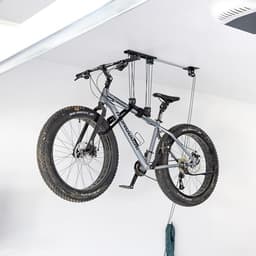
70 lb on a 4:1 pulley, which the manufacturer says cuts the lifting effort by three quarters, plus straps that hold the top tube and front wheel instead of hooks that hold a rim.
Published specs
- Weight capacity
- 70 lb
- Mechanical advantage
- 4:1, reducing lifting effort by 75 percent
- Ceiling height
- Fits ceilings up to 14 ft
- Mounting
- Parallel or perpendicular joists, any stud spacing
- Warranty
- Lifetime
Figures are the manufacturer's, from the StoreYourBoard Heavy Duty Bike Hoist page on storeyourboard.com, read 2026-09-21. We have not verified them by testing and do not imply that we have.
Our scoring
- Published capacity
- 8.5
- Lifting effort
- 9.5
- Bike protection
- 9.0
- Install flexibility
- 9.0
- Value
- 6.0
What works
- 70 lb covers an e-bike, which most hoists in this category do not
- Straps around the top tube and front wheel rather than hooks under the rims
- Mounts across joists in either direction, so the bike does not have to hang where the framing says
- Lifetime warranty, published
What doesn't
- Costs several times what a basic hook-and-pulley hoist costs
- A hoist is slower to use than a wall hook — this is for the bike you ride monthly, not daily
- 70 lb is the system limit, so a heavy cargo e-bike is out
- Ceiling storage means the bike is over whatever you park underneath it
Skip this one if the bike gets ridden several times a week. A wall rack takes seconds and a hoist takes a minute, and that difference decides whether you keep using it.
#2 · Best value hoist
RAD Sportz Bicycle Hoist, 2-pack
RAD Sportz
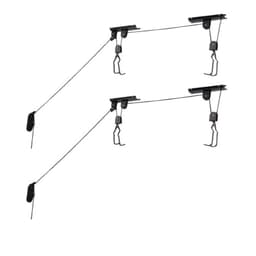
100 lb per hoist on the listing, two in a box, for the price of a decent hook. The rope-and-pulley basics done cheaply, with all the compromises that implies.
Published specs
- Weight capacity
- 100 lb per hoist, as listed
- Quantity
- 2 hoists per pack
- Mechanism
- Rope and pulley with rope lock
- Hangs from
- Ceiling joists
Figures are the manufacturer's, from the RAD Sportz Bicycle Hoist listing, read 2026-09-21. We have not verified them by testing and do not imply that we have.
Our scoring
- Published capacity
- 7.5
- Lifting effort
- 6.0
- Bike protection
- 5.5
- Install flexibility
- 7.0
- Value
- 9.5
What works
- Two hoists in a pack for less than most single units cost
- 100 lb listed capacity covers bikes, ladders and most cargo boxes
- The same hardware works for kayaks and ladders, not just bikes
What doesn't
- Hooks bear on the rims or frame rather than strapping the bike, so padding is on you
- No manufacturer specification sheet beyond the retail listing
- Rope locks on cheap hoists are the part that wears — inspect it before each season
- No published mechanical advantage, so expect to pull harder than with a 4:1 system
Skip this one if you want a published, traceable specification. The 100 lb figure comes from the listing rather than an engineering sheet, and we would rather say so.
#3 · Best wall-mounted bike rack
Steadyrack Classic Road Bike Rack
Steadyrack
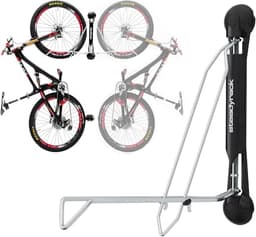
77 lb per bike, published, on a rack that pivots flat against the wall so the bike stops being an obstacle when you are not riding it. That pivot is what you are paying for.
Published specs
- Max recommended bike weight
- 35 kg / 77 lb
- Wheel diameter
- 20 in to 29 in
- Maximum tire width
- 2.1 in
- Material
- Chrome plated steel
- Mounting
- Four screws into timber stud, masonry, brick or concrete
Figures are the manufacturer's, from the Steadyrack Classic Road Bike Rack product page on steadyrack.com, read 2026-09-13. We have not verified them by testing and do not imply that we have.
Our scoring
- Published capacity
- 9.0
- Space saved
- 9.5
- Bike protection
- 9.0
- Tire compatibility
- 6.0
- Install simplicity
- 7.5
What works
- 77 lb per bike published — comfortably more than any road or hybrid bike weighs
- Pivots so the bike swings flat to the wall, which is the difference between parking a car alongside it and not
- Holds the bike by the wheel, so there is no frame contact to mark paint or carbon
- Fixings included for both timber and masonry
What doesn't
- 2.1 in maximum tire width rules out most mountain and fat bikes — those need the MTB or Fat version instead
- Steadyrack states it is for bikes without fenders
- One bike per rack, so a family of four is four racks and four sets of studs
Skip this one if your bikes are mountain bikes with 2.4 in or wider tires, or they have fenders. Buying the road version for an MTB is the most common mistake with this product and the tire width is published precisely so you can avoid it.
#4 · Best if you cannot drill
Delta Cycle Michelangelo 2-Bike Gravity Stand
Delta Cycle
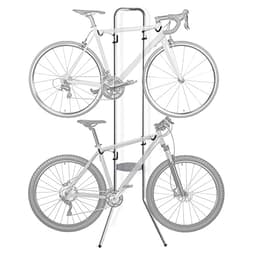
Two bikes, 80 lb total, and not a single hole in the wall. For a rented garage this is frequently the only bike storage you are allowed to install.
Published specs
- Capacity
- Holds up to 80 lb
- Bikes
- 2
- Mounting
- Gravity stand — no drilling required
- Adjustment
- Fully adjustable arms
Figures are the manufacturer's, from Delta Cycle's own published product listings for the Leonardo and Michelangelo racks, read 2026-09-13. We have not verified them by testing and do not imply that we have.
Our scoring
- Published capacity
- 7.5
- Space saved
- 5.5
- No-drill suitability
- 10.0
- Stability
- 6.0
- Install simplicity
- 9.5
What works
- No drilling at all, which makes it the renter's answer and the block-wall answer
- 80 lb published across two bikes
- Adjustable arms take road, mountain and hybrid frames
- Moves with you — it is furniture rather than a fixture
What doesn't
- A gravity stand leans on the wall and stands on the floor, so it does NOT save floor space the way a wall rack does
- Two bikes is the limit, and the upper bike has to be lifted to shoulder height
- Anything that leans can be knocked over; this is the wrong choice where children play
Skip this one if you can drill. A wall-mounted rack holds more, takes no floor, and cannot be knocked over — the gravity stand exists to solve a permission problem, not a storage one.
Questions people actually ask
How much weight can a bike hoist hold?
StoreYourBoard publishes 70 lb for its heavy duty bike hoist, which covers everything up to a commuter e-bike. Budget hoists commonly list 100 lb, but from a retail listing rather than a published specification. Weigh a cargo e-bike before trusting either figure.
Can you hang an e-bike from a ceiling hoist?
A commuter e-bike at 45 to 60 lb is inside a published 70 lb rating. A cargo e-bike often is not. Weigh the bike with its battery in, since that is how it goes up.
Do bike hoists need to be mounted into joists?
Yes. Every hoist here mounts into ceiling joists, not drywall. The load is concentrated into two fixings, so find the joists with a stud finder and confirm with a test screw before drilling.
How much ceiling height do you need for a bike hoist?
An adult bike hanging horizontally is roughly 3 ft 6 in deep, so an 8 ft ceiling leaves about 4 ft 6 in underneath. That clears a car hood but not a roof box. StoreYourBoard publishes a fit for ceilings up to 14 ft.
Is a bike hoist better than a wall rack?
Only for bikes you use rarely. A hoist uses space nothing else wants but takes about a minute each way; a pivoting wall rack takes seconds and costs you wall instead of ceiling.
Sources
- StoreYourBoard Heavy Duty Bike Hoist — 70 lb capacity, 4:1 mechanical advantage reducing lifting effort by 75 percent, fits ceilings up to 14 ft, parallel or perpendicular joists at any stud spacing, straps hold top tube and front wheel, lifetime warrantyChecked September 21, 2026
- RAD Sportz Bicycle Hoist 2-pack — 100 lb capacity per hoist, rope and pulley with rope lock (figures from the retail listing; no manufacturer specification sheet located)Checked September 21, 2026
- Steadyrack Classic bike rack — pivoting wall rack, front wheel; no weight limit publishedChecked September 13, 2026
- Delta Cycle Michelangelo — two-bike floor-to-ceiling gravity stand, no fixings requiredChecked September 13, 2026
Manufacturer documentation, manuals, warranty terms and exact product models reviewed September 21, 2026.
Read next
- Where the bikes goBikes are a wall problem, not a floor problem. The system, the stud check, and why hoists get abandoned.
- The best garage bike racksWall-mounted bike racks ranked on published per-bike capacity, tire fit and whether they pivot.
- How much weight can a garage ceiling hold?The complete 2x4 to 2x10 joist span tables at four spacings, and the arithmetic for your own ceiling.
- The best overhead garage storage racksFour overhead racks ranked on capacity, drop range and joist fit, with a reason to skip each one.
- Garage storage for a low ceilingThe clearance arithmetic for a 7 or 8 ft ceiling, and the two places a rack still works.
- Where the kayak goesThe one item where a ceiling hoist is genuinely right, plus the hull-support rule that saves the boat.