The Mess
Where the skis and snowboards go
Long, light, seasonal and sharp. Three of those make skis easy to store; the fourth is why you do not lean them against the drywall.
Disclosure: Rail & Rafter earns a commission on qualifying purchases made through links on this page, at no cost to you. Commission does not decide what we recommend — our criteria do, and here is how we are funded.

Put them on the wall, horizontally, on a track. Skis and snowboards are the easiest thing in this entire hub to store well, because they are light enough for almost any system and flat enough to sit against a wall without eating the room.
The reason they end up in a corner instead is that nothing in a standard garage is shaped for a 170 cm object. The fix is a horizontal band of track rather than a shelf. If you are working out the whole garage rather than one pile, start at the triage guide; the wall systems themselves are ranked in the wall hub.
Why this is a wall problem, not a shelf problem
A pair of skis is roughly 150 to 190 cm long and weighs about 7 to 10 lb with bindings. A snowboard is shorter and similar. That combination — long and light — is exactly wrong for shelving and exactly right for a wall.
- No shelf is long enough. A 24 in deep shelf holds a ski across it at a diagonal, wasting the shelf and still leaving the tips proud.
- Standing them in a corner means they fall over. Every time someone reaches past, and they take the paint with them.
- They are light enough that capacity is a non-issue. Almost any published rating clears a pair of skis easily, which is not true of bikes or ladders.
What to hang them on
| System | Published rating | Enough for skis? |
|---|---|---|
| Gladiator GearTrack | 75 lb per linear foot | Yes, by a wide margin |
| Proslat classic PVC slatwall | 75 lb per square foot | Yes |
| Gladiator GearWall | 50 lb per square foot | Yes |
| Wall Control metal pegboard | 10 to 15 lb per two-slot hook | Yes — two hooks, spread the pair |
Track is the best answer. Gladiator GearTrack publishes 75 lb per linear foot into studs, and a horizontal band at chest height takes skis, boards and poles on hooks you can slide along the channel as the collection changes. You are not buying it for the capacity — you are buying it because a band of track is the only thing in a garage shaped like a ski.
Pegboard works and is cheapest. Wall Control publishes 10 to 15 lb per two-slot hook, so a pair of skis across two hooks is comfortably inside the rating. Use two hooks, not one — a single hook under a 170 cm object is a pivot.
Slatwall if the wall is damp. Proslat's PVC does not care about an unheated garage, which matters more here than usual because ski gear comes home wet. The panel comparison is in Proslat against Gladiator GearWall.
Edges mark everything they touch
Ski and snowboard edges are hardened steel, and they will score drywall, cut into painted board and mark a car roof on the way past. Hang them edge-in towards the wall where the system allows it, and keep the traffic path clear of the tips. This is the one way ski storage damages a garage.
Dry them before you store them
This is the part that costs people equipment rather than wall space.
Skis come home wet, and edges are steel. Hanging a wet pair on a wall in an unheated garage in March and finding them again in November is how you get rust on the edges and corrosion around the binding hardware. Bindings should also be left in a relaxed state for long storage rather than under spring tension — check what your binding manufacturer says, because that varies.
Dry, then hang. A day standing in the house beats eight months of slow rust in the garage.
When to put them overhead instead
Ski gear is used for a few months and then not at all, which makes it a legitimate overhead candidate — it is exactly the bulky, light, seasonal profile a ceiling rack is for.
A 4x8 overhead rack publishes 600 lb with decking and holds skis, boards, poles and the bag of cold-weather kit that goes with them, all in one place, out of the way for the eight months nobody wants them. The ceiling question comes first though — the span tables are in how much weight a garage ceiling can hold, and the racks themselves are in the overhead rack ranking.
The honest trade: overhead means a ladder every time. If you ski six weekends a year that is fine. If you ski most weekends, keep them on the wall where you can grab them.
What not to do
- Do not lean them in a corner. They fall, they mark the wall, and the corner is usually the dampest part of the garage — which is the worst place for steel edges.
- Do not hang them from one hook. A single point under a long object is a pivot, and the pair will swing and slide.
- Do not store them wet. Covered above and worth repeating, because it is the mistake that actually costs money.
- Do not put them where a car door opens. Tips at car-door height in a narrow garage is a scratched door and a bent ski.
The rest of the winter pile
Skis are rarely alone. Boots, helmets and poles come with them, and they are a different shape of problem.
- Boots are heavy, awkward and should not hang from a hook rated for hand tools. They belong in a bin on a shelf, and they need to dry first — the bin options are in the storage bin roundup.
- Helmets want an open basket rather than a closed bin, because they need air and they get forgotten in a lid-down tote. This is the same argument made in the sports gear problem page.
- Poles go on the same track as the skis, on a small hook, and take almost no wall.
What we would buy for this
Every pick carries the manufacturer's published specs, our scoring against stated criteria, and a reason you might want to skip it.
#1 · Best track system
Gladiator GearTrack Channels
Gladiator GarageWorks
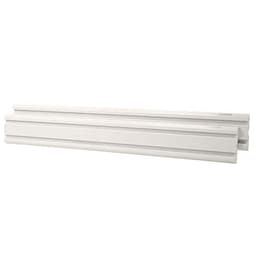
75 lb per linear foot, published in the installation manual rather than buried in marketing copy. Track beats full-panel systems when what you are hanging is heavy and few rather than light and many.
Published specs
- Rated capacity
- 75 lb per linear foot
- Mounting
- Into wood studs, including through drywall
- Format
- Horizontal channels, sold in packs
Figures are the manufacturer's, from Gladiator installation instructions W11087876 Rev A, read 2026-09-01. We have not verified them by testing and do not imply that we have.
Our scoring
- Published capacity
- 9.5
- Coverage per dollar
- 7.0
- Accessory range
- 9.0
- Install simplicity
- 8.5
- Documentation
- 9.5
What works
- 75 lb per linear foot is the highest published figure of the mainstream wall systems here
- Track means you only cover the strip of wall you need, not the whole thing
- Accessory range is broad and stays available
- The capacity figure is published in the installation instructions, which is where a figure you are going to rely on belongs
What doesn't
- Only holds things at the height of the track, so you are installing two or three runs to get real coverage
- The per-linear-foot rating assumes the track is fastened into studs, which caps you at where the studs are
- Accessories are proprietary
Skip this one if the wall is going to hold a lot of small light things — hand tools, spray cans, cordless batteries. That is pegboard's job, and pegboard does it for a fraction of the price.
#2 · Best in a damp or unheated garage
Proslat PVC Slatwall
Proslat
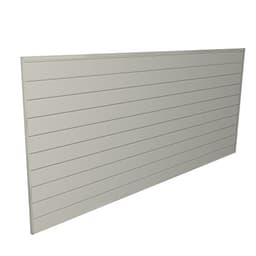
PVC rather than MDF or steel, rated to 75 lb per square foot and backed by a lifetime warranty. In a garage that gets damp, the material is the whole argument.
Published specs
- Rated capacity
- 75 lb per square foot
- Heavy-duty line
- Patented aluminum core rated to 200 lb
- Mounting
- 16 in studs
- Material
- PVC
- Warranty
- Lifetime
Figures are the manufacturer's, from the Proslat PVC slatwall collection page, read 2026-09-01. We have not verified them by testing and do not imply that we have.
Our scoring
- Published capacity
- 9.0
- Coverage per dollar
- 7.0
- Damp tolerance
- 9.5
- Install simplicity
- 7.5
- Documentation
- 8.5
What works
- PVC does not swell, rot or rust, which is the failure mode of MDF slatwall in an unheated garage
- 75 lb per sq ft is higher than Gladiator's panel rating
- Lifetime warranty
- The heavy-duty aluminum-core line is there when 75 lb per sq ft is not enough
What doesn't
- Published for 16 in stud spacing — a 24 in stud wall needs checking before you order
- Full-wall coverage is expensive, same as any panel system
- PVC has a plastic look that some people dislike next to steel cabinets
Skip this one if your studs are 24 in on center. The published mounting is 16 in, and stretching a panel system across wider studs is exactly the shortcut that ends with a panel pulling off the wall.
#3 · Best overall overhead rack
FlexiMounts GR48F 4 x 8 Overhead Rack
FlexiMounts
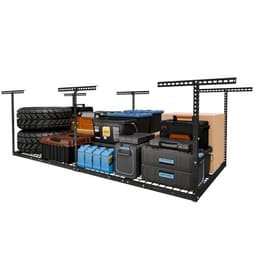
The widest useful drop range in its class and the only major rack that publishes what happens when your joists are further apart than 24 inches. That second fact is why it goes first.
Published specs
- Size
- 4 ft x 8 ft
- Rated capacity
- 600 lb, with 3/8 in plywood decking or thicker
- Ceiling drop
- 22 in to 40 in, adjustable
- Volume
- Up to 105 cu ft
- Joist spacing
- Any spacing up to 24 in; at wider spacing, fits 48 in exactly
Figures are the manufacturer's, from the FlexiMounts product page for the GR48F, read 2026-09-01. We have not verified them by testing and do not imply that we have.
Our scoring
- Published capacity
- 9.0
- Fit range
- 8.5
- Mounting honesty
- 9.5
- Low-ceiling suitability
- 7.0
- Documentation
- 9.0
What works
- 600 lb rating is at the top of the mainstream 4x8 field
- Publishes an explicit answer for joists wider than 24 in on center, which most brands leave you to discover on the ladder
- 22 in minimum drop is short enough for a lot of 8 ft ceilings
- Decking is your own plywood, so you can replace a sagging panel for the price of a sheet
What doesn't
- The 600 lb rating is conditional on you supplying 3/8 in plywood or thicker; the frame alone is not the rated system
- 22 in is still a real drop; under a 7 ft ceiling it leaves very little headroom
- Plywood is not included, so the real cost is the rack plus a sheet
Skip this one if your joists are 32 in or 36 in on center. The published fit is up to 24 in, or exactly 48 in — the in-between spacings mean mounting into a single joist per bracket, and that is how ceilings crack.
#4 · Best for hand tools
Wall Control Metal Pegboard
Wall Control
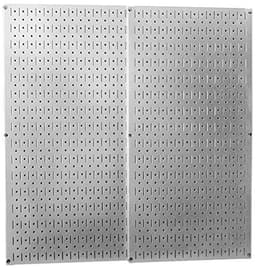
20-gauge steel pegboard with published per-panel and per-hook limits, which is more honesty about capacity than the entire hardboard-pegboard category offers combined.
Published specs
- Material
- 20-gauge galvanized steel
- Into studs
- Up to 200 lb per panel
- Into drywall anchors
- Up to 100 lb per panel
- Per hook, two slots
- 10 to 15 lb
- Per hook, one slot
- 5 to 10 lb
- Per shelf assembly
- 10 to 20 lb, evenly distributed
Figures are the manufacturer's, from Wall Control's published capacity guidance, read 2026-09-01. We have not verified them by testing and do not imply that we have.
Our scoring
- Published capacity
- 6.5
- Coverage per dollar
- 9.5
- Accessory range
- 9.0
- Install simplicity
- 8.0
- Documentation
- 10.0
What works
- Steel rather than hardboard, so the holes do not blow out and the board does not bow
- Publishes limits per panel, per hook AND per shelf — nobody else in pegboard does this
- Takes both round-hole and slotted accessories, so most existing pegboard hooks still work
- Cheapest way to get a lot of small tools off a bench and onto a wall
What doesn't
- Per-hook limits are genuinely low; this is a hand-tool wall, not a ladder-and-bike wall
- 100 lb per panel into drywall anchors is much less than 200 lb into studs, and most people install into drywall
- Panels are small, so a full wall is a lot of panels and a lot of alignment
Skip this one if what you need on the wall is bikes, ladders, or a wheelbarrow. A 10 to 15 lb hook limit is not a suggestion, and the right answer for those is track or heavy-duty hooks into studs.
Questions people actually ask
How do you store skis in a garage?
Horizontally on a wall, on two hooks rather than one, on a track or panel system fixed into studs. Skis are long and light — roughly 7 to 10 lb a pair with bindings — so capacity is never the constraint. Dry them thoroughly first, because steel edges rust in an unheated garage.
Can you hang skis on pegboard?
Yes. Wall Control publishes 10 to 15 lb per hook engaging two slots, which comfortably clears a pair of skis. Use two hooks spread along the length rather than one — a single hook under a 170 cm object acts as a pivot.
Is it bad to store skis in an unheated garage?
The temperature is not the problem; moisture is. Edges are steel and will rust if the skis go into storage wet. Dry them fully first, and check what your binding manufacturer says about leaving bindings under tension for long storage.
Should skis go overhead or on the wall?
Overhead if you ski a handful of times a season — they are the bulky, light, seasonal profile a ceiling rack is built for. On the wall if you ski often, because overhead storage means a ladder trip every single time.
Sources
- Gladiator installation instructions W11087876 Rev A — GearTrack 75 lb per linear foot, GearWall 50 lb per square footChecked September 13, 2026
- Wall Control published capacity guidance — 10 to 15 lb per two-slot hookChecked September 13, 2026
- Proslat PVC slatwall collection — 75 lb per square foot, PVC, lifetime warrantyChecked September 13, 2026
- FlexiMounts 4x8 overhead rack — 600 lb with 3/8 in plywood decking or thickerChecked September 13, 2026
Manufacturer documentation, manuals, warranty terms and exact product models reviewed September 13, 2026.
Read next
- Where the sports gear goesHigh-turnover and awkward-shaped. Why bins fail for sports gear and what open wall storage solves.
- The best garage wall storage systemsTrack, slatwall, panels and metal pegboard on published load ratings, converted into one comparable question.
- Garage hooks: what the weight ratings actually meanWhat garage hook ratings really mean, and which wall system to hang heavy things from.
- The best overhead garage storage racksFour overhead racks ranked on capacity, drop range and joist fit, with a reason to skip each one.
- Where the kids' stuff goesIt fails for one reason: it is stored at adult height. The height rule and the open-bin system.