The Mess
Where the extension cords go
A cord in a heap is a cord you will not use and a trip hazard you will. The fix is a reel or a loop on a hook, and the spec that matters is gauge, not length.
Disclosure: Rail & Rafter earns a commission on qualifying purchases made through links on this page, at no cost to you. Commission does not decide what we recommend — our criteria do, and here is how we are funded.

Extension cords fail as storage in a particular way. They are not heavy, they are not bulky, and they do not need protecting — so they end up in a loop over a nail, in a bucket, or across the floor between the bench and the car. Then the next job starts with ten minutes of untangling.
There are only two good answers: a reel, or a hook and a proper coil. This page covers both honestly, including when the free one is the better buy.
We have not tested these reels. The figures below are the manufacturers' own, read on the verification date — our method is on how we pick, and the rest of the garage is in the mess.
Gauge is the spec that matters, not length
The number people shop on is length. The number that decides whether the cord is safe for the tool is gauge — the thickness of the copper — and like steel gauge it runs backwards: a lower number is a thicker wire.
| Cord | Published rating | Comfortable for |
|---|---|---|
| 16/3 SJTW, 30 ft (DEWENWILS HCRC30N) | 10 A, 125 V, 1,250 W, 10 A breaker | Lights, drills, sanders, chargers |
| 14/3 SJTW, 75 ft (DEWENWILS HCRA75) | 10 A breaker, lighted triple outlets | Same loads at a longer reach |
The practical reading: both of these reels are breakered at 10 amps. That is a hand-tool and lighting circuit. A table saw, a compressor, a welder or a space heater will trip it — or worse, will run on a cord that heats up. For those, use a dedicated heavy-gauge cord straight to the outlet and skip the reel entirely.
The longer reel uses a heavier 14 gauge conductor for the same breaker, which is the right way round: over 75 feet, a thinner wire drops more voltage and a tool runs hotter and slower at the far end.
Reel or hook: pick by how often you use it
A reel, if the cord comes out weekly
A retractable reel earns its price on frequency. Pull the cord to the length you need, lock it with the stopper, and let it retract when you are done. Nothing is coiled by hand and nothing hits the floor. The DEWENWILS units publish a 180 degree swivel bracket, so one reel mounted near the corner can serve a bench on one side and the driveway on the other.
A hook, if it comes out monthly
A cord hung as a proper coil on a wide hook lasts decades and costs nothing beyond the hook. The rules are simple and they are what people get wrong:
- Coil over-under, not round and round. Alternate the direction of each loop. A cord coiled one way every time builds in twist, and twist is what makes a cord fight you.
- Use a wide hook, not a nail. A tight radius stresses the jacket at the same point every time. Wide and smooth is the whole specification.
- Hang it by the middle, not the plug. Hanging by the plug puts the whole weight on the moulded joint that fails first.
Hook ratings — and the fact that most hooks do not publish one — are covered in the garage hooks guide.
Where to mount a reel
A retractable reel is heavier than it looks and it gets pulled sideways every time it is used. That makes mounting a structural decision rather than a decorative one.
- Into framing. Studs for a wall mount, joists for a ceiling mount. Drywall anchors are not a reasonable answer for something you pull on.
- Ceiling, over the bench. The cord drops where the work is and nothing crosses the floor. This is the best position in most garages.
- High on the wall by the door. Second best, and better if the cord is mostly used outside on the driveway.
- Not behind where the car parks. Obvious once said, and a surprisingly common mistake with a ceiling reel.
If the wall already carries a rail system, both rails here take hooks that hold a coiled cord without any new fixings — the two systems are compared in FastTrack against GearTrack.
One cord that is long enough beats three joined together
Daisy-chaining extension cords adds resistance at every joint and puts connections on a garage floor that gets wet. If you regularly need to join two, buy the length you actually need instead.
Cold garages and cord jackets
The jacket code on these reels is SJTW, which is the common thermoplastic type for general use. In a genuinely cold garage a thermoplastic jacket goes stiff, and a stiff cord that gets yanked off a reel is a cord whose jacket cracks.
Neither manufacturer publishes a minimum temperature for these reels, so we are not going to invent one. The practical habit: on a freezing morning, pull the cord out slowly and let it warm before dragging it round corners.
What we could not verify
- Mounting hardware specification. Neither reel publishes screw sizes or a minimum fixing for the bracket.
- Reel weight. Not published, which matters when the plan is a ceiling mount.
- Temperature range. No published minimum operating temperature for either reel.
- Retraction cycle life. The retract mechanism is the part that wears and nobody publishes a cycle figure.
What to actually do
One cord, used occasionally: a wide hook on the wall and an over-under coil. Free if you already have a rail or a spare hook.
A bench you work at weekly: the 30 ft reel on the ceiling above it. Three outlets at the reel means the light and the tool can both be plugged in.
Work that happens on the driveway: the 75 ft reel, mounted high near the door. The heavier 14 gauge conductor is the reason to take the longer one seriously rather than joining two short cords.
Big tools: neither. A compressor or a table saw wants a dedicated heavy cord and, ideally, its own outlet. Where the tools themselves go is in where the power tools go.
What we would buy for this
Every pick carries the manufacturer's published specs, our scoring against stated criteria, and a reason you might want to skip it.
#1 · Best cord reel for a one-car garage
DEWENWILS 30 ft Retractable Extension Cord Reel (HCRC30N)
DEWENWILS
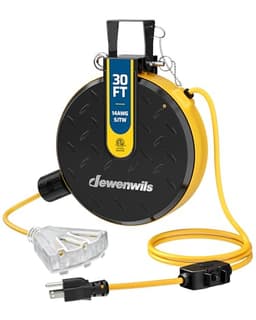
30 ft of 16/3 SJTW on an auto-retracting reel with a 10 A breaker and three grounded outlets, on a bracket that swivels 180 degrees for a ceiling or a wall.
Published specs
- Cord
- 30 ft of 16/3 SJTW, plus a 4 ft lead-in
- Rating
- 10 A, 125 V, 1,250 W
- Protection
- Built-in 10 A circuit breaker
- Outlets
- 3 grounded, with indicator light
- Mounting
- 180 degree swivel bracket, ceiling or wall
- Warranty
- 365 day
Figures are the manufacturer's, from DEWENWILS' own product pages for the HCRC30N and HCRA75 cord reels, read 2026-09-21. We have not verified them by testing and do not imply that we have.
Our scoring
- Published rating
- 8.0
- Reach
- 6.0
- Mounting flexibility
- 9.0
- Documentation
- 8.5
- Value
- 8.5
What works
- Retracts and locks at any length with an adjustable stopper, so the cord stops living on the floor
- Three outlets at the reel, which saves a second extension for a second tool
- Swivel bracket means one reel serves a bench and a driveway
- Published 10 A breaker rather than a bare reel
What doesn't
- 16 gauge and 10 A is fine for hand tools and lights, not for a table saw or a compressor
- 30 ft does not reach the far corner of a deep or double garage
- Auto-retract snaps back quickly if you let go of it
- The 365 day warranty is short next to the tool brands
Skip this one if the load is a compressor, a welder or a table saw. Those want a heavier gauge cord than 16/3 and more than 10 A.
#2 · Best reach
DEWENWILS 75 ft Retractable Extension Cord Reel (HCRA75)
DEWENWILS
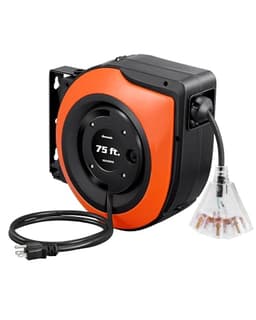
75 ft of 14/3 SJTW, a heavier gauge than the 30 ft reel, with lighted triple outlets and the same 10 A breaker. The one to buy if the cord has to reach the driveway.
Published specs
- Cord
- 75 ft of 14/3 SJTW
- Outlets
- Lighted triple outlets
- Protection
- 10 A circuit breaker
- Mounting
- Ceiling or wall
Figures are the manufacturer's, from DEWENWILS' own product pages for the HCRC30N and HCRA75 cord reels, read 2026-09-21. We have not verified them by testing and do not imply that we have.
Our scoring
- Published rating
- 8.0
- Reach
- 9.5
- Mounting flexibility
- 8.0
- Documentation
- 8.0
- Value
- 7.0
What works
- 75 ft reaches the end of a driveway from a garage ceiling
- 14 gauge conductor rather than 16, so less voltage drop over that distance
- Lighted outlets tell you the reel is live from across the garage
- Same retract-and-lock mechanism as the shorter reel
What doesn't
- Costs roughly twice what the 30 ft reel costs
- A 75 ft reel is heavy and bulky on a ceiling, and needs solid framing
- Still breakered at 10 A, so the heavier cable does not buy a bigger tool
- Full extension leaves a long cord to rewind and guide
Skip this one if everything you plug in lives within 30 ft of the reel. You would be paying for cable you never unwind.
#3 · Best rail for mixed stud spacing
Rubbermaid FastTrack 48 in Rail (2-pack)
Rubbermaid
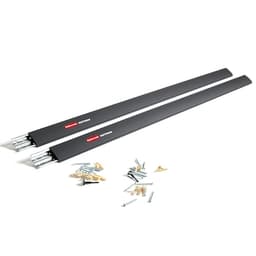
Rubbermaid publishes 1,750 lb per 48 in rail and a fit on both 16 in and 24 in stud spacing. The stud-spacing flexibility is the practical advantage; the rail rating is a number you will never approach, because the hooks decide it.
Published specs
- Rail length
- 48 in
- Published capacity
- Up to 1,750 lb per rail
- Stud spacing
- Works with 16 in or 24 in
- Material
- Steel
Figures are the manufacturer's, from Rubbermaid's own FastTrack rail listing and the True Value listing for the 48 in rail, read 2026-09-16. We have not verified them by testing and do not imply that we have.
Our scoring
- Published capacity
- 8.5
- Fit range
- 9.0
- Accessory range
- 8.5
- Install simplicity
- 8.5
- Documentation
- 6.5
What works
- Works with 16 in or 24 in stud spacing, so an older or non-standard garage wall is less likely to rule it out
- 1,750 lb per rail is published by Rubbermaid on its own listing — a real, checkable figure
- Sold widely enough that hooks and accessories stay easy to find
- Rails are cheap to add in bands, so a wall can be treated in stages
What doesn't
- The 1,750 lb rail figure is not the limit you will hit — individual hooks carry their own much lower ratings, and the kit listings we verified do not publish them
- Rubbermaid and Gladiator publish capacity in different ways, so the two rail figures are not directly comparable
- Accessories are FastTrack-profile only; they do not fit Gladiator or slatwall
Skip this one if the wall is becoming a matched system of cabinets, shelving and a workbench. FastTrack is a rail and hook system, and if the garage is going to look like one designed thing, the Gladiator range is the one built to line up.
#4 · Best track system
Gladiator GearTrack Channels
Gladiator GarageWorks
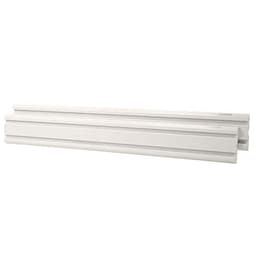
75 lb per linear foot, published in the installation manual rather than buried in marketing copy. Track beats full-panel systems when what you are hanging is heavy and few rather than light and many.
Published specs
- Rated capacity
- 75 lb per linear foot
- Mounting
- Into wood studs, including through drywall
- Format
- Horizontal channels, sold in packs
Figures are the manufacturer's, from Gladiator installation instructions W11087876 Rev A, read 2026-09-01. We have not verified them by testing and do not imply that we have.
Our scoring
- Published capacity
- 9.5
- Coverage per dollar
- 7.0
- Accessory range
- 9.0
- Install simplicity
- 8.5
- Documentation
- 9.5
What works
- 75 lb per linear foot is the highest published figure of the mainstream wall systems here
- Track means you only cover the strip of wall you need, not the whole thing
- Accessory range is broad and stays available
- The capacity figure is published in the installation instructions, which is where a figure you are going to rely on belongs
What doesn't
- Only holds things at the height of the track, so you are installing two or three runs to get real coverage
- The per-linear-foot rating assumes the track is fastened into studs, which caps you at where the studs are
- Accessories are proprietary
Skip this one if the wall is going to hold a lot of small light things — hand tools, spray cans, cordless batteries. That is pegboard's job, and pegboard does it for a fraction of the price.
Questions people actually ask
What is the best way to store extension cords in a garage?
A retractable reel if the cord comes out weekly, or a wide hook with an over-under coil if it comes out occasionally. Both keep the cord off the floor, which is the whole point.
What amp rating do retractable cord reels have?
DEWENWILS publishes 10 A, 125 V and 1,250 W with a built-in 10 A circuit breaker for its 30 ft reel, and a 10 A breaker on the 75 ft model. That suits hand tools and lighting, not compressors or table saws.
Should a cord reel be mounted on the ceiling or the wall?
Ceiling above the bench is best — the cord drops where the work is and nothing crosses the floor. A wall mount near the door is better if most of the work happens on the driveway. Either way, fix into framing.
Why do extension cords always tangle?
Because they are coiled the same direction every time, which builds twist into the cable. Coiling over-under — alternating the direction of each loop — is what stops it.
Sources
- DEWENWILS 30 ft retractable cord reel HCRC30N — 30 ft of 16/3 SJTW plus 4 ft lead-in, 10 A / 125 V / 1,250 W, built-in 10 A circuit breaker, 3 grounded outlets, 180 degree swivel bracket, adjustable stopper, metal housing, 365 day warrantyChecked September 21, 2026
- DEWENWILS 75 ft retractable cord reel HCRA75 series — 75 ft of 14/3 SJTW, lighted triple outlets, 10 A circuit breaker, ceiling or wall mountChecked September 21, 2026
- Rubbermaid FastTrack 48 in rail — up to 1,750 lb per rail, 16 in or 24 in studsChecked September 16, 2026
- Gladiator installation instructions W11087876 Rev A — GearTrack 75 lb per linear footChecked September 16, 2026
Manufacturer documentation, manuals, warranty terms and exact product models reviewed September 21, 2026.
Read next
- Where the power tools goCased, heavy and battery-dependent — why power tools are a shelf and cabinet problem, not a wall one.
- Garage hooks: what the weight ratings actually meanWhat garage hook ratings really mean, and which wall system to hang heavy things from.
- The best garage wall storage systemsTrack, slatwall, panels and metal pegboard on published load ratings, converted into one comparable question.
- Where the tools goTools in a bin become a search. The wall is the answer, and the hook limits decide what goes where.
- Rubbermaid FastTrack or Gladiator GearTrack?Published rail ratings, stud spacing and accessory systems on the two big garage wall rails — and why the rating gap misleads.
- Your garage is full. Start here.Four passes that turn a full garage into a list of piles, each with a system that fits it.