Shelving
Will garage shelving work in a basement?
Yes, and it is normally the better buy — garage shelving publishes capacities that basement shelving does not. Buy resin or wire if the basement gets damp, and boltless steel only if the stairs will take flat-packed parts.
Disclosure: Rail & Rafter earns a commission on qualifying purchases made through links on this page, at no cost to you. Commission does not decide what we recommend — our criteria do, and here is how we are funded.
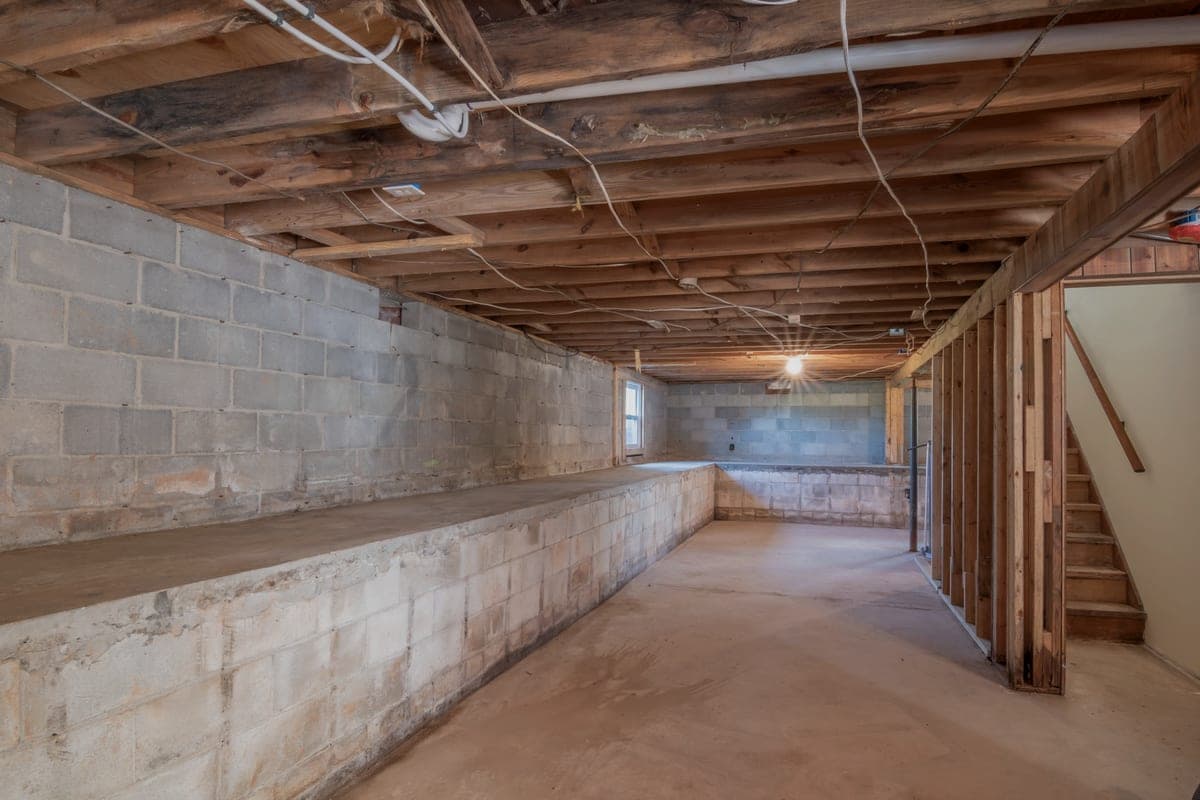
Yes — and garage shelving is usually the better buy for a basement than anything sold as basement shelving, because the garage category publishes per-shelf capacities and the basement category mostly does not. For a basement that gets damp, buy the Sterilite 5 Shelf Unit in resin or the Seville Classics UltraDurable in wire. For a dry basement with a wide stair, the SafeRacks boltless steel rack is the capacity answer.
The useful version of this question is not whether it fits. It is which four things a basement does differently from a garage, because each one rules out a specific kind of shelving.
We have not tested these units. This is published specifications read against the conditions a basement imposes — the method is on how we pick, and the rest of the category is in the shelving hub.
How we judged this
- Does the material tolerate year-round humidity? A garage dries out between rain. A basement often does not.
- Will it go down the stairs? Flat-packed and boltless units will. Welded ones will not.
- Does it fit under the joists, the ducts and the pipes? Basement headroom is the lowest in the house and it is not flat.
- Does it get the contents off the floor? The one thing a basement floor can do that a garage floor rarely does is get wet.
- A published capacity, and honest cons on everything.
The four things a basement does differently
1. The humidity does not go away
This is the difference that decides the material. Bare and lightly coated steel surface-rusts where it is cut and where the coating is scratched during assembly, and in a basement those spots stay damp rather than drying between seasons.
That is why both of the top picks here are the ones that cannot rust at all. Resin has no cut edges to corrode. Wire shelving is coated steel, but the open deck means air moves across it instead of sitting against it — which is the same argument the PVC slatwall makes on the wall side of the site.
2. The stairs are a hard filter
A garage has a door a car fits through. A basement has a stair, usually with a turn at the top or the bottom, and often a 32-inch doorway at one end of it.
Everything that arrives flat-packed goes down a stair. Anything that arrives assembled or welded does not, and the strongest freestanding shelving we recommend anywhere on this site — the Husky welded rack at 2,500 lb a shelf — is 77 inches of rigid steel in one piece. It is the right rack for a garage wall and the wrong one for a basement, for a reason that has nothing to do with its rating.
3. The ceiling is lower and it is not flat
Joists, ducts, a main drain, water lines and sometimes a beam all live at ceiling level in a basement, and they are at different heights. A 75 to 84 in rack that fits one bay will foul a duct in the next one.
Measure to the lowest obstruction over the run you are shelving, not to the joists. Then allow a few inches above the top shelf for getting boxes in and out — the same rule as garage storage under a low ceiling.
4. The floor can get wet
A floor drain, a sump, a washing-machine hose or a storm is enough. In a basement the bottom shelf height is a real decision rather than a detail, and the honest rule is that nothing you would mind losing belongs on the lowest few inches of a basement.
That is also the argument for sealed totes down there rather than cardboard. The Sterilite 20 Gal. Gasket Tote publishes a silicone gasket and wide latches and Sterilite states the tote is fully submersible, which is a far stronger claim than any snap-lid tote makes.
Resin, wire or steel
| Material | Published capacity | Damp | Down a stair? | Buy it when |
|---|---|---|---|---|
| Resin (Sterilite 5 Shelf) | 150 lb per shelf, 750 lb total | Cannot rust | Yes — tool-free, light | The basement is damp and the loads are domestic |
| Wire (Seville UltraDurable) | 800 lb per shelf on leveling feet, 4,000 lb total | Open deck, air moves | Yes — slides apart | You want capacity AND airflow |
| Boltless steel (SafeRacks 92 in) | 2,000 lb total; no per-shelf figure published | Will surface-rust at cut edges | Yes — knocks down flat | The basement is dry and the wall is long |
| Welded steel (Husky 4-tier) | 2,500 lb per shelf, 10,000 lb total | Will surface-rust at cut edges | No — arrives in one piece | Never, in a basement |
| Resin cabinet (Suncast BMC7200) | 75 lb per shelf, 19 cu ft | Cannot rust | Yes | The contents need a door, not a shelf |
The interesting row is the second one. Wire shelving is the only line here that publishes a per-shelf figure in the same league as steel — 800 lb a shelf — while behaving better than steel in damp air, because the deck is open rather than solid. If the basement is both damp and holding heavy things, that is the answer, and the reason it is not the headline pick is that small objects fall through a wire deck and wire marks anything with a soft finish.
Why the garage category is the better buy
Search “basement shelving” and most of what comes back is either the same resin and wire units sold under a different photograph, or no-name steel with a capacity claim and no manufacturer behind it to stand on.
Garage shelving is held to a slightly higher documentary standard because the loads are heavier and the buyers ask. That is the whole reason to shop the garage category for a basement: you get a published per-shelf number from a maker you can look up, which is the only thing that lets you plan a load at all. The way we read those numbers is in how to plan garage shelving, and the depth question is in how deep shelves should be.
When the answer is a cabinet instead
Shelving is right for boxes and totes. For anything that should not be open to basement air and basement dust — paint, paperwork, fabric, seasonal clothing — a resin cabinet does a job open shelving cannot.
The Suncast BMC7200 publishes 75 lb per shelf across three adjustable shelves, 19 cubic feet, and a 5 year limited warranty, in multi-wall resin that will not rust or rot. The catch is interior depth: 17.25 in, which means a 27-gallon tote does not fit inside it. If the plan is bins behind doors, that is the wrong product, and the rest of the range is in the best resin garage cabinets.
One thing not to carry down there
Cardboard. A basement is the worst room in the house for it — the humidity softens the board, the floor wicks into the bottom carton, and nobody looks for a year. If it is going in a basement, it goes in a tote. The sizes are in storage bin sizes.
The one thing a basement is better at than a garage
It is worth saying, because every other section here is about what a basement does worse: a basement holds a stable temperature and a garage does not.
An attached garage swings with the outside air. It is the hottest room in the house in August and close to the coldest in January, and that cycle is hard on a specific list of things — anything water-based, anything with an adhesive, anything with a battery in it, anything printed or photographic. A basement below the frost line barely moves by comparison.
So the honest division of labor is not “overflow goes downstairs”. It is:
- Basement, off the floor: anything temperature-sensitive that is also dry — paperwork, photographs, books, fabric, electronics, adhesives, and paint you intend to use again.
- Garage: anything bulky, dirty or wet that you want near the car and the door — tires, tools, yard equipment, sports gear, the things in the piles on the start-here page.
- Neither, without reading the label: fuel, solvents, pesticides and pool chemicals. The container's own storage instructions are the authority on where those may go, particularly in a basement with living space above it, and we are not a substitute for them.
Note how that list cuts across the material question above. The things a basement is genuinely better for — paper, fabric, photographs — are also the things that suffer most from a damp shelf and the things most attractive as nesting material. Which is why the resin and wire picks, a sealed tote for anything near the floor, and a closed cabinet for the soft goods are three parts of one answer rather than three alternatives.
Where the shelving actually goes
A basement has fixed things in it that a garage does not, and they decide the layout before capacity does.
- Leave the mechanical equipment alone. The furnace, water heater, electrical panel and any air handler need working clearance, and that clearance is specified by the equipment and by code rather than by us. Shelve the other walls.
- Do not shelve over the sump or the floor drain. Both need to be reachable, and the drain is the one place water is expected to go.
- Measure to the lowest obstruction, per bay. Ducts and the main drain hang lower than the joists and they are not at a consistent height.
- Keep the run to one side of the stair landing. You will be carrying boxes down with both hands.
- Put the heavy things on the bottom tier but not on the floor. That is the whole basement compromise in one line.
What we could not verify
- Corrosion rates. No maker here publishes a humidity rating or a salt-spray figure for its finish, so the damp column in the table is our reading of the published construction rather than a manufacturer claim.
- SafeRacks per-shelf capacity. SafeRacks publishes 2,000 lb for the whole unit and no per-tier number.
- Sterilite load ratings on the Gasket Tote. Sterilite publishes dimensions and the seal description for model 3948 but no weight capacity.
- Your basement. Headroom to the lowest duct, stair width and doorway width are the three measurements that decide this and nobody can publish them for you.
What to buy
Buy the Sterilite 5 Shelf Unit if the basement is damp and the loads are domestic — holiday bins, camping gear, paint, files. 150 lb a shelf, tool-free, cannot rust, and it goes down a stair in a box.
Buy Seville Classics UltraDurable wire if you need real capacity and the air is damp. 800 lb per shelf on leveling feet and a deck that does not trap moisture against a box.
Buy the SafeRacks 24 x 92 x 84 if the basement is dry, the wall is longer than eight feet, and the stair will take flat-packed steel. 2,000 lb across four adjustable tiers.
Buy the Suncast BMC7200 if the contents need a door. 75 lb a shelf and 19 cubic feet behind pad-lockable resin that will not rust.
Buy the Sterilite Gasket Tote if anything is going near the floor. A published, fully submersible seal is the difference between a damp scare and a loss.
What we would buy for this
Every pick carries the manufacturer's published specs, our scoring against stated criteria, and a reason you might want to skip it.
#1 · Best plastic shelving overall
Sterilite 5 Shelf Unit, 75 x 36 x 18 in
Sterilite
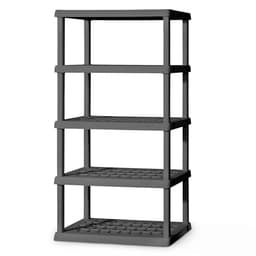
150 lb per shelf and 750 lb across the unit, in plastic that cannot rust and assembles without tools. The only plastic shelving here with a per-shelf rating that competes with entry-level steel.
Published specs
- Dimensions
- 75 1/4 in H x 36 in W x 18 in D
- Capacity per shelf
- 150 lb
- Total capacity
- 750 lb across five shelves
- Shelf clearance
- 15.77 in between shelves
- Assembly
- Tool-free
Figures are the manufacturer's, from Sterilite's own product pages for the 5 Shelf Unit (0155) and 4 Shelf Cabinet (0142), read 2026-09-21. We have not verified them by testing and do not imply that we have.
Our scoring
- Published capacity
- 7.0
- Damp tolerance
- 9.5
- Assembly
- 9.5
- Tote fit
- 8.5
- Adjustability
- 4.0
What works
- 150 lb per shelf is far above the rest of the plastic category
- Will not rust, dent or peel, which is the whole argument for plastic in a damp garage
- Tool-free assembly and light enough to move alone
- 18 in depth takes a 27-gallon tote across the shelf
What doesn't
- Shelves are fixed, so tall items have to fit the 15.77 in gap or go on top
- 750 lb total is a fraction of what a welded steel rack of the same footprint publishes
- Plastic flexes visibly under a heavy, concentrated load even within the rating
- Ventilated shelves let small parts and dust fall through to the shelf below
Skip this one if you are storing engine parts, paint by the case or anything else that concentrates weight. Steel publishes several times this per shelf for similar money.
#2 · Best wire shelving
Seville Classics UltraDurable NSF Wire Shelving
Seville Classics
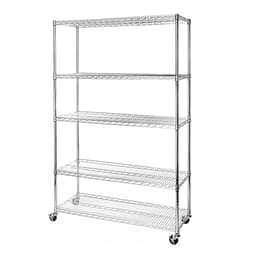
800 lb per shelf on the leveling feet and 4,000 lb across the unit, from a wire deck that lets you see what is in the back. In a damp garage the airflow is a feature, not a compromise.
Published specs
- Capacity per shelf
- 800 lb on leveling feet
- Total capacity
- 4,000 lb
- Certification
- NSF certified
- Deck
- Steel wire
Figures are the manufacturer's, from Seville Classics published specifications; the UltraHD 30 in cabinet (SKU UHD20162B) re-read 2026-09-12. We have not verified them by testing and do not imply that we have.
Our scoring
- Published capacity
- 9.0
- Build
- 8.5
- Tote fit
- 8.0
- Damp tolerance
- 9.5
- Warranty
- 7.5
What works
- 800 lb per shelf is genuinely heavy duty for a wire unit
- Wire deck means air moves and damp things dry rather than sitting in a puddle on a solid shelf
- NSF certification means it is built to a commercial standard, not a consumer one
- You can see into the back of the shelf, which is where garage items go to be forgotten
What doesn't
- Small items fall through the wire unless you sit them on a tray or in a bin
- The 800 lb figure is for the leveling-feet configuration; casters change the number
- Wire decks mark and scratch anything with a soft finish
Skip this one if you are storing loose small parts, hardware, or anything with a soft painted finish. Wire is the wrong deck for those and you will end up lining every shelf, which defeats the airflow you paid for.
#3 · Best boltless steel rack
SafeRacks Heavy-Duty Garage Shelving, 24 x 92 x 84 in
SafeRacks
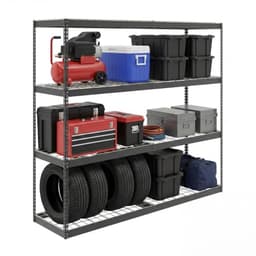
2,000 lb across four adjustable tiers, with an assembly SafeRacks describes as fast and easy and a limited lifetime warranty behind it. It knocks down flat, which is why it goes anywhere a welded rack cannot.
Published specs
- Dimensions
- 24 in D x 92 in W x 84 in H
- Total capacity
- 2,000 lb
- Tiers
- Four, heights adjustable
- Construction
- Heavy-duty steel
- Warranty
- Limited lifetime
Figures are the manufacturer's, from the SafeRacks product page for the 24 x 92 x 84 in Heavy-Duty Garage Shelving, read 2026-10-18. We have not verified them by testing and do not imply that we have.
Our scoring
- Published capacity
- 7.5
- Knock-down portability
- 9.5
- Adjustability
- 8.5
- Tote fit
- 9.0
- Published data
- 6.0
What works
- Knocks down to flat parts, so it goes down a basement stair and into a storage unit a welded rack will not
- Shelf heights adjust, which fixed-tier plastic shelving cannot do
- Limited lifetime warranty, published, which is rare below the commercial tier
- 24 in deep takes a 27-gallon tote across the shelf
- 92 in of run in one unit, so a long wall is covered in a single purchase
What doesn't
- SafeRacks publishes a 2,000 lb total but no per-shelf figure on its own product page, so you are planning against a whole-unit number
- 92 in wide is more than seven and a half feet of wall and will not fit a short run
- Bare steel in a damp basement or an unheated unit will eventually surface-rust at the cut edges
- Boltless means it can be racked out of square if the floor is uneven, and storage-unit floors often are
Skip this one if the wall is shorter than eight feet. There are 48 in and 72 in versions of the same rack, and buying 92 inches for a 60 inch wall is a problem you cannot assemble your way out of.
#4 · Best resin cabinet overall
Suncast Tall Storage Cabinet BMC7200, 30 x 20 x 72 in
Suncast
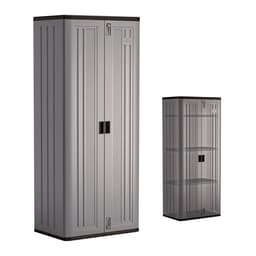
19 cubic feet behind pad-lockable doors, on three reinforced shelves rated 75 lb each, in multi-wall resin that will not rust. The resin cabinet to buy if you only buy one.
Published specs
- Exterior
- 30 in W x 20.25 in D x 72 in H
- Interior
- 27.25 in W x 17.25 in D x 69 in H
- Capacity per shelf
- 75 lb evenly distributed
- Shelves
- 3 adjustable, reinforced
- Volume
- 19 cu ft
- Warranty
- 5 year limited
Figures are the manufacturer's, from Suncast's own pages for BMC7200, BMC8000 and BMC3600, read 2026-09-21. We have not verified them by testing and do not imply that we have.
Our scoring
- Published capacity
- 6.5
- Damp tolerance
- 9.5
- Security
- 6.0
- Volume per footprint
- 8.5
- Documentation
- 9.0
What works
- 75 lb per shelf is nearly double the plastic competition and enough for most garage chemicals
- Multi-wall resin panels resist dents, rust and rot — the failure modes of steel and wood
- Pad-lockable doors with upper and lower latches
- 5 year limited warranty, published
What doesn't
- 20.25 in deep on the outside and 17.25 in inside, so a 27-gallon tote will not fit
- 75 lb a shelf is well under any steel cabinet in the same footprint
- Resin scuffs and the color is what you get — no repainting it later
- Doors are lockable, not secure; the panel is plastic
Skip this one if the plan is bins behind doors. The interior is 17.25 in deep and a standard tote is 19.6 in wide.
#5 · Best sealed tote
Sterilite 20 Gal. Gasket Tote (model 3948, 4-pack)
Sterilite
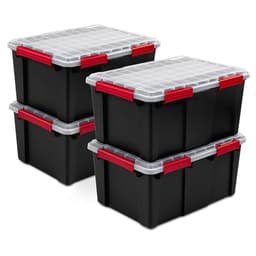
A silicone gasket and wide latches that Sterilite says make the tote fully submersible. That seals out water, dust, air and moisture — and the page is careful never to claim it seals out anything with teeth.
Published specs
- Model
- 3948 (item 39489004)
- Capacity
- 20 gallons
- Exterior
- 26 1/8 in L x 19 3/8 in W x 13 in H
- Interior at base
- 21 7/8 in L x 16 1/8 in W x 12 1/8 in H
- Seal
- Silicone gasket with wide latches; fully submersible
- Lid
- Clear, reinforced, deep-recessed for stacking
Figures are the manufacturer's, from the Sterilite product page for the 20 Gal. Gasket Tote (model 3948), read 2026-10-18. We have not verified them by testing and do not imply that we have.
Our scoring
- Damp tolerance
- 9.5
- Rodent resistance
- 4.0
- Stackability
- 8.5
- Published data
- 7.0
- Findability
- 7.0
What works
- Sterilite publishes that the tote is fully submersible, which is a far stronger damp claim than any snap-lid tote makes
- Latches rather than a snap-on lid, so the seal does not depend on the lid staying bowed into place
- Clear lid over an opaque base, so you can read the top layer without opening it
- 13 in exterior height clears the drop on most overhead racks, unlike the tall stacker totes
- Deep-recessed lid is designed for stacking rather than merely tolerating it
What doesn't
- Sterilite does not publish a load or weight-capacity rating for this tote
- The gasket is a water, dust and air seal — Sterilite makes no pest claim, and a determined rodent chews polypropylene
- 12 1/8 in of interior height at the base is well under the 14.75 in a 27-gallon industrial tote gives you, so the seal costs you usable depth
- Gaskets take a set over years in a cold garage, and a flattened gasket stops sealing
Skip this one if the problem is rodents rather than damp. A sealed plastic tote slows a mouse down; it does not stop one, and the honest answer for food and fabric is steel.
Questions people actually ask
Can you use garage shelving in a basement?
Yes, and it is usually the better buy — garage shelving publishes per-shelf capacities that most basement-marketed shelving does not. The two conditions are material and stairs: choose resin or wire if the basement is damp, and choose something flat-packed, because a welded rack will not go down a stair.
What is the best shelving for a damp basement?
Resin or wire. Resin has no cut edges to corrode and the best of it publishes 150 lb a shelf. Wire is coated steel but the open deck lets air move around a damp box instead of trapping it, and the commercial-grade units publish 800 lb per shelf on leveling feet.
Will steel shelving rust in a basement?
Coated steel surface-rusts where the coating is cut or scratched, and in a basement those spots stay damp rather than drying out between seasons. No maker publishes a humidity or salt-spray rating for these finishes, so treat steel as the dry-basement choice and resin or wire as the damp one.
How high should the bottom shelf be in a basement?
High enough that a wet floor is an inconvenience rather than a loss. A floor drain, a sump, a burst washing-machine hose or a storm all put water on a basement slab, so nothing you would mind losing belongs on the lowest few inches — and anything near the floor belongs in a sealed tote rather than a carton.
Sources
- Sterilite 5 Shelf Unit — 150 lb per shelf, 750 lb total, 75 1/4 in H x 36 in W x 18 in D, 15.77 in shelf clearance, tool-freeChecked September 21, 2026
- Sterilite 20 Gal. Gasket Tote (model 3948) — 26 1/8 x 19 3/8 x 13 in exterior, 21 7/8 x 16 1/8 x 12 1/8 in interior at base, silicone gasket and wide latches, stated fully submersible; no load rating publishedChecked October 18, 2026
- Seville Classics UltraDurable commercial-grade wire shelving — 800 lb per shelf on leveling feet, 4,000 lb total, NSF certifiedChecked September 1, 2026
- SafeRacks Heavy-Duty Garage Shelving 24 x 92 x 84 in — 2,000 lb total, four adjustable tiers, limited lifetime warranty; no per-shelf figure publishedChecked October 18, 2026
- Suncast BMC7200 tall storage cabinet — 30 x 20.25 x 72 in exterior, 27.25 x 17.25 x 69 in interior, 75 lb per shelf, 19 cu ft, 5 year limited warrantyChecked September 21, 2026
Manufacturer documentation, manuals, warranty terms and exact product models reviewed October 18, 2026.
Read next
- The best plastic garage shelvingPlastic shelving on published per-shelf ratings from 40 to 150 lb, and when steel is the better buy.
- The best shelving for a storage unitFreestanding shelving for a rented unit: nothing fixed to the building, everything knocks down for move-out.
- The best garage storage shelvesFive shelving units ranked on published per-shelf capacity and whether the depth takes a standard tote.
- How deep should garage shelves be?24 in for totes, 18 in beside a car, 12 in for cans. The one measurement that decides shelf depth.
- What actually keeps mice out of garage storage?Steel is the only material a rodent cannot chew. What to store food, fabric and everything else in.
- The best resin garage cabinetsResin cabinets on published shelf ratings and cubic feet, and when steel is worth the extra.