Bins
What actually keeps mice out of garage storage?
Steel. The Behrens 20 gallon galvanized can is the only container here whose maker prints the words rodent proof, and a steel cabinet handles everything that will not fit in a can. Every plastic tote on this page, sealed or not, is a delay rather than a barrier.
Disclosure: Rail & Rafter earns a commission on qualifying purchases made through links on this page, at no cost to you. Commission does not decide what we recommend — our criteria do, and here is how we are funded.

Steel. That is the answer, and it is the whole answer — the Behrens 20 gallon galvanized can is the only container on this page whose maker is willing to print the words “rodent proof” on its own product listing, and a steel cabinet with doors handles everything that will not fit in a can. Every plastic tote here, gasket or no gasket, is a delay rather than a barrier.
This page is about what you put things in. Sealing up the building, trapping, and anything involving bait is a different job with different experts, and we are not going to pretend otherwise. What storage choices can do is make your boxes a worse target than the ones in the garage next door.
We have not tested any of this and we have not run a rodent trial. This is published manufacturer claims read carefully, plus what each material physically is — the method is on how we pick, and the rest of the category is in the bins hub.
How we judged it
- Can the material be chewed? This is the only question that separates a barrier from a delay, and it has a yes or no answer.
- Does the maker publish a pest claim? Most do not. The ones that do are worth knowing about, and the ones that carefully do not are worth noticing.
- Does the lid seal, and against what? Water, dust and air are three different claims from pests, and makers are precise about which they make.
- Published dimensions and capacity. A container that solves the rodent problem and does not fit the shelf has not solved anything.
- Honest cons on every pick.
The one thing that decides it: can it be chewed
A rodent does not need a gap. It needs to make one, and a polypropylene tote wall is a few millimeters of soft thermoplastic. Sealing a plastic box does not change what the box is made of.
Which is why the material column below is the one that matters, and the lid column is secondary.
| Material | Chewing | Damp | Dust | Published pest claim? |
|---|---|---|---|---|
| Galvanized steel can (Behrens 1211K) | Stops it | Water resistant; Behrens states dry storage only | Stops it | Yes — Behrens publishes rodent proof |
| Steel cabinet (Seville UltraHD) | Stops it | Will sweat in a humidity swing | Stops it | No claim published |
| Gasketed plastic tote (Sterilite 3948) | Delays it | Sterilite states fully submersible | Stops it | No — the claim is water, dust, air and moisture |
| Snap-lid plastic tote (Sterilite Industrial) | Delays it | Not weathertight | Mostly | No claim published |
| Cardboard carton | No barrier at all | No barrier | No | No |
What a gasket is actually for
This is the most useful distinction on the page, and it comes straight from the manufacturer's own wording.
Sterilite's product page for the 20 Gal. Gasket Tote (model 3948) publishes a silicone gasket and wide latches, says the tote is fully submersible, and states that the seal protects against water, dust, air and moisture. That is a strong and specific claim, and it is worth paying for if the problem is a damp garage, a basement floor or a leaking roof.
Read what the page does not say. It does not mention pests, rodents, mice or chewing anywhere — and a company confident of a pest claim puts it in the title. Behrens does exactly that: its 20 gallon can is titled a “Rodent Proof Galvanized Steel Trash Can” and the features list reads “Rodent proof, Recyclable, Weather resistant”.
Read the claim, not the category
A sealed tote and a rodent-proof container are two different products that look similar on a shelf. The seal keeps water out. The steel keeps teeth out. Plenty of garages need both, and that means two containers, not one clever one.
What they are actually coming for
Two things, and matching the container to which one you have is most of the job.
Food: this is the non-negotiable one
Pet food, birdseed, grass seed, livestock feed, bulk dry goods. These are the reason a garage gets a rodent problem rather than a rodent visit, and they are the one category where a plastic tub is genuinely not good enough.
The Behrens can is built for exactly this. Behrens publishes it for “Large pet food & Livestock Feed storage” with an approximate hold capacity of up to 75 lb, in galvanized steel with a patented steel Infinity Lid and an offset bottom that keeps the base off a damp slab. 20 gallons, 25 inches tall, 19.5 inches across the lid.
A twenty-dollar plastic bin with a snap lid holds the same bag of dog food and announces it to the whole neighborhood.
Nesting material: the one people forget
Fabric, paper, cardboard, insulation, foam, upholstery, old curtains, camping sleeping bags. Nothing in a box of winter coats is food — but all of it is excellent bedding, and a mouse will chew into a tote to get at it.
This is where the steel cabinet earns its place. The Seville Classics UltraHD at 600 lb total, 150 lb per shelf, 18 inches deep and lockable is a steel box with doors that happens to be the right size for fabric, paper and anything soft you actually care about. It publishes no pest claim — but a steel door is a steel door.
Cardboard is the worst case, by a distance
A carton is food, bedding and an unlocked door in a single product. It is the one storage decision on this site that is simply wrong in a garage, and the rodent argument is only one of four reasons — the others are damp, crushing and the fact that nobody can see what is in it.
The full case is in plastic totes or cardboard boxes in a garage. If you take one thing from this page and nothing else: get the cardboard out.
Where the container sits matters too
- Off the floor. A slab is the approach route and the moisture path. Any shelf breaks both — the options are in the shelving roundup.
- Away from the wall line. Rodents travel along edges. A box pushed tight into the junction of floor and wall is sitting on the route; the same box on a shelf with air around it is not.
- Overhead is the quietest real estate. A ceiling rack is harder to reach from the floor than a bottom shelf is, and the overhead racks publish 600 lb for a 4 x 8.
- Keep the food container separate from everything else. If the steel can is across the garage from the fabric, a problem with one is not automatically a problem with both.
- Do not stack onto the can. The Behrens can is round with a domed lid; nothing stacks on it and anything you balance there pops the lid off its seat.
Small parts, hardware and the packaging problem
Drawer organizers are not sealed and do not need to be. A drawer of wall anchors is not food and it is not bedding, so the Akro-Mils cabinets and the rest of the small parts organizers are fine as they are.
What is not fine is what arrives with the hardware. A bin full of part-used cardboard boxes, blister packs and paper bags is a nesting-material store with screws in it, and that is the usual reason a tidy-looking parts bin turns out to be a problem. Decanting hardware into drawers and throwing the packaging away solves it for free, which is a rare thing on a site that mostly recommends buying something.
The order to do this in
If the garage is already full, do not start by buying four containers. Start by sorting what you have into the three groups that actually matter.
- Food first, today. Every bag of pet food, birdseed, grass seed or feed goes into steel. This is the one step that changes whether you have an attractive garage or an ordinary one, and it is one purchase.
- Soft goods second. Fabric, paper, photographs, sleeping bags, upholstery, insulation offcuts. These go behind a steel door or, at minimum, up off the floor in a latching tote.
- Cardboard third, and permanently. Get it out. Everything in it moves to a tote and the cartons are recycled.
- Everything else, last or never. Tools, car parts, tile, hardware, decorations in hard cases — a snap-lid tote on a shelf is already the right answer and swapping it for something sealed buys you nothing.
- Then raise the whole lot. Shelving or an overhead rack, so nothing sits on the floor-and-wall junction.
Containers we looked at and did not pick
There is a whole category of marketplace listings whose titles contain the words “rodent proof” or “pest proof” and which come from sellers with no manufacturer page, no model number and no published specification of any kind.
We did not feature any of them, for the same reason we rejected whole categories in earlier rounds: a pest claim in a marketplace listing title is a seller's marketing copy, not a manufacturer specification. Behrens' claim is on behrens.com, attached to a stock number, next to a dimension table and a “dry storage only” caveat. That is a different kind of statement, and it is the only one of its kind we found. The test we use on any brand is in which garage storage brands are worth it.
What we could not verify
- Any gnaw-resistance or pest-exclusion test. Nobody in this category publishes one. Behrens' rodent-proof claim is a manufacturer statement on its own product page, not a test result we can read.
- A load or weight rating for the Sterilite Gasket Tote. Sterilite publishes dimensions and the seal description for model 3948 and no capacity figure.
- Plastic wall thickness. No tote maker here publishes one, so we cannot tell you how long a given tote delays anything.
- The Behrens hold-capacity figure. Behrens publishes “approximately up to 75 lbs” with its own asterisk noting that hold capacity may vary.
- Steel gauge on the Behrens can or the Seville cabinet. Neither maker publishes one.
- Anything about rodent behavior. We are a storage site. Species, entry points, population and control are outside what we can source, and we have not guessed at them.
What to buy for what
Buy the Behrens 20 gallon galvanized can for anything edible — pet food, birdseed, grass seed, feed. The only published rodent-proof claim here, up to about 75 lb of feed, and Behrens states dry storage only.
Buy the Seville Classics UltraHD cabinet for fabric, paper and anything soft that matters. 600 lb total, 150 lb per shelf, steel, lockable, and 18 inches deep so it does not eat the walkway. The full read is in the UltraHD review.
Buy the Sterilite 20 Gal. Gasket Tote for damp, not for teeth. A published fully-submersible seal is the right answer to a wet floor or a leaking roof, and the honest limitation is that the box is still plastic.
Buy the Sterilite 27 Gal. Industrial Tote for everything a mouse has no interest in — tools, car parts, tile, hardware, decorations in hard cases. 28.5 x 19.625 x 15.5 in, with 14.75 in of usable interior height.
Do not buy a “weathertight” tote expecting it to be pest-proof. No maker claims that, and the one that does claim rodent proof made the container out of steel.
What we would buy for this
Every pick carries the manufacturer's published specs, our scoring against stated criteria, and a reason you might want to skip it.
#1 · Best for anything a mouse wants to eat
Behrens 20 Gallon Galvanized Steel Can with Lid (1211K)
Behrens
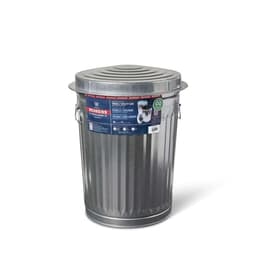
The only container here whose maker puts the words rodent proof in writing. Galvanized steel with a patented Infinity Lid, rated by Behrens for up to about 75 lb of pet food or feed, and nothing is chewing through it.
Published specs
- Stock number
- 1211K
- Capacity
- 20 gallons
- Top diameter
- 19.50 in, with lid
- Bottom diameter
- 15.25 in
- Height
- 25.00 in
- Empty weight
- 7.92 lb
- Material
- Galvanized steel, patented Infinity Lid
- Hold capacity
- Approximately up to 75 lb of pet food or feed
Figures are the manufacturer's, from Behrens' own product page for the 20 Gallon Galvanized Steel Utility / Trash Can with Lid (stock 1211K), read 2026-10-18. We have not verified them by testing and do not imply that we have.
Our scoring
- Rodent resistance
- 10.0
- Damp tolerance
- 7.5
- Space efficiency
- 4.5
- Published data
- 8.5
- Stackability
- 2.0
What works
- Behrens publishes the phrase rodent proof on its own product page, which no plastic tote maker does
- Galvanized steel cannot be gnawed, which is the single failure mode plastic has
- Offset bottom keeps the base off a damp concrete floor
- Wire handles and 7.92 lb empty, so a full can still moves
- Lid is steel rather than plastic, so the part a rodent attacks is also the strong part
What doesn't
- Behrens states dry storage only — the lid is water resistant, not watertight
- Round, so it wastes shelf and corner space a rectangular tote would use
- Nothing stacks on it and it does not stack on anything
- Galvanized steel rings and dents, and the lid is easy to leave half-seated
Skip this one if the contents are not food. A 20 gallon round steel can is the wrong shape for holiday decorations, tools or paperwork, and a rectangular tote holds far more of those per square foot of floor.
#2 · Best all-steel cabinet
Seville Classics UltraHD Storage Cabinet, 30 x 18 x 72 in
Seville Classics
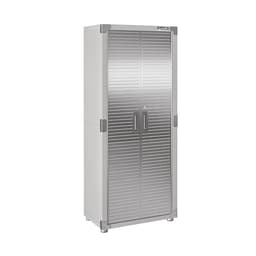
600 lb across the cabinet and 150 lb per shelf, in a footprint 18 inches deep. The depth is the reason it works in a garage where a 24 in cabinet would eat the walkway.
Published specs
- Dimensions
- 30 in W x 18 in D x 72 in H
- Total capacity
- 600 lb
- Capacity per shelf
- 150 lb
- Body
- Steel, lockable
Figures are the manufacturer's, from Seville Classics published specifications; the UltraHD 30 in cabinet (SKU UHD20162B) re-read 2026-09-12. We have not verified them by testing and do not imply that we have.
Our scoring
- Published capacity
- 7.5
- Footprint efficiency
- 9.0
- Build
- 8.5
- Security
- 8.5
- Tote fit
- 4.5
What works
- 18 in depth keeps the walkway usable in a single-car garage
- Steel body and lockable doors, which matters if the garage is also where the chemicals live
- 150 lb per shelf is enough for anything that belongs behind a door
- Doors mean the contents stay out of sight, which is most of what a garage tidy actually is
What doesn't
- 600 lb total is modest next to open shelving of the same size
- 18 in depth will not take a 27-gallon tote across the depth
- Steel cabinets in an unheated garage will sweat in a humidity swing
Skip this one if what you are storing is bins. A 27-gallon tote is over 19 in wide and this cabinet is 18 in deep — you would be buying doors you cannot close.
#3 · Best sealed tote
Sterilite 20 Gal. Gasket Tote (model 3948, 4-pack)
Sterilite
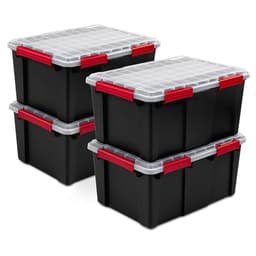
A silicone gasket and wide latches that Sterilite says make the tote fully submersible. That seals out water, dust, air and moisture — and the page is careful never to claim it seals out anything with teeth.
Published specs
- Model
- 3948 (item 39489004)
- Capacity
- 20 gallons
- Exterior
- 26 1/8 in L x 19 3/8 in W x 13 in H
- Interior at base
- 21 7/8 in L x 16 1/8 in W x 12 1/8 in H
- Seal
- Silicone gasket with wide latches; fully submersible
- Lid
- Clear, reinforced, deep-recessed for stacking
Figures are the manufacturer's, from the Sterilite product page for the 20 Gal. Gasket Tote (model 3948), read 2026-10-18. We have not verified them by testing and do not imply that we have.
Our scoring
- Damp tolerance
- 9.5
- Rodent resistance
- 4.0
- Stackability
- 8.5
- Published data
- 7.0
- Findability
- 7.0
What works
- Sterilite publishes that the tote is fully submersible, which is a far stronger damp claim than any snap-lid tote makes
- Latches rather than a snap-on lid, so the seal does not depend on the lid staying bowed into place
- Clear lid over an opaque base, so you can read the top layer without opening it
- 13 in exterior height clears the drop on most overhead racks, unlike the tall stacker totes
- Deep-recessed lid is designed for stacking rather than merely tolerating it
What doesn't
- Sterilite does not publish a load or weight-capacity rating for this tote
- The gasket is a water, dust and air seal — Sterilite makes no pest claim, and a determined rodent chews polypropylene
- 12 1/8 in of interior height at the base is well under the 14.75 in a 27-gallon industrial tote gives you, so the seal costs you usable depth
- Gaskets take a set over years in a cold garage, and a flattened gasket stops sealing
Skip this one if the problem is rodents rather than damp. A sealed plastic tote slows a mouse down; it does not stop one, and the honest answer for food and fabric is steel.
#4 · Best on shelving
Sterilite 27 Gallon Industrial Tote (4-pack)
Sterilite
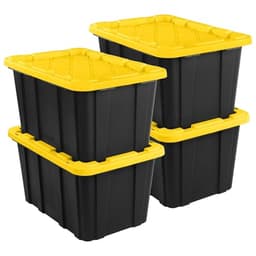
Practically the same footprint as the HDX at 28.5 by 19.625 inches, but with 14.75 in of usable interior height at the base rather than 13 in. Nearly two more inches of what you actually load.
Published specs
- Capacity
- 27 gallons
- Exterior
- 28.5 in L x 19.625 in W x 15.5 in H
- Interior at base
- 23.375 in L x 14.625 in W x 14.75 in H
Figures are the manufacturer's, from the Sterilite product pages, read 2026-09-01. We have not verified them by testing and do not imply that we have.
Our scoring
- Overhead rack fit
- 8.5
- Stackability
- 9.0
- Durability
- 8.5
- Findability
- 5.5
- Availability
- 9.5
What works
- 14.75 in interior height at the base is nearly two inches more usable depth than the comparable HDX
- Same exterior footprint, so the two mix on the same shelf without a stepped run
- Industrial line is thicker-walled than the standard Sterilite totes
What doesn't
- 15.5 in exterior height is a quarter-inch taller than the HDX, which matters under a tight rack
- Snap-on lid, not a latching one
- No handles on some colorways
Skip this one if your overhead rack drop leaves you less than 16 in of clearance. A quarter-inch sounds like nothing until the lid catches on the joist every time.
Questions people actually ask
Can mice chew through plastic storage totes?
A tote wall is a few millimeters of soft thermoplastic, and no tote maker publishes a gnaw-resistance test or claims pest resistance. Treat a plastic tote as a delay rather than a barrier. The only container on this page with a published rodent-proof claim is made of galvanized steel.
Are gasketed or weathertight totes rodent proof?
No, and their makers do not say they are. Sterilite publishes that its Gasket Tote is fully submersible and that the seal protects against water, dust, air and moisture — pests are not mentioned anywhere on the page. A seal keeps water out; it does not change what the box is made of.
What should I store pet food in, in a garage?
Galvanized steel with a steel lid. Behrens publishes its 20 gallon can for large pet food and livestock feed storage at an approximate hold capacity of up to 75 lb, lists the can as rodent proof, and specifies dry storage only. Bulk food in a snap-lid plastic bin is the single most common way a garage acquires a problem.
Is a steel garage cabinet enough to keep rodents out?
For everything that fits in one, a closed steel cabinet is the practical answer — steel cannot be chewed. Note that no cabinet maker here publishes a pest claim or a gauge, and a cabinet is only as closed as its doors and its back panel. It is a strong choice, not a certified one.
Does getting storage off the floor help?
Yes, for two reasons at once. A concrete slab is both the approach route along the floor-and-wall junction and a moisture path into the bottom carton. Any shelf, at any rating, breaks both — and an overhead rack is harder to reach from the floor than a bottom shelf is.
Sources
- Behrens 20 Gallon Galvanized Steel Utility / Trash Can with Lid, stock 1211K — galvanized steel, patented Infinity Lid, offset bottom, wire handles; features list states rodent proof, recyclable, weather resistant and dry storage only; published for large pet food and livestock feed storage at an approximate hold capacity of up to 75 lb; top diameter 19.50 in with lid, bottom diameter 15.25 in, height 25.00 in, 7.92 lb emptyChecked October 18, 2026
- Sterilite 20 Gal. Gasket Tote, model 3948 (item 39489004) — 26 1/8 x 19 3/8 x 13 in exterior, 21 7/8 x 16 1/8 x 12 1/8 in interior at base, silicone gasket and wide latches, stated fully submersible, seal described as protecting against water, dust, air and moisture; no pest claim and no load rating publishedChecked October 18, 2026
- Sterilite 27 Gal. Industrial Tote — 28.5 x 19.625 x 15.5 in exterior, 23.375 x 14.625 x 14.75 in interior at base, snap-on lidChecked September 1, 2026
- Seville Classics UltraHD storage cabinet (SKU UHD20162B) — 30 x 18 x 72 in, 600 lb total, 150 lb per shelf, steel body, lockable; no pest claim publishedChecked September 12, 2026
Manufacturer documentation, manuals, warranty terms and exact product models reviewed October 18, 2026.
Read next
- The best garage storage binsThree 27-gallon totes on published exterior dimensions, and where each one actually fits.
- Plastic totes or cardboard boxes in a garage?What humidity does to corrugated, what it does not do to polypropylene, and the two cases where cardboard still wins.
- Storage bin sizes, in real dimensionsPublished tote dimensions from 20 qt to 50 gal, and which sizes fit shelves, cabinets and racks.
- The best garage storage cabinetsCabinets ranked on published capacity and the depth question that decides whether your bins fit.
- Will garage shelving work in a basement?Garage shelving is usually the better basement buy — in resin or wire. The four constraints a basement adds.
- Where the holiday decorations goThe textbook overhead case. Six bins on one rack, how to label them, and what a garage breaks.