Shelving
Shelving vs racking
They look similar and they are not the same thing. Racking is engineered for forklifts and pallets; shelving is engineered for hands and boxes. That difference decides which one belongs in your garage.
Disclosure: Rail & Rafter earns a commission on qualifying purchases made through links on this page, at no cost to you. Commission does not decide what we recommend — our criteria do, and here is how we are funded.
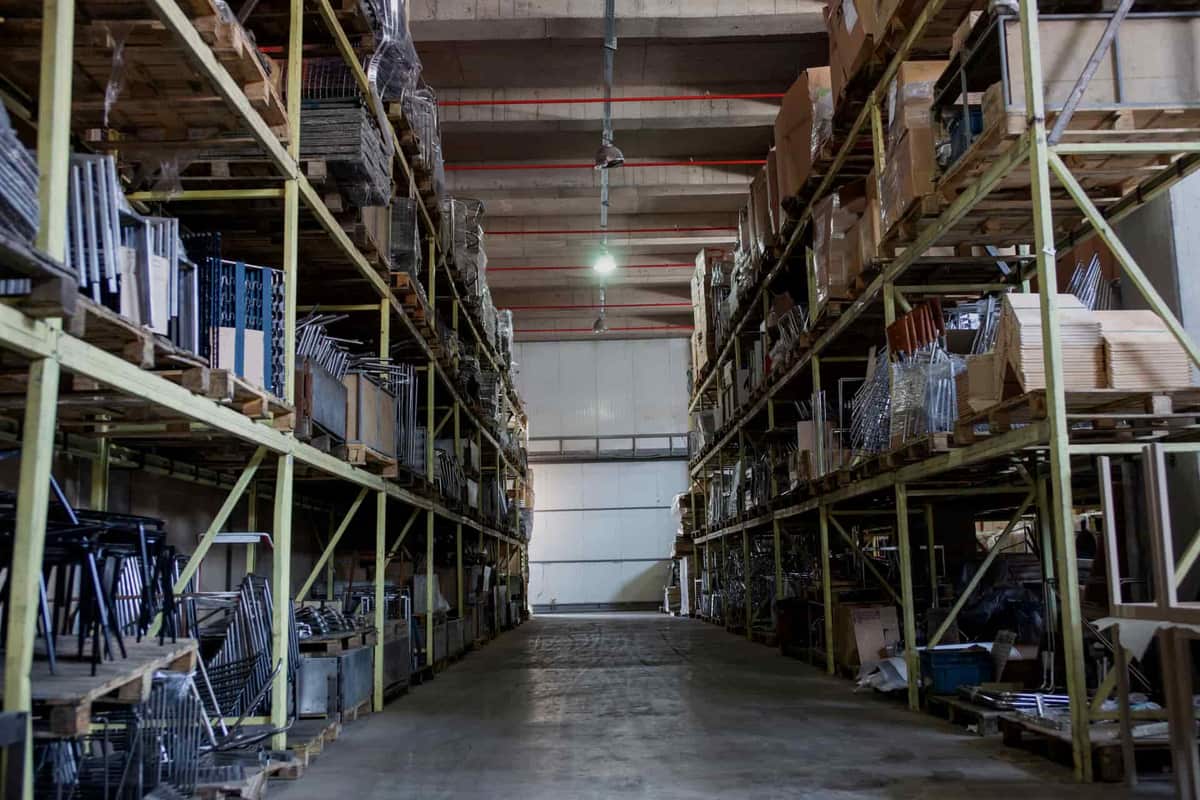
The words get used interchangeably and they should not be. In a warehouse they describe two different product categories with different engineering, different installation requirements and different failure modes. In a garage, picking the wrong one is expensive in one direction and genuinely unsafe in the other.
The verdict, first
Almost every garage wants shelving. Racking is designed around pallets and mechanical handling, which is to say around a way of moving goods that does not exist in a domestic garage. Buying it because the capacity number is bigger is buying a different problem.
The exception is narrow and real: if you are storing genuinely palletized goods, or single items too heavy to lift onto a shelf by hand, racking is the correct category — and at that point the installation is a job for somebody who does it professionally.
What actually differs
| Shelving | Pallet racking | |
|---|---|---|
| Designed around | Hands, boxes, bins | Pallets and mechanical handling |
| Typical shelf depth | 18" to 24" | Pallet-sized, commonly 42 in or more |
| Load placed by | A person | A forklift or pallet truck |
| Levels | Fixed or small increments | Beams relocated in large steps |
| Anchoring | Often optional, always advisable | Floor-anchored as standard |
| Failure mode | Sag, then bend | Impact damage to an upright, then collapse |
The depth problem
Racking is built around a pallet, and a standard pallet is 40 by 48 inches. That means racking beams are set for a depth in that neighborhood, and depth is exactly what a garage cannot afford.
A 42 in deep rack against a garage wall takes three and a half feet out of the room before anything is stored on it. And because you are loading it by hand rather than with a forklift, everything past about arm's reach becomes storage you cannot get at — you end up with a deep shelf whose back half is archaeology.
24 in shelving takes a standard tote across its depth with room to spare and you can reach the back of it. That is not a compromise; it is the correct dimension for hand-loaded storage.
The failure mode is different, and it matters
Shelving fails gradually. An overloaded shelf sags, and the sag is a visible warning you get months of.
Racking fails differently. It is engineered as a system on the assumption that it is floor-anchored and that damaged uprights are inspected and replaced — because in a warehouse the thing that kills racking is a forklift clipping a leg. A rack with a bent upright can carry its load for a long time and then not.
If you do buy racking
Anchor it to the slab, follow the manufacturer's configuration rather than improvising beam heights, and do not modify the uprights. Second-hand racking with unknown history and no load plates is specifically the thing to avoid — the capacity of a rack depends on its exact configuration, and without the documentation you do not know what you have.
The capacity argument is weaker than it looks
The usual reason people look at racking is the load rating. But look at what shelving already publishes: the Husky welded 4-tier is rated at 2,500 lb per shelf and 10,000 lb across the unit. That is a warehouse number on a product designed for hand loading at a garage-appropriate depth.
If 2,500 lb per shelf is not enough, the honest question is what you are storing, and whether a garage floor and a domestic slab are the right place for it. Full figures on best heavy-duty garage shelving.
Who should buy which
Buy shelving if you are storing bins, tools, tires, paint, sports gear, or anything else you will be lifting by hand — which is essentially every domestic garage.
Consider racking if you genuinely store palletized goods, run a business out of the space, or have single items too heavy to lift onto a shelf. In that case treat the installation as a professional job rather than a weekend one.
Consider neither if the problem is floor space rather than storage capacity. Both of these stand on the ground. Getting things off the ground entirely is what overhead racks and wall systems are for.
What we would buy for this
Every pick carries the manufacturer's published specs, our scoring against stated criteria, and a reason you might want to skip it.
#1 · Best heavy-duty shelving
Husky 4-Tier Welded Steel Rack, 77 x 78 x 24 in
Husky
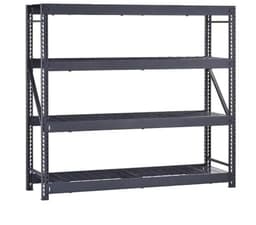
2,500 lb per shelf and 10,000 lb across the unit. That is not a garage number, it is a warehouse number, and it means this is the last shelving you buy for that wall.
Published specs
- Model
- HBR782478W4R
- Dimensions
- 77 in W x 78 in H x 24 in D
- Capacity per shelf
- 2,500 lb, evenly distributed
- Total capacity
- 10,000 lb
- Adjustment
- Shelves adjust in 3 in increments
- Warranty
- Lifetime
Figures are the manufacturer's, from the Home Depot listing for Husky HBR782478W4R, read 2026-09-01. We have not verified them by testing and do not imply that we have.
Our scoring
- Published capacity
- 10.0
- Build
- 9.5
- Tote fit
- 9.0
- Footprint efficiency
- 7.0
- Warranty
- 9.5
What works
- 2,500 lb per shelf is far beyond what a garage will ever ask of it, which is exactly why it never sags
- Welded construction rather than bolt-together, so it does not develop a wobble over years
- 24 in depth swallows a 27-gallon tote sideways with room to spare
- Lifetime warranty
What doesn't
- 77 in wide is a lot of wall. In a single-car garage this is a real commitment
- Welded means it arrives heavy and assembles in one configuration
- Only 3 in adjustment increments, so a tall item may cost you a whole shelf of headroom
Skip this one if you are storing light bulk — holiday bins, sleeping bags, empty coolers. You are paying for steel you will never load, and the same money buys twice the shelf area in a lighter unit.
#2 · Best wire shelving
Seville Classics UltraDurable NSF Wire Shelving
Seville Classics
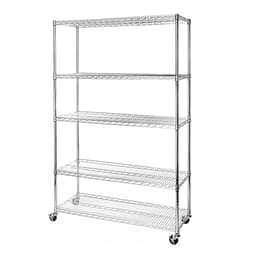
800 lb per shelf on the leveling feet and 4,000 lb across the unit, from a wire deck that lets you see what is in the back. In a damp garage the airflow is a feature, not a compromise.
Published specs
- Capacity per shelf
- 800 lb on leveling feet
- Total capacity
- 4,000 lb
- Certification
- NSF certified
- Deck
- Steel wire
Figures are the manufacturer's, from Seville Classics published specifications; the UltraHD 30 in cabinet (SKU UHD20162B) re-read 2026-09-12. We have not verified them by testing and do not imply that we have.
Our scoring
- Published capacity
- 9.0
- Build
- 8.5
- Tote fit
- 8.0
- Damp tolerance
- 9.5
- Warranty
- 7.5
What works
- 800 lb per shelf is genuinely heavy duty for a wire unit
- Wire deck means air moves and damp things dry rather than sitting in a puddle on a solid shelf
- NSF certification means it is built to a commercial standard, not a consumer one
- You can see into the back of the shelf, which is where garage items go to be forgotten
What doesn't
- Small items fall through the wire unless you sit them on a tray or in a bin
- The 800 lb figure is for the leveling-feet configuration; casters change the number
- Wire decks mark and scratch anything with a soft finish
Skip this one if you are storing loose small parts, hardware, or anything with a soft painted finish. Wire is the wrong deck for those and you will end up lining every shelf, which defeats the airflow you paid for.
Questions people actually ask
Is pallet racking safe in a home garage?
It can be, when it is floor-anchored, assembled to the manufacturer's configuration and undamaged. The risks are second-hand racking with no load documentation, improvised beam heights, and damaged uprights — a rack's capacity depends on its exact configuration, so without the paperwork you do not know what you have.
Is racking cheaper than shelving?
Second-hand racking often looks cheaper per pound of capacity, which is most of its appeal. It is not cheaper per usable cubic foot in a garage, because the depth you are paying for is depth you cannot reach into by hand.
How deep is pallet racking?
It is built around a standard pallet, which is 40 by 48 inches, so beam depths are in that neighborhood. That is roughly double what a garage wants and past what you can reach across.
What is the strongest garage shelving I can buy without going to racking?
Of the units we looked at, the Husky welded 4-tier publishes the highest figures at 2,500 lb per shelf and 10,000 lb total, at a 24 in depth that still suits hand loading.
Sources
- Husky HBR782478W4R listing — per-shelf and total capacityChecked September 1, 2026
- Seville Classics UltraDurable published capacity figuresChecked September 1, 2026
Manufacturer documentation, manuals, warranty terms and exact product models reviewed September 1, 2026.
Read next
- The best heavy-duty garage shelvingHeavy-duty shelving on published load figures, plus when you are buying steel you will never load.
- The best garage storage shelvesFive shelving units ranked on published per-shelf capacity and whether the depth takes a standard tote.
- How to plan garage shelvingThe six measurements that decide which shelving fits, in the order to take them.
- Where the tires goDense weight in a small footprint, sitting for six months. A shelving problem, not a ceiling one.
- Where the lumber and plywood goOffcuts and sheet goods are two problems. Where each goes, and why leaning plywood warps.