Shelving
Husky or Seville Classics: welded steel against wire
One publishes 2,500 lb a shelf, the other 800 lb. Both are far past what a garage asks. The deck, the width and the damp decide this, not the rating.
Disclosure: Rail & Rafter earns a commission on qualifying purchases made through links on this page, at no cost to you. Commission does not decide what we recommend — our criteria do, and here is how we are funded.

These are the two units this site rates highest, and they are barely the same product. The Husky welded 4-tier publishes 2,500 lb per shelf and 10,000 lb total on a solid deck. Seville Classics UltraDurable publishes 800 lb per shelf on leveling feet, NSF certified, on a wire deck. Both numbers are far beyond what a domestic garage will ever ask.
So the capacity gap — the thing the two spec sheets are shouting about — is the least useful way to choose between them. What actually decides it is whether your garage is damp, how much wall you have, and whether the things on the shelf are big or small. Our method is on how we pick, and both units appear in the shelving hub ranking.
Published figures, side by side
| Husky 4-tier welded | Seville UltraDurable | |
|---|---|---|
| Capacity per shelf | 2,500 lb, evenly distributed | 800 lb on leveling feet |
| Total capacity | 10,000 lb | 4,000 lb |
| Deck | Solid steel | Steel wire |
| Construction | Welded | Bolt-together with leveling feet |
| Certification | None published | NSF certified |
| Dimensions | 77 W x 78 H x 24 D in | Sold in multiple widths and depths |
| Shelf adjustment | 3 in increments | Adjustable on the post |
| Warranty | Lifetime | Not published as a lifetime term |
The capacity gap, converted into reality
A 27-gallon tote of holiday decorations is 20 to 30 lb. Packed with books or hardware it reaches 60. Four of those on one shelf is 240 lb at the heavy end.
Against 240 lb, both of these units are enormously over-specified. Seville's 800 lb is already more than three times a heavy shelf-load, and Husky's 2,500 lb is more than ten times. You are not choosing between adequate and inadequate. You are choosing between two units that will both hold whatever you put on them.
What the Husky number really buys is never thinking about it — no sag, no creep, no bounce when you lean on it. That is a legitimate reason to buy, just not the reason the number implies. The heavier end of this category is ranked in the heavy-duty shelving roundup.
The deck is the real decision
Wire wins in a damp or unheated garage
Air moves through a wire deck. A damp cardboard box on a solid shelf sits in whatever condensation forms under it; on wire it dries. In an unheated garage that goes through a real winter, this is not a minor preference — it is the difference between boxes that survive and boxes that go soft at the bottom.
Wire also lets you see into the back of the shelf from below, which is where garage items go to be forgotten.
Solid wins for anything small or soft
Anything that fits through the grid goes through the grid. Screws, washers, drill bits, small parts — all of it. And a wire deck marks a soft painted finish, so furniture, painted panels and anything with a nice face wants solid steel under it.
The usual fix for small items on wire is a bin rather than a different shelf, which is covered in the storage bin roundup.
Welded against bolt-together
Husky is welded. No bolted joints to work loose, which matters over a decade of taking bins off and putting them back. It also means it arrives heavy, assembles one way, and is awkward to move.
Seville is bolt-together on leveling feet. The leveling feet are a genuine advantage on the sloped floor most garages have — a welded unit on a slope rocks, and shimming it is a job. The trade is that a bolted frame develops a wobble under a load that shifts, and you will re-tighten it eventually.
Width is the constraint that ends most of these arguments
The Husky welded 4-tier is 77 inches wide. That is six and a half feet of continuous wall, and in a single-car garage it often simply does not exist once you account for the door, the panel and the water heater. Seville UltraDurable is sold in multiple widths, and the Gladiator 48 in EZ Connect puts five 24 in shelves into four feet. Measure the clear run before you compare anything else.
Assembly, moving and the floor underneath
These two units behave completely differently on the day they arrive and on the day you want to move them, and neither difference shows up on a spec sheet.
The Husky arrives as a commitment
Welded means the frame is already a frame. There is less to assemble, which is genuinely pleasant, but the boxes are heavy and the finished unit is one shape forever. Getting it into position is a two-person job, and getting it out of a garage later is the same job in reverse.
It also means no shimming tolerance built in. On the sloped slab most garages have, a welded frame either sits right or it rocks, and the fix is packers under a leg rather than a turn of a foot.
The Seville arrives as parts, and that is partly the point
Bolt-together with leveling feet is more assembly and more forgiveness. The feet handle the slope directly, which matters because Seville publishes the 800 lb per shelf figure for the leveling-feet configuration specifically — casters are a different number. If you are planning around 800 lb, plan around feet.
The trade is that bolted joints work loose. Not dramatically, and not quickly, but a wall of shelving that gets loaded and unloaded weekly will want the bolts checked once a year. Put it on the same annual pass you use for everything else in the garage.
What each one costs you in wall
Shelf area per foot of wall is the constraint people notice last and regret first. Comparing like for like:
| Unit | Width | Shelves | Shelf runs per foot of wall |
|---|---|---|---|
| Husky 4-tier welded | 77" | 4 | About 0.62 |
| Gladiator 48 in EZ Connect | 48" | 5 | About 1.25 |
That is the honest case for the narrow unit: in a garage where wall is the scarce thing rather than capacity, five shelves in four feet beats four shelves in six and a half. Seville sits between the two and varies by model, which is exactly why we recommend checking the specific width you are buying rather than the range.
The verdict
Buy the Husky welded 4-tier if you have 77 inches of clear wall, the garage is dry or heated, and you want the last shelving unit you will buy for that wall. The published capacity, the welded frame and the lifetime warranty are all real, and nothing else at this price publishes numbers like it.
Buy Seville Classics UltraDurable if the garage is damp or unheated, the floor slopes, or you need a width that is not 77 inches. 800 lb per shelf is more capacity than you will use, the NSF certification means it is built to a commercial standard, and the airflow is a feature rather than a compromise.
Buy the Gladiator 48 in EZ Connect instead if your clear run is under about five feet. Five shelves in four feet is the efficient answer to a narrow wall, at the cost of headroom per tier and a brand that does not publish per-shelf capacity as prominently.
Buy neither if what you actually need is the floor back. Both of these stand on the ground. Getting things off it entirely is what overhead racks and wall systems are for, and a shelving unit in a garage with no floor left just moves the pile.
What we would buy for this
Every pick carries the manufacturer's published specs, our scoring against stated criteria, and a reason you might want to skip it.
#1 · Best heavy-duty shelving
Husky 4-Tier Welded Steel Rack, 77 x 78 x 24 in
Husky
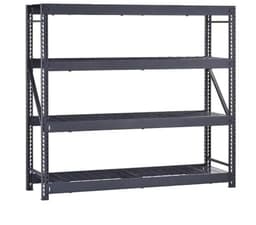
2,500 lb per shelf and 10,000 lb across the unit. That is not a garage number, it is a warehouse number, and it means this is the last shelving you buy for that wall.
Published specs
- Model
- HBR782478W4R
- Dimensions
- 77 in W x 78 in H x 24 in D
- Capacity per shelf
- 2,500 lb, evenly distributed
- Total capacity
- 10,000 lb
- Adjustment
- Shelves adjust in 3 in increments
- Warranty
- Lifetime
Figures are the manufacturer's, from the Home Depot listing for Husky HBR782478W4R, read 2026-09-01. We have not verified them by testing and do not imply that we have.
Our scoring
- Published capacity
- 10.0
- Build
- 9.5
- Tote fit
- 9.0
- Footprint efficiency
- 7.0
- Warranty
- 9.5
What works
- 2,500 lb per shelf is far beyond what a garage will ever ask of it, which is exactly why it never sags
- Welded construction rather than bolt-together, so it does not develop a wobble over years
- 24 in depth swallows a 27-gallon tote sideways with room to spare
- Lifetime warranty
What doesn't
- 77 in wide is a lot of wall. In a single-car garage this is a real commitment
- Welded means it arrives heavy and assembles in one configuration
- Only 3 in adjustment increments, so a tall item may cost you a whole shelf of headroom
Skip this one if you are storing light bulk — holiday bins, sleeping bags, empty coolers. You are paying for steel you will never load, and the same money buys twice the shelf area in a lighter unit.
#2 · Best wire shelving
Seville Classics UltraDurable NSF Wire Shelving
Seville Classics
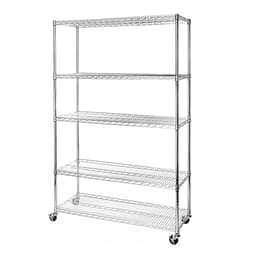
800 lb per shelf on the leveling feet and 4,000 lb across the unit, from a wire deck that lets you see what is in the back. In a damp garage the airflow is a feature, not a compromise.
Published specs
- Capacity per shelf
- 800 lb on leveling feet
- Total capacity
- 4,000 lb
- Certification
- NSF certified
- Deck
- Steel wire
Figures are the manufacturer's, from Seville Classics published specifications; the UltraHD 30 in cabinet (SKU UHD20162B) re-read 2026-09-12. We have not verified them by testing and do not imply that we have.
Our scoring
- Published capacity
- 9.0
- Build
- 8.5
- Tote fit
- 8.0
- Damp tolerance
- 9.5
- Warranty
- 7.5
What works
- 800 lb per shelf is genuinely heavy duty for a wire unit
- Wire deck means air moves and damp things dry rather than sitting in a puddle on a solid shelf
- NSF certification means it is built to a commercial standard, not a consumer one
- You can see into the back of the shelf, which is where garage items go to be forgotten
What doesn't
- Small items fall through the wire unless you sit them on a tray or in a bin
- The 800 lb figure is for the leveling-feet configuration; casters change the number
- Wire decks mark and scratch anything with a soft finish
Skip this one if you are storing loose small parts, hardware, or anything with a soft painted finish. Wire is the wrong deck for those and you will end up lining every shelf, which defeats the airflow you paid for.
#3 · Best for a narrow wall
Gladiator 48 in EZ Connect Rack, five 24 in shelves
Gladiator GarageWorks
Five shelves in 48 inches of wall. In a single-car garage where the only free wall is four feet wide, shelf count per foot is the number that actually matters.
Published specs
- Model
- GARK485XGG
- Width
- 48 in
- Shelves
- Five, 24 in deep
Figures are the manufacturer's, from the Gladiator GarageWorks catalog, read 2026-09-01. We have not verified them by testing and do not imply that we have.
Our scoring
- Published capacity
- 6.5
- Build
- 8.0
- Tote fit
- 8.5
- Footprint efficiency
- 9.5
- Warranty
- 7.5
What works
- Five shelves rather than four, so more tiers in less wall
- 48 in is the width that fits between a garage door track and a corner in a lot of single-car garages
- Connects to further units, so the wall can grow later
What doesn't
- Five shelves in the same height means less clearance per tier — measure your tallest item first
- No prominently published per-shelf capacity
Skip this one if you store tall things — a shop vac, a leaf blower, stacked folding chairs. Five tiers buys you shelves at the cost of the headroom those items need.
Questions people actually ask
Is Husky or Seville Classics shelving better for a garage?
Husky if the garage is dry and you have 77 inches of clear wall — 2,500 lb per shelf, welded, lifetime warranty. Seville Classics UltraDurable if the garage is damp or unheated, or if you need a different width: 800 lb per shelf, NSF certified, and a wire deck that lets air move.
Is wire or solid shelving better in a garage?
Wire in a damp or unheated garage, because air moves through it and damp boxes dry rather than sitting in condensation. Solid for small loose parts that fall through a grid, and for anything with a soft painted finish that wire would mark.
Do I need 2,500 lb per shelf in a garage?
No. Four packed 27-gallon totes on one shelf is roughly 240 lb. What the 2,500 lb figure buys is a shelf that never sags, creeps or flexes — worth paying for, but not because you need the capacity.
Does welded shelving beat bolt-together?
For a unit that goes against a wall and stays there, yes — bolted joints work loose under a load that shifts every time you take a bin off. Bolted wins when the floor slopes, though: Seville's leveling feet solve a problem a welded frame cannot.
Sources
- Husky HBR782478W4R — 2,500 lb per shelf, 10,000 lb total, 77 x 78 x 24 in, lifetime warrantyChecked September 6, 2026
- Seville Classics UltraDurable — 800 lb per shelf on leveling feet, 4,000 lb total, NSF certifiedChecked September 6, 2026
- Gladiator GARK485XGG EZ Connect — 48 in wide, five 24 in deep shelvesChecked September 6, 2026
Manufacturer documentation, manuals, warranty terms and exact product models reviewed September 6, 2026.
Read next
- The best garage storage shelvesFive shelving units ranked on published per-shelf capacity and whether the depth takes a standard tote.
- The best heavy-duty garage shelvingHeavy-duty shelving on published load figures, plus when you are buying steel you will never load.
- How deep should garage shelves be?24 in for totes, 18 in beside a car, 12 in for cans. The one measurement that decides shelf depth.
- Home Depot garage shelving, and what to compare it againstWhere the Husky range wins on published capacity, where it does not, and what to compare against.
- Where the tires goDense weight in a small footprint, sitting for six months. A shelving problem, not a ceiling one.
- FlexiMounts or Husky: the ceiling or the floor?Ceiling rack against welded shelving on published capacity, floor cost and how many totes each actually holds.