Walls
The best tire storage racks
Four wheels off the floor is the easy part. Whether the rack holds them depends on a number most buyers never check: what a set of tires actually weighs.
Disclosure: Rail & Rafter earns a commission on qualifying purchases made through links on this page, at no cost to you. Commission does not decide what we recommend — our criteria do, and here is how we are funded.

Quick picks
Our ranking, verdict first. Every row links to the full write-up below, and every price cell goes straight to Amazon. Scores follow the criteria on our methodology page.
| # | Product | Best for | Score | Price |
|---|---|---|---|---|
| 1 |  SafeRacks Adjustable Wall Mount Tire Rack, 400 lb400 lb on telescoping 12-gauge tubing that adjusts from 31 to 56 inches, which is the range that lets you land both brackets on studs wherever they happen to be. SafeRacks Adjustable Wall Mount Tire Rack, 400 lb400 lb on telescoping 12-gauge tubing that adjusts from 31 to 56 inches, which is the range that lets you land both brackets on studs wherever they happen to be. | Best tire rack overall | 8.4 | $69.98View on AmazonPrice as of September 22, 2026. #ad how this is funded |
| 2 |  Proslat 10026 Steel Tire Storage Rack, 48 in350 lb of welded steel that mounts to studs or hangs on Proslat panel, with a published lifetime warranty. The one to buy if the wall is already paneled. Proslat 10026 Steel Tire Storage Rack, 48 in350 lb of welded steel that mounts to studs or hangs on Proslat panel, with a published lifetime warranty. The one to buy if the wall is already paneled. | Best if you already have slatwall | 8.0 | $149.99View on AmazonPrice as of September 22, 2026. #ad how this is funded |
| 3 |  MaxxHaul 70489 Folding Wall Mount Tire Rack, 300 lb300 lb, 32 to 48 inches of adjustment, and it folds flat to the wall when the tires come off. The folding is the feature, not the capacity. MaxxHaul 70489 Folding Wall Mount Tire Rack, 300 lb300 lb, 32 to 48 inches of adjustment, and it folds flat to the wall when the tires come off. The folding is the feature, not the capacity. | Best for a narrow garage | 7.6 | $43.99View on AmazonPrice as of September 22, 2026. #ad how this is funded |
| 4 |  Husky 4-Tier Welded Steel Rack, 77 x 78 x 24 in2,500 lb per shelf and 10,000 lb across the unit. That is not a garage number, it is a warehouse number, and it means this is the last shelving you buy for that wall. Husky 4-Tier Welded Steel Rack, 77 x 78 x 24 in2,500 lb per shelf and 10,000 lb across the unit. That is not a garage number, it is a warehouse number, and it means this is the last shelving you buy for that wall. | Best heavy-duty shelving | 9.2 | $399.00View on AmazonPrice as of September 22, 2026. #ad how this is funded |
Scores are our editorial assessment against the criteria on how we pick. They are not test results and are not marked up as review ratings.
A set of winter tires spends six months sitting somewhere, and the floor is the worst place for them. A purpose-built rack gets them onto the wall in a way that shelving cannot always match — four wheels, one bracket pair, no shelf given up.
The catch is that the published capacities in this category run from 300 to 400 lb, and a set of four truck tires can sit right at the top of that range. This page compares what each rack publishes against what tires actually weigh.
We have not installed these racks. What follows is each manufacturer's published specification read against real loads — the method is on how we pick, and the wider category is in the walls hub.
How we picked
- A published capacity from the manufacturer or its own listing. This category is full of unbranded racks with a number and no source behind it. None of those are here.
- Adjustable width, or a width that suits standard framing. A rack has to land on studs. Adjustment is what makes that possible on a wall you did not frame yourself.
- Depth from the wall. Every rack here projects at least two feet at hip height, and that is the specification most likely to make you regret the purchase.
- What it costs you in walkway against a shelf. One pick here is not a tire rack at all, for good reason.
- Honest cons on every pick.
Start by weighing the tires
Nobody looks this up before buying a rack, and it is the number that decides which rack is safe to buy.
| Vehicle | Per wheel and tire | Set of four | Inside 300 lb? |
|---|---|---|---|
| Compact car, 16 in | 35 to 45 lb | 140 to 180 lb | Yes, comfortably |
| Sedan, 17 to 18 in | 45 to 55 lb | 180 to 220 lb | Yes |
| Crossover / SUV, 18 to 20 in | 55 to 70 lb | 220 to 280 lb | Close |
| Half-ton truck, 20 in | 70 to 90 lb | 280 to 360 lb | Often not |
| Off-road / all-terrain, 33 in+ | 90 to 120 lb | 360 to 480 lb | No |
Read that against the ratings below and the conclusion is uncomfortable: a 300 lb rack is a car rack. It is fine for a sedan's winter set and marginal for a truck's. The difference between the cheapest and the dearest rack here is roughly the price of one tire, and it buys 100 lb of headroom.
The published figures
| Rack | Capacity | Width | Depth from wall | Mounting |
|---|---|---|---|---|
| SafeRacks adjustable | 400 lb | 31 to 56 in, telescoping | 27 in | Lag bolts into studs |
| Proslat 10026 | 350 lb | 48 in, fixed | 28 in | Studs, or Proslat slatwall |
| MaxxHaul 70489 | 300 lb | 32 to 48 in, adjustable | Not published | Vertical wall studs |
| Husky 4-tier welded shelf | 2,500 lb per shelf | 77 in | 24 in | Freestanding |
The last row is the one worth staring at. A welded steel shelving unit publishes 2,500 lb per shelf — six times the best tire rack here — is 24 in deep rather than 27 or 28, and needs no fixings at all.
Rack or shelf: the honest comparison
A tire rack is not automatically the right answer, and our position on the tire problem generally is that tires are a shelving problem rather than a ceiling one. So when is the rack the better buy?
Buy the rack when the floor is spoken for
A shelving unit takes about 13 square feet of floor. A wall rack takes none — it takes wall, which in most garages is the cheaper currency. If the floor is already full, that settles it.
Buy the shelf when the tires are heavy or the wall is not strong
Four truck tires at 90 lb each is 360 lb hanging on two brackets and four lag bolts. Four truck tires on a welded shelf is 360 lb of a 2,500 lb rating sitting on the slab. When weight is the question, the floor wins — and it keeps winning as the tires get bigger.
Buy neither if the tires are mounted and stacked flat
Mounted wheels can be stacked flat on the floor on a board, four high, for the off-season. It is free. It is also exactly what most people already do badly — the how and the why is in where the tires go.
27 inches is a lot of garage
Every rack here projects 27 to 28 inches from the wall when loaded. That is not a footnote; it is the single most common reason a tire rack gets taken down again.
Measure with the car door open
Park as you normally do, open the door fully, and measure from the wall to the door edge. If that number is under about 32 inches, a loaded tire rack at hip height will be in the way — and a car door into a tire sidewall is the good outcome. The bad one is a door edge into an alloy wheel.
The MaxxHaul rack is the answer to this specific problem: it folds flat when the tires are on the car, giving the walkway back for the half of the year the rack is empty.
Height matters too. Put the rack high enough that the tires clear the hood and the door swing, and low enough that a 60 lb wheel does not have to be lifted above your shoulders. Chest height for the lower rod is the usual compromise — and a wheel lifted to chest height is the most awkward part of the whole operation.
Fixing: the part that actually carries the load
Every rack here mounts into studs, and none of them will forgive a drywall anchor. The published fixing detail is thin across the category — SafeRacks states high-grade lag bolts into 11-gauge mounts; the others state studs without specifying fastener size.
The practical checklist:
- Find both studs, confirm with a test screw. A rack fixed into one stud and one guess is a rack that will eventually pivot.
- Match the rack width to the stud spacing. This is where adjustment earns its money: 31 to 56 in covers studs at 16 in centers (32 or 48 in apart) and at 24 in centers (48 in apart).
- Use the lag bolts supplied, not drywall screws. A drywall screw is hardened and brittle; it shears where a lag bolt bends.
- Load the rack low first. Put one wheel on, leave it a day, then check the fixings before the other three go up.
What a stud can take, and why the fixing matters more than the bracket, is worked through in how much weight a garage wall can hold.
The slatwall option
The Proslat rack is the only one here that can hang on a paneled wall instead of going directly into studs — Proslat publishes both mounting routes for it. If your wall is already slatwall, that is genuinely convenient: the rack goes where you want it rather than where the studs are.
Two cautions. The panel system has its own rating, and the rack's 350 lb does not override it — Proslat's classic PVC slatwall publishes 75 lb per square foot, so a heavily loaded tire rack wants to be spread across a decent area of panel and fixed through to framing where the instructions call for it. And if you do not already own slatwall, the panels cost several times what the rack does. The panel systems are ranked in the best garage slatwall panels.
The ProRack trap, worth knowing before you click
Proslat also sells a ProRack Tire Storage Option that looks like a standalone freestanding unit in retail listings, dimensions and all. It is not. Proslat states plainly that it requires purchase of the ProRack system — it is an attachment, and the published 800 lb figure is for the attachment paired with that system into studs.
It may well be the best option on this page if you already own a ProRack. If you do not, you are one purchase short of a working tire rack, and the listing does not make that obvious.
Storing tires so they survive the six months
The rack keeps them off the floor. It does not keep them in good condition, and those are different problems.
- Clean and dry before they go up. Road salt and brake dust left on a wheel for six months is six months of corrosion.
- Hang mounted wheels, stack unmounted tires. A tire with no wheel in it deforms where it bears. Mounted wheels are supported by the rim and do not care.
- Keep them out of sunlight. UV degrades rubber, and a garage window is not a small exposure over half a year.
- Away from the electric motors. Ozone accelerates rubber aging, so the wall next to the furnace or a running compressor is the wrong wall.
- Cover them loosely. A cover keeps dust and light off; sealed plastic traps moisture against the rim.
What we could not verify
- SafeRacks does not publish its own capacity figure. The 400 lb rating, the 31 to 56 in range, the 27 in depth and the 12-gauge tubing all come from the retail listing. saferacks.com publishes the limited lifetime warranty but not the numbers.
- MaxxHaul publishes no depth and no warranty term on its product page.
- No rack here publishes a fastener specification — lag bolt diameter, length or embedment depth. For a bracket carrying 300 lb at hip height, that is a real gap.
- Tire weights are planning assumptions. The table above is for scale. Your wheels carry their own weight and a bathroom scale settles it.
- Long-term behavior. We have not loaded any of these racks for a season and will not pretend to know how the telescoping joints wear.
Who should buy which
Buy the SafeRacks rack if you want the highest published capacity and the widest adjustment. 400 lb covers a truck set, and 31 to 56 inches lands on almost any stud spacing.
Buy the Proslat rack if your wall is already slatwall, or you want welded steel and a published lifetime warranty rather than a telescoping tube.
Buy the MaxxHaul rack if the garage is narrow and the tires come off the rack every spring. Folding flat for six months is worth more than 100 lb of rating you were never going to use.
Buy the Husky shelving instead if the tires are heavy, the wall is questionable, or you would rather not drill at all. 2,500 lb a shelf, 24 inches deep, and the rest of the unit stores everything else — the ranked options are in the best heavy-duty garage shelving.
The picks in full
Every pick carries the manufacturer's published specs, our scoring against stated criteria, and a reason you might want to skip it.
#1 · Best tire rack overall
SafeRacks Adjustable Wall Mount Tire Rack, 400 lb
SafeRacks
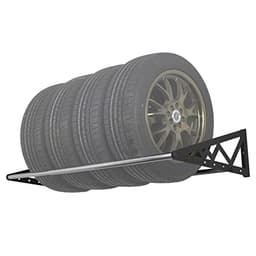
400 lb on telescoping 12-gauge tubing that adjusts from 31 to 56 inches, which is the range that lets you land both brackets on studs wherever they happen to be.
Published specs
- Capacity
- 400 lb per rack
- Adjustable width
- 31 to 56 in
- Depth from wall
- 27 in
- Tubing
- 12-gauge telescoping steel
- Warranty
- Limited lifetime
Figures are the manufacturer's, from SafeRacks' own tire rack page for the warranty, plus its retail listing for the capacity and gauge figures, read 2026-09-22. We have not verified them by testing and do not imply that we have.
Our scoring
- Published capacity
- 9.0
- Fit range
- 9.5
- Documentation
- 7.0
- Build
- 8.5
- Footprint
- 5.5
What works
- 400 lb is the highest published figure of the wall racks here, and it covers a set of four truck tires
- 31 to 56 in of adjustment means the brackets can land on studs at 16 or 24 in centers
- 12-gauge tubing, published — most of this category publishes no gauge at all
- Limited lifetime warranty from the manufacturer
What doesn't
- 27 in of depth is a lot of walkway to give up beside a parked car
- SafeRacks' own page does not publish the capacity or the gauge; those come from the retail listing
- Fully extended to 56 in, the tubing is doing the most work it will ever do
- Tall off-road tires can foul the wall and end up leaning on it rather than sitting on the rods
Skip this one if your garage is narrow. Anything that projects 27 inches from the wall at hip height is in the way every time you open a car door.
#2 · Best if you already have slatwall
Proslat 10026 Steel Tire Storage Rack, 48 in
Proslat
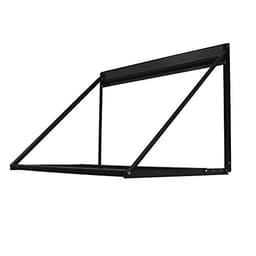
350 lb of welded steel that mounts to studs or hangs on Proslat panel, with a published lifetime warranty. The one to buy if the wall is already paneled.
Published specs
- Capacity
- 350 lb
- Holds
- Up to 4 standard tires, 11.5 in wide
- Dimensions
- 48 in L x 28 in H x 28 in D
- Mounting
- Directly to studs, or on Proslat PVC slatwall
- Material
- Welded steel, powder-coated
Figures are the manufacturer's, from the Proslat tire rack page on proslat.com, read 2026-09-22. We have not verified them by testing and do not imply that we have.
Our scoring
- Published capacity
- 8.0
- Fit range
- 6.5
- Documentation
- 9.5
- Build
- 9.0
- Footprint
- 5.0
What works
- Mounts to studs or to slatwall, which almost nothing else in the category does
- Welded steel rather than telescoping tube, so nothing to slip at width
- Published lifetime warranty coverage
- Fixed 48 in width lands cleanly on studs at 16 in centers
What doesn't
- 28 in deep — the deepest of the three racks here, and the most walkway lost
- 350 lb is below the SafeRacks figure while costing more
- Fixed width, so it cannot be nudged to suit awkward stud spacing
- Published tire width is 11.5 in; wider truck tires are outside the stated fit
Skip this one if you have bare drywall and no plans for slatwall. The slatwall compatibility is much of what you are paying for.
#3 · Best for a narrow garage
MaxxHaul 70489 Folding Wall Mount Tire Rack, 300 lb
MaxxHaul
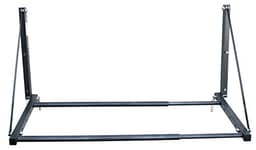
300 lb, 32 to 48 inches of adjustment, and it folds flat to the wall when the tires come off. The folding is the feature, not the capacity.
Published specs
- Capacity
- Up to 300 lb
- Adjustable width
- 32 to 48 in between uprights
- Holds
- Up to 4 standard vehicle tires
- Folds
- Flat against the wall when empty
- Mounting
- Directly into vertical wall studs
Figures are the manufacturer's, from the MaxxHaul 70489 product page on maxxhaul.com, read 2026-09-22. We have not verified them by testing and do not imply that we have.
Our scoring
- Published capacity
- 6.5
- Fit range
- 8.0
- Documentation
- 6.5
- Build
- 7.0
- Footprint
- 9.0
What works
- Folds flat when the tires are on the car, which gives the walkway back for six months of the year
- Cheapest of the three by a clear margin
- 32 to 48 in of adjustment covers 16 in stud spacing at either end of the range
- All-steel construction with a powder-coated finish
What doesn't
- 300 lb is the lowest figure here and a set of four truck tires can exceed it
- MaxxHaul does not publish the depth from the wall or a warranty term
- A folding joint is one more thing to seize or work loose than a welded rack has
- Folding only helps if you actually take the tires off it — a permanently loaded rack never folds
Skip this one if you store a set of heavy truck or SUV tires year round. Weigh them: four at 75 lb is 300 lb, which is the whole published rating.
#4 · Best heavy-duty shelving
Husky 4-Tier Welded Steel Rack, 77 x 78 x 24 in
Husky
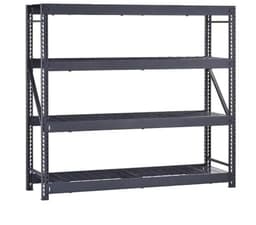
2,500 lb per shelf and 10,000 lb across the unit. That is not a garage number, it is a warehouse number, and it means this is the last shelving you buy for that wall.
Published specs
- Model
- HBR782478W4R
- Dimensions
- 77 in W x 78 in H x 24 in D
- Capacity per shelf
- 2,500 lb, evenly distributed
- Total capacity
- 10,000 lb
- Adjustment
- Shelves adjust in 3 in increments
- Warranty
- Lifetime
Figures are the manufacturer's, from the Home Depot listing for Husky HBR782478W4R, read 2026-09-01. We have not verified them by testing and do not imply that we have.
Our scoring
- Published capacity
- 10.0
- Build
- 9.5
- Tote fit
- 9.0
- Footprint efficiency
- 7.0
- Warranty
- 9.5
What works
- 2,500 lb per shelf is far beyond what a garage will ever ask of it, which is exactly why it never sags
- Welded construction rather than bolt-together, so it does not develop a wobble over years
- 24 in depth swallows a 27-gallon tote sideways with room to spare
- Lifetime warranty
What doesn't
- 77 in wide is a lot of wall. In a single-car garage this is a real commitment
- Welded means it arrives heavy and assembles in one configuration
- Only 3 in adjustment increments, so a tall item may cost you a whole shelf of headroom
Skip this one if you are storing light bulk — holiday bins, sleeping bags, empty coolers. You are paying for steel you will never load, and the same money buys twice the shelf area in a lighter unit.
Questions people actually ask
How much weight can a tire rack hold?
The wall racks here publish 300 to 400 lb: SafeRacks 400 lb, Proslat 350 lb and MaxxHaul 300 lb. A set of four car tires is roughly 140 to 220 lb, but a truck set can reach 360 lb — which is past every rack on this page except the SafeRacks.
How far does a tire rack stick out from the wall?
Proslat publishes 28 in and the SafeRacks listing states 27 in; MaxxHaul does not publish a depth. Measure from the wall to your car door fully open before buying — a loaded rack at hip height is in the way if that gap is under about 32 in.
Can a tire rack be mounted on drywall?
No. All three racks specify mounting into wall studs. Drywall anchors are not a reasonable fixing for 300 lb of tires at hip height.
Is a tire rack better than shelving for storing tires?
A rack is better when floor space is the constraint, since it uses wall instead. Shelving is better when the tires are heavy — a welded steel shelf publishes 2,500 lb per shelf against 400 lb for the best rack here, and it needs no fixings.
Should tires be stored standing up or lying down?
Mounted wheels can hang or stack either way because the rim supports them. Unmounted tires should be stood upright or stacked flat rather than hung, since hanging an unmounted tire lets it deform where it bears.
Sources
- Proslat 10026 tire rack — 350 lb capacity, up to 4 standard tires 11.5 in wide, 48 in L x 28 in H x 28 in D, welded steel with powder-coated finish, mounts to studs or Proslat slatwall, assembly requiredChecked September 22, 2026
- Proslat ProRack Tire Storage Option — requires purchase of the ProRack system; 800 lb paired with ProRack into studs, 350 lb into slatwall; up to 4 tires adjustable to 11.5 in wide x 30 in diameterChecked September 22, 2026
- SafeRacks tire rack — limited lifetime warranty (capacity and dimensions are not published on this page)Checked September 22, 2026
- SafeRacks adjustable wall mount tire rack listing — 400 lb capacity, 31 to 56 in adjustable width, 27 in depth, 12-gauge telescoping tubing, 11-gauge wall mounts with lag boltsChecked September 22, 2026
- MaxxHaul 70489 folding tire rack — up to 300 lb, adjusts 32 to 48 in between uprights, holds up to 4 standard tires, all-steel powder-coated, folds flat, mounts into vertical wall studsChecked September 22, 2026
- Husky 4-tier welded steel shelving HBR782478W4R — 2,500 lb per shelf, 10,000 lb total, 24 in deepChecked September 1, 2026
Manufacturer documentation, manuals, warranty terms and exact product models reviewed September 22, 2026.
Read next
- Where the tires goDense weight in a small footprint, sitting for six months. A shelving problem, not a ceiling one.
- How much weight can a garage wall hold?The fixing decides it, not the wall. Published stud-versus-drywall figures and how to find your studs.
- The best heavy-duty garage shelvingHeavy-duty shelving on published load figures, plus when you are buying steel you will never load.
- The best garage wall storage systemsTrack, slatwall, panels and metal pegboard on published load ratings, converted into one comparable question.
- The best garage slatwall panelsFive slatwall systems on published ratings from 50 to 300 lb per sq ft, and the mounting condition behind each number.
- Garage hooks: what the weight ratings actually meanWhat garage hook ratings really mean, and which wall system to hang heavy things from.