Overhead
SafeRacks or MonsterRax: the 4x8 overhead rack, compared
Both publish a capacity. Only one publishes a 12 inch minimum drop, and in most garages the drop range decides this before the capacity ever gets a vote.
Disclosure: Rail & Rafter earns a commission on qualifying purchases made through links on this page, at no cost to you. Commission does not decide what we recommend — our criteria do, and here is how we are funded.

The short answer: SafeRacks publishes 600 lb and a 12 to 45 inch drop range; MonsterRax publishes 500 lb and starts at 18 inches. If your ceiling is low, or the garage door opens into the space you were planning to fill, that six inches of extra drop adjustment settles it before the capacity figure gets a hearing.
If your ceiling is high and the load is holiday bins rather than tile, the 100 lb difference is not going to be the thing you notice, and MonsterRax becomes a legitimate pick. The rest of this page is the arithmetic behind both of those sentences, using the manufacturers' own published numbers. The wider category is in our overhead storage hub and the criteria are on how we pick.
The published numbers, side by side
| SafeRacks 4x8 | MonsterRax 4x8 | FlexiMounts GR48F | |
|---|---|---|---|
| Rated capacity | 600 lb, evenly distributed | 500 lb | 600 lb, with 3/8 in plywood or thicker |
| Ceiling drop | 12 to 45 in | 18 to 45 in | 22 to 40 in |
| Drop sold as | One adjustable range | 12 to 21 in and 24 to 45 in ranges | One adjustable range |
| Brackets | Patented 27 in, spanning two wood joists | Not published as a span figure | Fits any spacing up to 24 in |
| Warranty | Limited lifetime | Not published on the product page | Not published as a lifetime term |
What 500 versus 600 pounds actually buys you
It is the number everybody compares first and it is rarely the number that matters. Convert it into the thing you are actually going to put up there.
A 27-gallon tote of holiday decorations runs perhaps 20 to 30 lb. The same tote packed with books, tools or tile reaches 60. A 4x8 rack holds roughly eight of those totes in a sensible layout.
| Rack | Rated capacity | Light totes at 25 lb | Heavy totes at 60 lb |
|---|---|---|---|
| MonsterRax 4x8 | 500 lb | 20 — more than fits | 8 — exactly a full rack |
| SafeRacks 4x8 | 600 lb | 24 — more than fits | 10 — a full rack with margin |
Read that honestly and the gap shrinks. Both racks run out of physical space before MonsterRax runs out of rating unless every single tote is packed heavy. If your garage attic is seasonal decorations, camping gear and empty suitcases — which is what most of them are — you will never approach 500 lb, and choosing on that number alone is choosing on a number you will not use.
Where the 100 lb does matter: tile, paint, paving sand, boxed books, automotive parts. Dense things. If that is your pile, take the 600 lb rating and the margin that comes with it.
The rating is not the real limit — the ceiling is
Both of these numbers assume the rack is fastened into sound structure. A 600 lb rating hung off a ceiling that cannot carry 600 lb is a 600 lb problem. Work out what your joists can take first, using the span tables on how much weight a garage ceiling can hold, then choose the rack. That order is not optional.
Drop range: the number that usually decides it
Drop is the distance from the ceiling to the top of the rack deck. It sets two things at once — how much headroom you keep underneath, and whether the rack clears your garage door and its opener track.
SafeRacks goes to 12 inches. MonsterRax starts at 18.
On a standard 8 ft ceiling, a 12 inch drop leaves about 6 ft 8 in of clear height beneath the rack — you can walk under it. At 18 inches you are down to about 6 ft 2 in, which most adults will duck for, every time, forever.
That is the practical difference, and it is the reason SafeRacks appears in our low-ceiling garage storage guide and MonsterRax does not. If your ceiling is 9 ft or better, the point is moot and you should ignore it entirely.
MonsterRax sells the drop as two ranges, not one
MonsterRax publishes its drop in two purchasable bands — 12 to 21 in and 24 to 45 in. That is a genuine advantage in one specific way and a trap in another. The advantage: you can buy the short band and get down to 12 inches, matching SafeRacks. The trap: you are choosing the band at checkout, and if you measure wrong you have bought the wrong rack rather than simply adjusting it after it arrives.
Measure your ceiling to the underside of the joist, and measure the garage door in its fully open position, before you order either one. The door track is where this goes wrong most often, and it is covered in storage above the garage door.
Brackets and joists
SafeRacks publishes a specific bracket design: patented 27 inch brackets intended to span two wood joists. That is a real engineering statement, and it is worth something — spreading the load across two joists rather than hanging it off one is exactly what you want a ceiling rack to do.
MonsterRax does not publish an equivalent span figure on its product page. That is not evidence the hardware is worse; it is evidence you have less information, and on a product that hangs several hundred pounds over your car, less information is a cost. We score published documentation openly for this reason, and MonsterRax scores lower on it.
FlexiMounts takes a third approach and publishes fit rather than span: any joist spacing up to 24 in, and at wider spacing the 48 in width lands on joists exactly. If your joists are on unusual centers, that is the most directly useful statement of the three — the full comparison is in FlexiMounts against SafeRacks.
Warranty, and what a published one is worth
SafeRacks publishes a limited lifetime warranty. MonsterRax does not publish a warranty term on the product page we read. Warranty rarely gets used on a steel rack that is correctly installed, so treat this the way you would treat the bracket documentation: not as a promise of better steel, but as a measure of how much the manufacturer is willing to put in writing.
SafeRacks also includes 8 accessory hooks in the box. Small thing, but it is the difference between hanging the extension cords on day one and buying hooks separately.
Installation, and what is the same about both
Neither of these is a one-person job and neither manufacturer pretends otherwise. The sequence is the same for both racks and it is worth knowing before you choose, because the difficult parts are not brand-specific.
- Find and mark the joists across the whole footprint, not just at the four corners. A stud finder plus a small test hole is the honest method; guessing from the drywall seams is how brackets end up in nothing.
- Check the direction the joists run. A 4x8 rack has to cross them, not sit between two. This single fact reorients more installations than any other, and it is why the fit statements in the table above matter more than the capacity figures.
- Lift and hold while somebody else drives the lags. The frame is heavy and awkward at ceiling height. Two people, or a prop.
- Load it low first. Put the heaviest thing you intend to store on it before you fill it, and look at the ceiling while you do.
If any of that reads as more of a job than you want, it is a real cost and worth pricing — what drives an installer's quote is broken down in overhead garage storage installation cost.
What actually goes on either of these
Both racks suit the same profile of stuff, and it is worth naming because it is narrower than people expect: bulky, light, and seasonal. Holiday bins, camping gear, empty suitcases, spare bedding, the crib you are keeping.
What does not belong overhead on either rack: anything you need weekly (every retrieval is a ladder trip), anything you cannot lift above your head safely, and anything that will be damaged by the warmest, most temperature-swung air in the building — which is exactly what collects at ceiling height. The sorting logic is in the bins and totes problem page.
The verdict
Buy the SafeRacks 4x8 if your ceiling is 8 ft or lower, if the load is dense, or if you want the most published information of the two — capacity, bracket span and warranty are all stated. For most garages this is the safer purchase.
Buy the MonsterRax 4x8 if your ceiling is high enough that drop range is irrelevant, your load is light and bulky rather than dense, and the price at the moment you are shopping favors it. There is nothing wrong with a 500 lb rack holding 200 lb of camping gear.
Buy the FlexiMounts GR48F instead if you intend to deck the rack with plywood. Its 600 lb rating is published with a decking condition attached — 3/8 in plywood or thicker — which is unusually specific and exactly right if you plan to slide boxes rather than sit totes on rails.
Buy none of them if you need the load to come back down regularly. A fixed rack at any drop is a ladder job every time, and if you are up there monthly the honest answer is a lifting rack instead — that trade-off is worked through in fixed rack against motorized lift. And if what is going up there is totes, check the fit numbers first in bin sizes that fit overhead racks.
What we would buy for this
Every pick carries the manufacturer's published specs, our scoring against stated criteria, and a reason you might want to skip it.
#1 · Best drop range and warranty
SafeRacks 4 x 8 Overhead Rack
SafeRacks
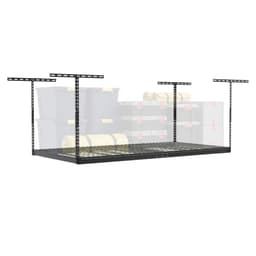
A 12 to 45 inch drop range is the widest published in this category, which makes it the rack that fits both a 7 ft ceiling and a cathedral one. The limited lifetime warranty is the other reason it is here.
Published specs
- Size
- 4 ft x 8 ft
- Rated capacity
- 600 lb total, evenly distributed
- Ceiling drop
- 12 in to 45 in, adjustable
- Brackets
- Patented 27 in brackets spanning two wood joists
- Warranty
- Limited lifetime
- Included
- 8 accessory hooks
Figures are the manufacturer's, from the SafeRacks 4x8 product page, read 2026-09-01. We have not verified them by testing and do not imply that we have.
Our scoring
- Published capacity
- 9.0
- Fit range
- 9.5
- Mounting honesty
- 9.0
- Low-ceiling suitability
- 9.5
- Documentation
- 8.5
What works
- 12 in minimum drop is the shortest published in the mainstream field — this is the low-ceiling answer
- Brackets are designed to span two joists rather than load one
- Limited lifetime warranty, which almost nobody else in the category offers
- Accessory hooks included rather than sold separately
What doesn't
- Wood joists only. The instructions explicitly rule out I-beams, steel joists and concrete ceilings
- The 12 to 24 in and 24 to 45 in drop ranges are separate purchases, so you have to measure before you order rather than after
- 600 lb assumes even distribution; a concentrated load in one corner is not the rated case
Skip this one if your garage ceiling is concrete, steel joist, or an engineered I-beam floor system. SafeRacks says in writing not to install into any of those, and that is not a warning to work around.
#2 · Best when the load is light and bulky
MonsterRax 4 x 8 Overhead Rack
MonsterRax
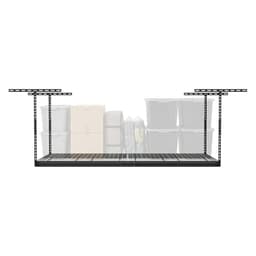
500 lb rather than 600, which matters less than you would think: almost nobody fills a 4x8 rack with 500 lb of anything. The 18 in minimum drop is the number to look at.
Published specs
- Size
- 4 ft x 8 ft
- Model
- MR-48-24H
- Rated capacity
- 500 lb
- Ceiling drop
- 18 in to 45 in, adjustable
- Drop options
- Sold in 12 to 21 in and 24 to 45 in ranges
Figures are the manufacturer's, from the MonsterRax 4x8 product page (SKU MR-48-24H), read 2026-09-01. We have not verified them by testing and do not imply that we have.
Our scoring
- Published capacity
- 7.5
- Fit range
- 9.0
- Mounting honesty
- 7.5
- Low-ceiling suitability
- 8.5
- Documentation
- 7.0
What works
- 18 in minimum drop clears more 8 ft ceilings than a 22 in minimum does
- 45 in maximum reaches down into a high or vaulted garage ceiling
- Two published drop ranges means you buy the one that fits rather than adjusting into the wrong end of a range
What doesn't
- 500 lb rating is the lowest of the three mainstream 4x8 racks here
- Fewer published mounting details than FlexiMounts or SafeRacks give you
Skip this one if you are storing dense weight — tools, tile, paint, engine parts. 500 lb sounds like a lot until you stack six full 27-gallon totes of hardware on it. Buy capacity you will not think about.
#3 · Best overall overhead rack
FlexiMounts GR48F 4 x 8 Overhead Rack
FlexiMounts
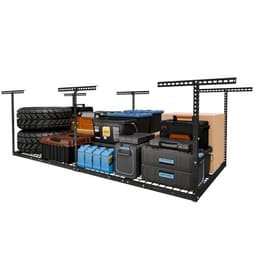
The widest useful drop range in its class and the only major rack that publishes what happens when your joists are further apart than 24 inches. That second fact is why it goes first.
Published specs
- Size
- 4 ft x 8 ft
- Rated capacity
- 600 lb, with 3/8 in plywood decking or thicker
- Ceiling drop
- 22 in to 40 in, adjustable
- Volume
- Up to 105 cu ft
- Joist spacing
- Any spacing up to 24 in; at wider spacing, fits 48 in exactly
Figures are the manufacturer's, from the FlexiMounts product page for the GR48F, read 2026-09-01. We have not verified them by testing and do not imply that we have.
Our scoring
- Published capacity
- 9.0
- Fit range
- 8.5
- Mounting honesty
- 9.5
- Low-ceiling suitability
- 7.0
- Documentation
- 9.0
What works
- 600 lb rating is at the top of the mainstream 4x8 field
- Publishes an explicit answer for joists wider than 24 in on center, which most brands leave you to discover on the ladder
- 22 in minimum drop is short enough for a lot of 8 ft ceilings
- Decking is your own plywood, so you can replace a sagging panel for the price of a sheet
What doesn't
- The 600 lb rating is conditional on you supplying 3/8 in plywood or thicker; the frame alone is not the rated system
- 22 in is still a real drop; under a 7 ft ceiling it leaves very little headroom
- Plywood is not included, so the real cost is the rack plus a sheet
Skip this one if your joists are 32 in or 36 in on center. The published fit is up to 24 in, or exactly 48 in — the in-between spacings mean mounting into a single joist per bracket, and that is how ceilings crack.
Questions people actually ask
Is SafeRacks better than MonsterRax?
On published figures SafeRacks states more: 600 lb against 500 lb, a 12 to 45 in drop against 18 to 45 in, a patented 27 in bracket spanning two joists, and a limited lifetime warranty. MonsterRax publishes a capacity and a drop range and less besides. For a low ceiling or a dense load, SafeRacks. For a high ceiling and light bulky storage, MonsterRax is enough rack.
Is 500 lb enough for an overhead garage rack?
For most garages, yes. A 4x8 rack holds roughly eight 27-gallon totes, and totes of seasonal decorations run 20 to 30 lb each — nowhere near 500 lb. The rating becomes the limit only when the load is dense: tile, paint, boxed books, automotive parts.
What ceiling drop should I choose?
The smallest one that clears your garage door in its fully open position and whatever you park underneath. On an 8 ft ceiling a 12 in drop leaves roughly 6 ft 8 in of walking height; an 18 in drop leaves about 6 ft 2 in. Measure the door track open before ordering, not after.
Do these racks need to go into joists?
Yes. Both are ceiling-hung racks and both depend on being fastened into sound structure. The rack's rating is a ceiling on what the hardware can carry, not a statement about your ceiling — work out the joist capacity separately before choosing a rack.
Sources
- SafeRacks 4x8 overhead rack — 600 lb rating, 12 to 45 in drop, 27 in brackets, limited lifetime warranty, 8 hooksChecked September 6, 2026
- MonsterRax 4x8 overhead rack (MR-48-24H) — 500 lb rating, 18 to 45 in drop, drop bandsChecked September 6, 2026
- FlexiMounts GR48F — 600 lb with 3/8 in plywood decking, 22 to 40 in drop, joist spacing guidanceChecked September 6, 2026
Manufacturer documentation, manuals, warranty terms and exact product models reviewed September 6, 2026.
Read next
- The best overhead garage storage racksFour overhead racks ranked on capacity, drop range and joist fit, with a reason to skip each one.
- FlexiMounts vs SafeRacksTwo 600 lb racks compared on drop range, bracket span and warranty. The verdict names a loser.
- FlexiMounts vs MonsterRax600 lb versus a shorter drop. Which one wins depends entirely on your ceiling height.
- How much weight can a garage ceiling hold?The complete 2x4 to 2x10 joist span tables at four spacings, and the arithmetic for your own ceiling.
- Garage storage for a low ceilingThe clearance arithmetic for a 7 or 8 ft ceiling, and the two places a rack still works.
- SafeRacks: what the 12 inch drop is really worthThe 12 in minimum drop, the two-joist bracket span, the lifetime warranty — and the ceilings SafeRacks rules out in writing.