Overhead
Fixed rack vs motorized lift
A lifting rack solves the real problem with overhead storage — that you stop using it. It costs you about half your capacity. Here is when that trade is worth making.
Disclosure: Rail & Rafter earns a commission on qualifying purchases made through links on this page, at no cost to you. Commission does not decide what we recommend — our criteria do, and here is how we are funded.

Here is the honest problem with overhead storage, and every brand in the category knows it: people stop using it. The rack goes up, it gets loaded, and then everything on it becomes something you have to get a ladder out for. By month three the floor is filling up again because the floor does not need a ladder.
A lifting rack is the direct answer to that. The platform comes down to you, you load it standing on the floor, and it goes back up. The question is what it costs — and the cost is not only money.
The verdict, first
Buy a fixed rack unless the load comes down more than about four times a year. At genuinely seasonal frequency, a ladder is not a hardship and a fixed rack gives you roughly double the capacity for substantially less money. Above that frequency, the lift stops being a luxury and starts being the reason the system gets used at all.
The capacity trade, in numbers
| FlexiMounts GL1 lifting rack | SafeRacks 4x8 fixed | |
|---|---|---|
| Published safe load | 350 lb | 600 lb |
| Tested to | 600 lb total | Not published as a separate figure |
| Moving parts | Yes | None |
| Access | Comes down to you | Ladder |
350 lb against 600 is the whole trade stated plainly. FlexiMounts publishes the GL1 as tested to 600 lb total with a 350 lb safe load, which is a more transparent way of putting it than most of this category manages — two numbers, both stated, rather than one number with the conditions hidden.
Worth noticing: 350 lb is still a lot of holiday decorations. The capacity difference only bites if what you are storing is dense, and dense things arguably should not be over your head anyway — see what your ceiling can actually carry.
The frequency test
Before you spend the extra, answer one question honestly: how many times a year does this come down?
- Once or twice a year — holiday decorations, the Christmas tree, seasonal bedding. Fixed rack. A ladder twice a year is not a problem worth several hundred dollars.
- Four to eight times a year — camping gear, a roof box, seasonal sports kit. This is the genuine gray zone and it depends on how heavy each trip is. A roof box you cannot lift alone changes the calculation completely.
- Monthly or more — this does not belong overhead at all. That is shelving or a wall system, and no amount of lifting hardware makes an overhead rack the right home for something you reach for every few weeks.
The number that decides it is not annual frequency
It is the weight of a single item. A ladder is fine for a 20 lb bin of decorations. A ladder is a genuinely bad idea for a 60 lb roof box or a 40 lb kayak, because the failure mode is not inconvenience, it is coming off a ladder holding something heavy.
If any single item going up there is heavy or awkward enough that you would rather not carry it up a ladder, the lift has already justified itself on that item alone. That is the situation on kayaks and paddleboards, where the object is not especially heavy but is long enough to be unmanageable one-handed.
What else changes with a lift
- Moving parts fail. A fixed rack is four brackets and some steel; there is nothing in it to seize, fray or lose power. A lift has a mechanism, and a mechanism is a service item.
- The travel path has to be clear. A lifting platform needs the whole column of space beneath it kept empty, which is sometimes exactly the floor space you were trying to reclaim.
- Cost per cubic foot is much worse. For the price difference between a lift and a fixed rack you can often fit two fixed racks — and two racks spread the load across more joists, which is structurally the better outcome.
The trap in the middle
The bad purchase is a lift bought for genuinely seasonal storage. You pay a premium and give up half the capacity for access you use twice a year. If what is going up there is holiday bins, buy the fixed rack and spend the difference on a bin system you can actually find things in.
Who should buy which
Fixed rack for seasonal storage, for anyone who wants maximum capacity per dollar, and for anyone whose ceiling arithmetic is already tight enough that spreading load across two racks is the right call.
Lifting rack if any single item is too heavy or awkward to carry up a ladder, if the load comes down more than a few times a year, or if a ladder is not something you want to be using at all. That last one is a perfectly good reason on its own and nobody in this category says it.
What we would buy for this
Every pick carries the manufacturer's published specs, our scoring against stated criteria, and a reason you might want to skip it.
#1 · Best if you need the load to come down
FlexiMounts GL1 Lifting Rack
FlexiMounts
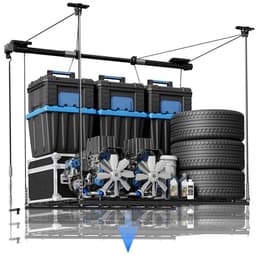
A lifting rack solves the one real problem with overhead storage: you stop using it. The trade is capacity — the published safe load is 350 lb, not the 600 lb a fixed rack of the same size carries.
Published specs
- Type
- Lifting / lowering overhead rack
- Safe load capacity
- 350 lb
- Tested to
- 600 lb total
Figures are the manufacturer's, from the FlexiMounts product page for the GR48F, read 2026-09-01. We have not verified them by testing and do not imply that we have.
Our scoring
- Published capacity
- 6.0
- Access
- 9.5
- Mounting honesty
- 8.5
- Low-ceiling suitability
- 7.5
- Documentation
- 8.0
What works
- The load comes to you instead of you going up a ladder, which is the difference between storage you use and storage you forget
- Published safe load and tested load are stated as two separate numbers, which is more transparency than most of this category offers
What doesn't
- 350 lb safe load is roughly half a comparable fixed rack
- More moving parts than a fixed rack, and every moving part is a thing that can seize or need service
- Costs substantially more per square foot of storage than a fixed rack
Skip this one if the things going up there are genuinely seasonal — holiday bins, camping gear, the spare bedding. Twice a year with a ladder is not a hardship, and a fixed rack gives you more capacity for less money.
#2 · Best drop range and warranty
SafeRacks 4 x 8 Overhead Rack
SafeRacks
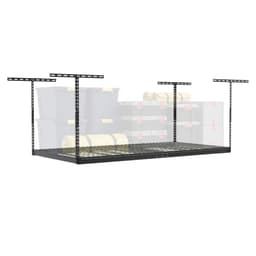
A 12 to 45 inch drop range is the widest published in this category, which makes it the rack that fits both a 7 ft ceiling and a cathedral one. The limited lifetime warranty is the other reason it is here.
Published specs
- Size
- 4 ft x 8 ft
- Rated capacity
- 600 lb total, evenly distributed
- Ceiling drop
- 12 in to 45 in, adjustable
- Brackets
- Patented 27 in brackets spanning two wood joists
- Warranty
- Limited lifetime
- Included
- 8 accessory hooks
Figures are the manufacturer's, from the SafeRacks 4x8 product page, read 2026-09-01. We have not verified them by testing and do not imply that we have.
Our scoring
- Published capacity
- 9.0
- Fit range
- 9.5
- Mounting honesty
- 9.0
- Low-ceiling suitability
- 9.5
- Documentation
- 8.5
What works
- 12 in minimum drop is the shortest published in the mainstream field — this is the low-ceiling answer
- Brackets are designed to span two joists rather than load one
- Limited lifetime warranty, which almost nobody else in the category offers
- Accessory hooks included rather than sold separately
What doesn't
- Wood joists only. The instructions explicitly rule out I-beams, steel joists and concrete ceilings
- The 12 to 24 in and 24 to 45 in drop ranges are separate purchases, so you have to measure before you order rather than after
- 600 lb assumes even distribution; a concentrated load in one corner is not the rated case
Skip this one if your garage ceiling is concrete, steel joist, or an engineered I-beam floor system. SafeRacks says in writing not to install into any of those, and that is not a warning to work around.
Questions people actually ask
How much weight can a motorized garage lift hold?
FlexiMounts publishes the GL1 as having a 350 lb safe load capacity and being tested to 600 lb total. Those are two different figures and the safe load is the one to design around.
Are lifting racks worth the extra money?
Only if the load actually comes down. For genuinely seasonal storage the answer is usually no — a fixed rack gives roughly double the capacity for less. The case flips when a single item is too heavy or awkward to carry up a ladder safely.
Do lifting racks need a power outlet?
Powered models do. Check the installation requirements for the specific model before ordering, because a ceiling outlet is not something most garages have where the rack wants to go.
Can I put a lift on the same ceiling as a fixed rack?
The ceiling arithmetic applies to the total load, not to each rack separately. Two systems on one ceiling means adding the loads together and checking that against the joist tables on how much weight a garage ceiling holds.
Sources
- FlexiMounts GL1 published capacity figuresChecked September 1, 2026
- SafeRacks 4x8 product pageChecked September 1, 2026
Manufacturer documentation, manuals, warranty terms and exact product models reviewed September 1, 2026.
Read next
- The best overhead garage storage racksFour overhead racks ranked on capacity, drop range and joist fit, with a reason to skip each one.
- The best garage storage liftsStorage lifts on published safe load, and the honest case for buying a fixed rack instead.
- How much weight can a garage ceiling hold?The complete 2x4 to 2x10 joist span tables at four spacings, and the arithmetic for your own ceiling.
- Where the kayak goesThe one item where a ceiling hoist is genuinely right, plus the hull-support rule that saves the boat.
- Where the holiday decorations goThe textbook overhead case. Six bins on one rack, how to label them, and what a garage breaks.