Overhead
FlexiMounts or Husky: the ceiling or the floor?
These are not rival products. One is a ceiling rack, one is a shelving unit, and choosing between them is really a question about which surface in your garage is the scarce one.
Disclosure: Rail & Rafter earns a commission on qualifying purchases made through links on this page, at no cost to you. Commission does not decide what we recommend — our criteria do, and here is how we are funded.
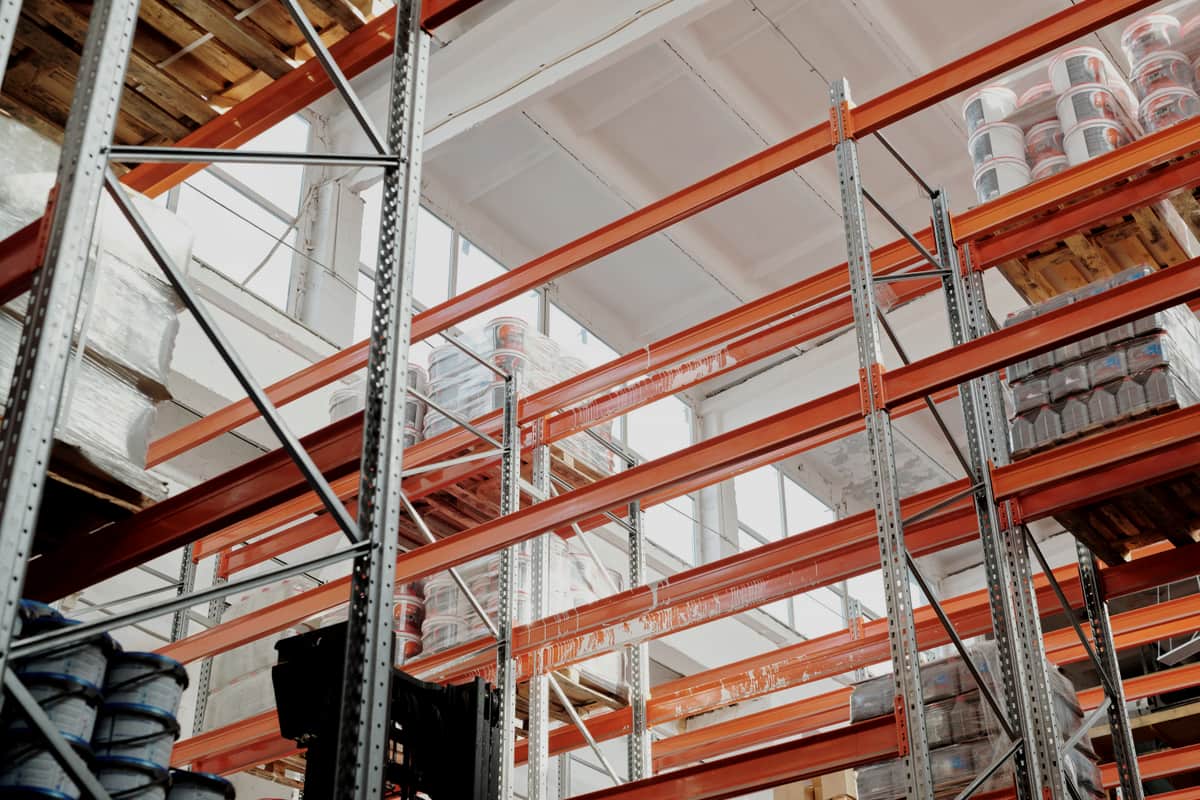
People search this as a head-to-head, so it is worth saying plainly: these two products do not compete for the same space. The FlexiMounts GR48F hangs from your ceiling joists and publishes 600 lb. The Husky 4-tier welded rack stands on your slab and publishes 2,500 lb per shelf, 10,000 lb across the unit.
The 1,900 lb gap between those figures is not a quality gap. It is the difference between what a timber ceiling can carry and what a concrete floor can. So the real question is not which is better — it is whether your garage has spare floor or spare ceiling, and the rest of this page answers that with arithmetic. The full category is in our overhead storage hub and the criteria are on how we pick.
The published figures, side by side
| FlexiMounts GR48F | Husky 4-tier welded | |
|---|---|---|
| Where it goes | Ceiling joists | Floor, against a wall |
| Rated capacity | 600 lb, with 3/8 in plywood decking or thicker | 2,500 lb per shelf; 10,000 lb total |
| Storage surface | One deck, 4 ft x 8 ft | Four shelves, 77 x 24 in each |
| Published volume | Up to 105 cu ft | Not published as a volume |
| Adjustment | 22 to 40 in ceiling drop | Shelves adjust in 3 in increments |
| Fit constraint | Joist spacing up to 24 in; 48 in width lands on joists at wider spacing | Needs 77 in of clear wall |
| Warranty | Not published as a lifetime term | Lifetime |
Why the capacity gap is structural, not qualitative
A concrete slab will take essentially anything a domestic garage can put on it. A timber ceiling will not, and that is the entire explanation for the difference in these two numbers.
It also means the FlexiMounts 600 lb rating is not really the ceiling on what you can store — your joists are. A 600 lb rack fastened to a ceiling that cannot carry 600 lb is a 600 lb problem, and the rack's rating tells you nothing about your particular ceiling. Work that out first with the span tables in how much weight a garage ceiling can hold, then choose.
The Husky number has the opposite property: 2,500 lb per shelf is real and you can use all of it, because the load path is straight down into the slab. What you cannot do is use all of it and keep the floor.
What each one costs you in floor
This is the trade in one table. Both figures are arithmetic from the published dimensions rather than manufacturer claims.
| Footprint | Floor consumed | |
|---|---|---|
| FlexiMounts GR48F | Hangs from the ceiling | None |
| Husky 4-tier welded | 77 x 24 in | About 12.8 sq ft |
| Gladiator 48 in EZ Connect | 48 x 24 in | About 8 sq ft |
Twelve and a half square feet is roughly the space a motorcycle occupies, or most of the walking room down one side of a single-car garage. If your problem is that there is no floor left, the Husky solves the wrong problem extremely well.
How many totes each one actually holds
Capacity ratings are abstract. Totes are not. Using the published exterior of a 27-gallon Sterilite Industrial tote — 28.5 x 19.625 in — here is what fits on each.
| Unit | Surface | Totes that fit | How |
|---|---|---|---|
| FlexiMounts GR48F | 48 x 96 in deck | 6 | 2 across the 48 in width, 3 along the 96 in run |
| Husky 4-tier welded | Four 77 x 24 in shelves | 8 | 2 per shelf, tote width into the 24 in depth |
So the shelving unit wins on raw tote count — eight against six — and loses twelve and a half square feet of floor to do it. That is the trade stated as honestly as we can put it. If you stack totes two high on the Husky the count rises again, and the fit figures for both are in bin sizes that fit overhead racks.
The answer for a lot of garages is both
These two solve different halves of the same problem. Seasonal and bulky goes overhead where you will not miss it; everything you touch monthly goes on the shelves at eye level. A garage with a rack and a shelving unit is a more useful garage than one with two of either.
Access is the difference you live with
Every retrieval from the FlexiMounts is a ladder trip. Every retrieval from the Husky is a reach. That sounds obvious written down and it is the single biggest predictor of whether people are happy with an overhead rack a year later.
- Overhead suits: bulky, light, seasonal. Holiday bins, camping gear, empty suitcases, spare bedding. Things you want out of the way and touch once or twice a year.
- Shelving suits: dense, frequent, or awkward to lift. Paint, fluids, power tools, the wet vac. Anything you would not want to hand down a ladder.
There is a height caveat on the Husky too: at 78 inches tall its top shelf is above comfortable reach for most people, so it has a ladder tier of its own. The layout that follows from this — deep and heavy low, light and seasonal high — is in how deep garage shelves should be.
What each one needs from your garage
FlexiMounts needs joists you can find and reach
FlexiMounts publishes a genuinely useful fit statement: any joist spacing up to 24 in, and at wider spacing the 48 in width lands on joists exactly. That is more directly actionable than a capacity number, because joist spacing is the thing that stops installations dead.
The catch is the drop range. The GR48F adjusts from 22 to 40 inches, and 22 inches is a lot of ceiling to give up on a standard 8 ft garage. If your ceiling is low, this is the wrong rack in the range and the shorter-drop options are covered in low ceiling garage storage and FlexiMounts against SafeRacks.
Husky needs 77 inches of clear wall
Not 77 inches of wall — 77 inches of clear wall, after the electrical panel, the water heater, the door swing and the light switch you need to reach. In a single-car garage that run frequently does not exist.
When it does not, the Gladiator 48 in EZ Connect puts five 24 in shelves into four feet, which is more shelves in less wall at the cost of headroom per tier. Gladiator does not publish a per-shelf capacity as prominently, so you are trading published information for footprint — the fuller version of that argument is in Husky against Seville Classics.
Honest cons on each
FlexiMounts GR48F
- The 600 lb rating carries a condition — 3/8 in plywood decking or thicker. Without the decking you are not operating at the rated figure, and the plywood is a separate purchase and a separate job.
- 22 in is a high minimum drop. On an 8 ft ceiling you will notice it.
- Installation is a two-person job at ceiling height, and it depends entirely on hitting joists. What that costs if you pay someone is broken down in installation cost.
- Everything up there is a ladder trip, forever.
Husky 4-tier welded
- 77 inches wide is a serious commitment of wall, and welded means one configuration for the life of the unit.
- It takes 12.8 sq ft of floor — the exact resource most cluttered garages are short of.
- Heavy to move, awkward to get through a door, and no help at all if the problem is that you cannot park the car.
- 3 in adjustment increments mean a tall item can cost you a whole tier of headroom.
The verdict
Buy the FlexiMounts GR48F if your floor is full and your ceiling is empty, your joists are sound and findable, and what needs storing is bulky, light and seasonal. It is the only one of these that adds storage without taking anything away.
Buy the Husky welded 4-tier if you have 77 inches of clear wall and the things you store are dense, frequently used, or too heavy to want overhead. Nothing here comes close to it on published capacity or warranty, and it is the top pick in our shelving ranking.
Buy the Gladiator 48 in EZ Connect if the wall run is short. Five shelves in four feet is the efficient answer to a narrow garage, with the honest caveat that Gladiator publishes less about capacity than Husky does.
Buy neither yet if you have not worked out what is actually going into the garage. Both of these are answers to a sorting question you have to ask first, and the order to ask it in is on start here. Buying storage before sorting is how garages end up with full shelves and no floor.
What we would buy for this
Every pick carries the manufacturer's published specs, our scoring against stated criteria, and a reason you might want to skip it.
#1 · Best overall overhead rack
FlexiMounts GR48F 4 x 8 Overhead Rack
FlexiMounts
The widest useful drop range in its class and the only major rack that publishes what happens when your joists are further apart than 24 inches. That second fact is why it goes first.
Published specs
- Size
- 4 ft x 8 ft
- Rated capacity
- 600 lb, with 3/8 in plywood decking or thicker
- Ceiling drop
- 22 in to 40 in, adjustable
- Volume
- Up to 105 cu ft
- Joist spacing
- Any spacing up to 24 in; at wider spacing, fits 48 in exactly
Figures are the manufacturer's, from the FlexiMounts product page for the GR48F, read 2026-09-01. We have not verified them by testing and do not imply that we have.
Our scoring
- Published capacity
- 9.0
- Fit range
- 8.5
- Mounting honesty
- 9.5
- Low-ceiling suitability
- 7.0
- Documentation
- 9.0
What works
- 600 lb rating is at the top of the mainstream 4x8 field
- Publishes an explicit answer for joists wider than 24 in on center, which most brands leave you to discover on the ladder
- 22 in minimum drop is short enough for a lot of 8 ft ceilings
- Decking is your own plywood, so you can replace a sagging panel for the price of a sheet
What doesn't
- The 600 lb rating is conditional on you supplying 3/8 in plywood or thicker; the frame alone is not the rated system
- 22 in is still a real drop; under a 7 ft ceiling it leaves very little headroom
- Plywood is not included, so the real cost is the rack plus a sheet
Skip this one if your joists are 32 in or 36 in on center. The published fit is up to 24 in, or exactly 48 in — the in-between spacings mean mounting into a single joist per bracket, and that is how ceilings crack.
#2 · Best heavy-duty shelving
Husky 4-Tier Welded Steel Rack, 77 x 78 x 24 in
Husky
2,500 lb per shelf and 10,000 lb across the unit. That is not a garage number, it is a warehouse number, and it means this is the last shelving you buy for that wall.
Published specs
- Model
- HBR782478W4R
- Dimensions
- 77 in W x 78 in H x 24 in D
- Capacity per shelf
- 2,500 lb, evenly distributed
- Total capacity
- 10,000 lb
- Adjustment
- Shelves adjust in 3 in increments
- Warranty
- Lifetime
Figures are the manufacturer's, from the Home Depot listing for Husky HBR782478W4R, read 2026-09-01. We have not verified them by testing and do not imply that we have.
Our scoring
- Published capacity
- 10.0
- Build
- 9.5
- Tote fit
- 9.0
- Footprint efficiency
- 7.0
- Warranty
- 9.5
What works
- 2,500 lb per shelf is far beyond what a garage will ever ask of it, which is exactly why it never sags
- Welded construction rather than bolt-together, so it does not develop a wobble over years
- 24 in depth swallows a 27-gallon tote sideways with room to spare
- Lifetime warranty
What doesn't
- 77 in wide is a lot of wall. In a single-car garage this is a real commitment
- Welded means it arrives heavy and assembles in one configuration
- Only 3 in adjustment increments, so a tall item may cost you a whole shelf of headroom
Skip this one if you are storing light bulk — holiday bins, sleeping bags, empty coolers. You are paying for steel you will never load, and the same money buys twice the shelf area in a lighter unit.
#3 · Best for a narrow wall
Gladiator 48 in EZ Connect Rack, five 24 in shelves
Gladiator GarageWorks
Five shelves in 48 inches of wall. In a single-car garage where the only free wall is four feet wide, shelf count per foot is the number that actually matters.
Published specs
- Model
- GARK485XGG
- Width
- 48 in
- Shelves
- Five, 24 in deep
Figures are the manufacturer's, from the Gladiator GarageWorks catalog, read 2026-09-01. We have not verified them by testing and do not imply that we have.
Our scoring
- Published capacity
- 6.5
- Build
- 8.0
- Tote fit
- 8.5
- Footprint efficiency
- 9.5
- Warranty
- 7.5
What works
- Five shelves rather than four, so more tiers in less wall
- 48 in is the width that fits between a garage door track and a corner in a lot of single-car garages
- Connects to further units, so the wall can grow later
What doesn't
- Five shelves in the same height means less clearance per tier — measure your tallest item first
- No prominently published per-shelf capacity
Skip this one if you store tall things — a shop vac, a leaf blower, stacked folding chairs. Five tiers buys you shelves at the cost of the headroom those items need.
Questions people actually ask
Is FlexiMounts or Husky better for a garage?
They solve different problems. FlexiMounts hangs from the ceiling and adds storage without taking floor; Husky stands on the floor and publishes far more capacity — 2,500 lb per shelf against the rack's 600 lb total. If floor space is your constraint, FlexiMounts. If you have wall to spare and the load is dense, Husky.
Why does the Husky rack hold so much more than the overhead rack?
Because it loads into a concrete slab rather than timber joists. The gap is a structural difference between the two surfaces, not a difference in build quality. It also means the overhead rack's real limit is your ceiling rather than the rack's published rating.
How many totes fit on a 4x8 overhead rack versus a shelving unit?
Six flat 27-gallon totes on a 4x8 rack — two across the 48 in width and three along the 96 in run. Eight on the Husky 4-tier, two per shelf across four shelves, with the tote width going into the 24 in depth. The shelving unit wins on count and costs you about 12.8 sq ft of floor to do it.
Can I use both an overhead rack and garage shelving?
That is the right answer for most garages. Bulky, light and seasonal goes overhead where it is out of the way; dense and frequently used goes on shelves at eye level. The two are complements rather than alternatives.
Sources
- FlexiMounts GR48F — 600 lb with 3/8 in plywood decking or thicker, 22 to 40 in drop, up to 105 cu ft, joist spacing guidanceChecked September 8, 2026
- Husky HBR782478W4R — 2,500 lb per shelf, 10,000 lb total, 77 x 78 x 24 in, 3 in shelf increments, lifetime warrantyChecked September 8, 2026
- Gladiator GARK485XGG EZ Connect — 48 in wide, five 24 in deep shelvesChecked September 8, 2026
- Sterilite 27 gal Industrial Tote — published exterior 28.5 x 19.625 in, used for the tote-count arithmeticChecked September 8, 2026
Manufacturer documentation, manuals, warranty terms and exact product models reviewed September 8, 2026.
Read next
- The best overhead garage storage racksFour overhead racks ranked on capacity, drop range and joist fit, with a reason to skip each one.
- How much weight can a garage ceiling hold?The complete 2x4 to 2x10 joist span tables at four spacings, and the arithmetic for your own ceiling.
- The best garage storage shelvesFive shelving units ranked on published per-shelf capacity and whether the depth takes a standard tote.
- Husky or Seville Classics: welded steel against wireWelded solid deck against NSF wire, on published capacity, damp tolerance and the width you actually have.
- Which bins actually fit an overhead rackPublished tote dimensions against published rack drops, with the clearance arithmetic run for you.