Bins
Plastic totes or cardboard boxes in a garage?
A garage is a humidity swing with a door on it. That single fact decides most of this, but not all of it — cardboard still wins in two specific cases.
Disclosure: Rail & Rafter earns a commission on qualifying purchases made through links on this page, at no cost to you. Commission does not decide what we recommend — our criteria do, and here is how we are funded.

The deciding fact is a material one and it is published: as ambient relative humidity rises past 95 percent, the stacking strength of a corrugated box can fall by more than 60 percent, according to Fibre Box Association data reported by the NMFTA. An unheated garage in a wet spring reaches that. Polypropylene does not care.
So for anything that stacks, anything heavy, and anything staying more than a season, totes win and it is not close. But cardboard is not simply the wrong answer — it is the right answer twice, and this page says where. The category ranking is in the bins and totes hub and our criteria are on how we pick.
What a garage actually does to a cardboard box
A box does not need to get rained on to fail. It absorbs water vapor out of the air, and its compressive strength — the thing that stops the box beneath from crushing — falls as it does. The published FBA figure above is the headline; the lived version is a stack of boxes that was square in October and is leaning by March.
Three garage-specific consequences follow:
- Stacks compress from the bottom. The box carrying the most weight is the one closest to the damp slab, which is the worst possible place for the weakest box.
- Concrete wicks. A box set directly on a garage floor takes up moisture from the slab regardless of what the air is doing. This is why every organizing guide says "get it off the floor" and it is a material reason, not a tidiness one.
- Cardboard is habitat. Corrugated is a nesting material and the flutes are a warm void. Rodents and insects are a real garage problem and cardboard is on their side.
What we could not source
Consumer moving boxes do not carry a published stacking rating you can look up the way you can a shelf capacity. Commercial corrugated is specified by Edge Crush Test and stamped with a Box Maker's Certificate, but the boxes most people have in the garage arrived around a television. We are not going to publish a pounds-per-box figure for them, because there is not one to publish.
The tote side, with numbers
Totes can be compared because manufacturers publish dimensions. These are the three we use as reference points across the site:
| Tote | Exterior L x W x H | Interior at base |
|---|---|---|
| Sterilite 27 gal Industrial | 28.5 x 19.625 x 15.5" | 23.375 x 14.625 x 14.75" |
| HDX 27 gal Tough Tote | 28.55 x 19.61 x 15.27" | 23.5 x 14.5 x 13" |
| Sterilite 27 gal Stacker | 25.75 x 18.375 x 19.375" | 20.125 x 14.125 x 18.875" |
That the numbers exist at all is half the argument. You can check a tote against a shelf depth or a rack drop before you buy — the arithmetic is on bin sizes that fit overhead racks. You cannot do that with a box that came with a dishwasher.
Where cardboard genuinely wins
1. Short-term, indoors, moving
For a move, cardboard is correct: it is cheap, it is disposable, it folds flat, and the humidity exposure is measured in days. Buying forty totes to move house is a way of owning forty totes afterwards.
2. Odd shapes and one-offs
A box can be cut, taped, and made to fit a lampshade or a length of trim. A tote is a fixed rectangle. For the awkward single item that needs to be boxed once and forgotten, cardboard costs nothing and works.
There is a third half-case: cardboard inside a tote. Small boxes as dividers inside a large tote is a genuinely good system, and it gets the corrugated up off the floor and out of the humidity swing where it cannot do any harm.
Honest cons on totes
Totes are not free of problems and it would be dishonest to pretend otherwise:
- Opaque totes hide their contents completely. A cardboard box at least takes a marker pen naturally. An unlabeled tote is a mystery box with a better lid, which is why labeling a garage bin system is a job rather than an afterthought.
- Sealed plastic traps moisture in. If something goes in damp, it stays damp. Cardboard at least breathes. Anything that might be wet — camping gear, pool equipment, sports kit — needs to be dry before the lid goes on.
- Cold plastic gets brittle. A tote dropped on a cold slab in January cracks in a way it would not in July.
- Cost. Totes cost real money per unit and cardboard is frequently free. Over a full garage that difference is not trivial, and the budget approach is to convert the stacks that matter first rather than all of them at once.
The pest argument, which is separate from the damp one
Corrugated board is not just vulnerable to rodents and insects — it is useful to them. The flutes are a ready-made insulated void, the board itself is nesting material, and the glue used in corrugated is starch-based. A stack of boxes in a quiet corner of a garage is closer to a habitat than to a container.
A sealed polypropylene tote is not rodent-proof in an absolute sense — enough determination gets through most things — but it offers nothing on the way in and nothing to build with once inside. For anything fabric-based in long-term storage, that difference is the whole reason to convert: seasonal clothing, spare bedding, sleeping bags, fabric decorations.
Converting without buying forty totes at once
The cost objection to totes is real, and the answer is not to do it all in one weekend. Convert in this order and the money goes where it matters first:
- Anything on the floor. The slab wicks moisture regardless of the weather, so floor-level boxes are failing now rather than eventually.
- Anything fabric. Clothing, bedding, sleeping bags, fabric decorations — the pest and damp arguments both apply hardest here.
- Anything at the bottom of a stack. That box carries the most weight and loses the most strength as it takes up moisture.
- Anything going on an overhead rack. A box that fails at head height fails onto something, and rack rails are not a continuous surface. Fit numbers are in bin sizes that fit overhead racks.
- Everything else, eventually or never. A box of paperwork on a dry shelf in a heated garage is fine and does not need your money.
What to do
Use the Sterilite 27 gal Industrial for shelving. At 28.5 x 19.625 x 15.5 in it is the reference tote on this site, and its published dimensions are what the 24 inch shelf depth recommendation is built around.
Use the HDX 27 gal Tough Tote for overhead racks. At 15.27 in tall it is the shortest of the three, which is what you want when a rack drop is fixed and every inch of clearance counts.
Use the Sterilite 27 gal Stacker for floor stacks. 19.375 in tall and designed to interlock — good on the floor, wrong under most overhead racks for the same reason.
Keep the cardboard for the move and the odd shapes, and get all of it off the concrete. If it must live in the garage, it goes on a shelf, not on the slab — the sorting method is in the bins and totes problem page.
What we would buy for this
Every pick carries the manufacturer's published specs, our scoring against stated criteria, and a reason you might want to skip it.
#1 · Best on shelving
Sterilite 27 Gallon Industrial Tote (4-pack)
Sterilite
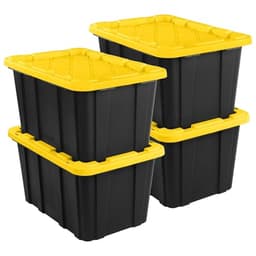
Practically the same footprint as the HDX at 28.5 by 19.625 inches, but with 14.75 in of usable interior height at the base rather than 13 in. Nearly two more inches of what you actually load.
Published specs
- Capacity
- 27 gallons
- Exterior
- 28.5 in L x 19.625 in W x 15.5 in H
- Interior at base
- 23.375 in L x 14.625 in W x 14.75 in H
Figures are the manufacturer's, from the Sterilite product pages, read 2026-09-01. We have not verified them by testing and do not imply that we have.
Our scoring
- Overhead rack fit
- 8.5
- Stackability
- 9.0
- Durability
- 8.5
- Findability
- 5.5
- Availability
- 9.5
What works
- 14.75 in interior height at the base is nearly two inches more usable depth than the comparable HDX
- Same exterior footprint, so the two mix on the same shelf without a stepped run
- Industrial line is thicker-walled than the standard Sterilite totes
What doesn't
- 15.5 in exterior height is a quarter-inch taller than the HDX, which matters under a tight rack
- Snap-on lid, not a latching one
- No handles on some colorways
Skip this one if your overhead rack drop leaves you less than 16 in of clearance. A quarter-inch sounds like nothing until the lid catches on the joist every time.
#2 · Best overhead-rack tote
HDX 27 Gallon Tough Tote (4-pack)
HDX
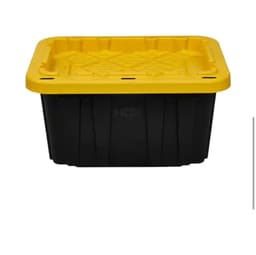
28.55 by 19.61 by 15.27 inches. Those three numbers are why it is here: two of them fit across a 4 ft rack, and the 15.27 in height clears the drop on most overhead racks.
Published specs
- Capacity
- 27 gallons
- Exterior
- 28.55 in L x 19.61 in W x 15.27 in H
- Interior at base
- 23.5 in L x 14.5 in W x 13 in H
- Material
- Polypropylene
Figures are the manufacturer's, from the HDX Tough Tote listing, read 2026-09-01. We have not verified them by testing and do not imply that we have.
Our scoring
- Overhead rack fit
- 9.5
- Stackability
- 8.5
- Durability
- 8.0
- Findability
- 5.5
- Availability
- 9.5
What works
- 15.27 in tall is short enough to clear the drop on most overhead racks
- Two fit across the 48 in width of a standard 4x8 rack
- Opaque, so contents do not degrade in the light through a garage window
- Sold everywhere, so matching more later is easy
What doesn't
- Opaque means you cannot see what is in it without a label
- Snap-on lids are not weathertight
- Polypropylene gets brittle in a cold garage over years
Skip this one if you need to see the contents. In a garage you will not remember what is in bin four, and an opaque tote without a labeling system is a box you open every time.
#3 · Best for stacking on the floor
Sterilite 27 Gallon Stacker Tote (4-pack)
Sterilite
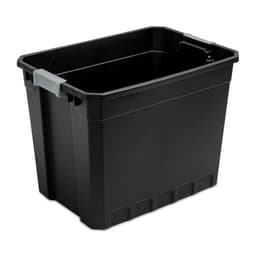
A completely different shape: 25.75 by 18.375 by 19.375 inches. Taller and narrower, with 18.875 in of interior height — it is a floor-stacking bin, and it will not fit most overhead racks.
Published specs
- Capacity
- 27 gallons
- Exterior
- 25.75 in L x 18.375 in W x 19.375 in H
- Interior at base
- 20.125 in L x 14.125 in W x 18.875 in H
Figures are the manufacturer's, from the Sterilite product pages, read 2026-09-01. We have not verified them by testing and do not imply that we have.
Our scoring
- Overhead rack fit
- 3.0
- Stackability
- 9.5
- Durability
- 8.0
- Findability
- 5.5
- Availability
- 9.0
What works
- 18.875 in of interior height swallows tall awkward things a flat tote cannot
- Smaller footprint means more bins per square foot of floor
- Designed to stack, so a column of them stays a column
What doesn't
- 19.375 in tall will not clear the drop on most overhead racks
- Taller stacks are less stable and harder to get the bottom bin out of
- The narrower base means less shelf contact
Skip this one if these are going on an overhead rack. At 19.375 in tall they need more clearance than most rack drops leave, and you will find that out on the ladder.
Questions people actually ask
Are plastic totes better than cardboard boxes in a garage?
For anything stacked, heavy or stored beyond a season, yes. Fibre Box Association data reports that corrugated stacking strength can fall by more than 60 percent once ambient humidity passes 95 percent, which an unheated garage reaches. Polypropylene totes are unaffected by that, and their dimensions are published so you can check fit before buying.
Is it bad to store cardboard boxes in a garage?
On a concrete floor, yes — the slab wicks moisture into the box regardless of the air, and corrugated is a nesting material for rodents and insects. On a shelf, in a dry heated garage, for a limited period, it is fine.
Do plastic totes get brittle in the cold?
They do. Polypropylene stiffens as temperature drops, and a loaded tote dropped on a cold slab in winter can crack where the same drop in summer would not. Carry them with two hands in cold weather and do not stack them higher than you can lift down.
Should I use clear or opaque totes?
Clear if you will not label reliably, opaque if you will. The failure mode for opaque totes is a wall of identical boxes nobody can search, and the fix is a labeling system rather than a different tote.
Sources
- Fibre Box Association data on corrugated stacking strength above 95 percent relative humidity, reported by NMFTAChecked September 6, 2026
- Sterilite 27 gal Industrial Tote — published exterior and interior dimensionsChecked September 6, 2026
- Sterilite 27 gal Stacker Tote — published exterior and interior dimensionsChecked September 6, 2026
- HDX 27 gal Tough Tote listing — published exterior and interior dimensionsChecked September 6, 2026
Manufacturer documentation, manuals, warranty terms and exact product models reviewed September 6, 2026.
Read next
- The best garage storage binsThree 27-gallon totes on published exterior dimensions, and where each one actually fits.
- How to organize garage binsA labeling system that survives a decade, and the sorting rule for what belongs in a bin at all.
- Which bins actually fit an overhead rackPublished tote dimensions against published rack drops, with the clearance arithmetic run for you.
- Where the bins and totes goThe easiest pile in the garage to fix. Where totes go, how many fit, and the labeling that works.
- Where the holiday decorations goThe textbook overhead case. Six bins on one rack, how to label them, and what a garage breaks.
- What actually keeps mice out of garage storage?Steel is the only material a rodent cannot chew. What to store food, fabric and everything else in.