The Mess
Where the kayak goes
Long, light, awkward and used a handful of times a year. A kayak is the one item in the garage where a ceiling hoist is genuinely the right answer.
Disclosure: Rail & Rafter earns a commission on qualifying purchases made through links on this page, at no cost to you. Commission does not decide what we recommend — our criteria do, and here is how we are funded.

A kayak takes up an absurd amount of a garage for something used four weekends a year. It is twelve feet long, it does not stack, and there is nowhere in a normal garage it is not in the way.
It goes overhead — and this is the one item on this site where we recommend a lifting system rather than arguing you out of one.
Why the hoist argument flips here
Everywhere else on this site we argue against lifting hardware, because the frequency test usually fails: for seasonal bins, a ladder twice a year is not a hardship and a fixed rack gives roughly double the capacity for less money. That case is made on fixed rack vs motorized lift.
A kayak fails that test in the opposite direction, and the reason is not weight — it is length. A twelve-foot boat cannot be managed one-handed on a ladder. It is not heavy; it is unmanageable, and the failure mode is coming off a ladder holding something you cannot control.
A lifting system brings it down to chest height where you can get both hands on it. That is a safety argument rather than a convenience one, and it is the strongest case for a lift anywhere in a domestic garage.
The cheaper alternative that also works
Before buying a powered system: wall-mounted J-cradles hold a kayak on its side against a wall, and for a garage with a long free wall they are the cheapest good answer.
| Overhead lift | Wall J-cradles | |
|---|---|---|
| Floor used | None | None, but occupies a wall |
| Getting it down | Comes to you | Lift off at shoulder height |
| Cost | Highest | Low |
| Needs | Clear column beneath, joists | A long free wall, studs |
| Best for | No spare wall, or a heavy boat | A long wall you are not using |
Cradles fix into studs, and a kayak in a cradle is a load acting away from the wall — leverage rather than weight, same as a ladder. Gladiator's GearTrack publishes 75 lb per linear foot, which is well beyond what most kayaks weigh, but the fixing still has to be into structure. See how much weight a garage wall holds.
The hull rule that saves the boat
Support the hull, not the deck, and spread the support
A kayak hull is not designed to carry the boat's own weight concentrated on two narrow points for six months. Stored badly — hanging from two thin straps around the middle, or resting on two hard bars — a plastic hull deforms, and the deformation can be permanent.
Store it on its side or upside down rather than flat on the hull, use wide padded supports rather than narrow straps, and place the supports at roughly a third and two thirds of the boat's length rather than at the very ends or clustered in the middle.
Check your manufacturer's guidance for your specific boat — hull materials differ and we have not tested any of them.
Paddleboards are the easier case: flat, rigid and light, and they store well on horizontal wall racks or flat overhead. Inflatable boards want to be stored rolled or flat and out of prolonged direct sun.
The other constraint: the column below
A lifting system needs the ceiling and the entire column of space beneath it kept clear so the boat can come down. In a single-bay garage that frequently means the boat only comes down when the car is out.
Walk the garage and pick the spot before you buy. That constraint is the most common reason a lift disappoints, and it is covered on best garage storage lifts.
The ceiling itself is rarely the limit here — a kayak is light for its size, and the published safe load on a lifting rack is 350 lb against a boat that usually weighs a small fraction of that. But it is still weight on joists, and the arithmetic is on how much weight a garage ceiling holds.
What it costs and how long it takes
Wall cradles are an hour and two fixings per cradle. A lifting system is a larger install and a larger cost, and it needs power if it is a powered model — check the requirements before ordering, because most garages do not have an outlet where the lift wants to go.
Start with cradles if you have the wall. Move to a lift if you do not, or if the boat is heavy enough that shoulder-height removal is a two-person job you do not always have a second person for.
What not to do
- Do not hang it from two narrow straps around the middle. That is the classic way to deform a hull.
- Do not store it flat on its hull for months. On its side or upside down, on wide padded supports.
- Do not carry it up a ladder. The length is the hazard, not the weight, and this is the specific case a lift exists for.
- Do not leave it in direct sun through a garage window. UV degrades hull materials over years.
What we would buy for this
Every pick carries the manufacturer's published specs, our scoring against stated criteria, and a reason you might want to skip it.
#1 · Best if you need the load to come down
FlexiMounts GL1 Lifting Rack
FlexiMounts
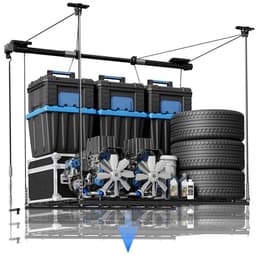
A lifting rack solves the one real problem with overhead storage: you stop using it. The trade is capacity — the published safe load is 350 lb, not the 600 lb a fixed rack of the same size carries.
Published specs
- Type
- Lifting / lowering overhead rack
- Safe load capacity
- 350 lb
- Tested to
- 600 lb total
Figures are the manufacturer's, from the FlexiMounts product page for the GR48F, read 2026-09-01. We have not verified them by testing and do not imply that we have.
Our scoring
- Published capacity
- 6.0
- Access
- 9.5
- Mounting honesty
- 8.5
- Low-ceiling suitability
- 7.5
- Documentation
- 8.0
What works
- The load comes to you instead of you going up a ladder, which is the difference between storage you use and storage you forget
- Published safe load and tested load are stated as two separate numbers, which is more transparency than most of this category offers
What doesn't
- 350 lb safe load is roughly half a comparable fixed rack
- More moving parts than a fixed rack, and every moving part is a thing that can seize or need service
- Costs substantially more per square foot of storage than a fixed rack
Skip this one if the things going up there are genuinely seasonal — holiday bins, camping gear, the spare bedding. Twice a year with a ladder is not a hardship, and a fixed rack gives you more capacity for less money.
#2 · Best track system
Gladiator GearTrack Channels
Gladiator GarageWorks
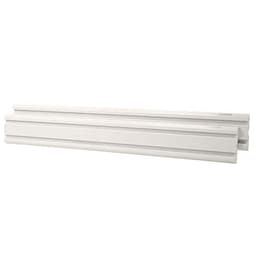
75 lb per linear foot, published in the installation manual rather than buried in marketing copy. Track beats full-panel systems when what you are hanging is heavy and few rather than light and many.
Published specs
- Rated capacity
- 75 lb per linear foot
- Mounting
- Into wood studs, including through drywall
- Format
- Horizontal channels, sold in packs
Figures are the manufacturer's, from Gladiator installation instructions W11087876 Rev A, read 2026-09-01. We have not verified them by testing and do not imply that we have.
Our scoring
- Published capacity
- 9.5
- Coverage per dollar
- 7.0
- Accessory range
- 9.0
- Install simplicity
- 8.5
- Documentation
- 9.5
What works
- 75 lb per linear foot is the highest published figure of the mainstream wall systems here
- Track means you only cover the strip of wall you need, not the whole thing
- Accessory range is broad and stays available
- The capacity figure is published in the installation instructions, which is where a figure you are going to rely on belongs
What doesn't
- Only holds things at the height of the track, so you are installing two or three runs to get real coverage
- The per-linear-foot rating assumes the track is fastened into studs, which caps you at where the studs are
- Accessories are proprietary
Skip this one if the wall is going to hold a lot of small light things — hand tools, spray cans, cordless batteries. That is pegboard's job, and pegboard does it for a fraction of the price.
Questions people actually ask
How should I store a kayak in a garage?
Overhead on a lifting system, or on its side in wall-mounted J-cradles. Store it on its side or upside down rather than flat on the hull, on wide padded supports placed at roughly a third and two thirds of its length.
Is a ceiling hoist worth it for a kayak?
This is the one case where we would say yes. A twelve-foot boat cannot be managed one-handed on a ladder — the hazard is the length rather than the weight, and a lift brings it to chest height where you can get both hands on it.
Will storing a kayak damage the hull?
It can, if it hangs from narrow straps or rests on hard points for months. Use wide padded supports, store on the side or upside down, and check your manufacturer's guidance — hull materials differ and we have not tested any of them.
What about paddleboards?
Easier: flat, rigid and light, and they store well on horizontal wall racks or flat overhead. Inflatables want to be stored rolled or flat and out of prolonged direct sunlight.
Sources
- FlexiMounts GL1 published safe load capacityChecked September 1, 2026
- Gladiator GearTrack installation instructions W11087876 Rev A — 75 lb per linear footChecked September 1, 2026
Manufacturer documentation, manuals, warranty terms and exact product models reviewed September 1, 2026.
Read next
- Fixed rack vs motorized liftA lifting rack halves your capacity to give you access. When to take that deal and when a ladder wins.
- The best garage storage liftsStorage lifts on published safe load, and the honest case for buying a fixed rack instead.
- How much weight can a garage wall hold?The fixing decides it, not the wall. Published stud-versus-drywall figures and how to find your studs.
- Where the sports gear goesHigh-turnover and awkward-shaped. Why bins fail for sports gear and what open wall storage solves.
- How much weight can a garage ceiling hold?The complete 2x4 to 2x10 joist span tables at four spacings, and the arithmetic for your own ceiling.
- The best garage wall storage systemsTrack, slatwall, panels and metal pegboard on published load ratings, converted into one comparable question.
- Where the skis and snowboards goLong, light and seasonal — skis are a wall problem for eight months a year. What to hang them on.