Overhead
What overhead rack installation actually costs
We are not going to invent a dollar range. What we can do is tell you exactly what drives the number, so you can read a quote and know whether it is fair.
Disclosure: Rail & Rafter earns a commission on qualifying purchases made through links on this page, at no cost to you. Commission does not decide what we recommend — our criteria do, and here is how we are funded.
Why there is no price table on this page
Installation pricing varies by region, by installer and by garage, and we could not find a published, authoritative national figure we were willing to stand behind. Rather than print a range that looks authoritative and is not, this page tells you what drives the cost so you can read a quote and judge it. That is the same standard we apply to every figure on the site — see how we pick.
Both SafeRacks and MonsterRax offer or refer installation services, so professional install is a normal option in this category rather than an exotic one. Whether you need it comes down to four variables.
The four things that move the number
1. Ceiling height
A standard 8 ft ceiling is a stepladder job. A 12 ft or vaulted ceiling means a taller ladder or scaffolding, two people rather than one, and considerably more time holding a heavy steel frame overhead. This is the single biggest driver, and it is the one you cannot change.
2. Whether the ceiling is finished
Open joists are the easy case: you can see exactly what you are fixing into. A drywalled ceiling means locating every joist through the board, and every locating error is a hole to patch. If the ceiling is finished and you are not confident with a stud finder, this is where a lot of the value of paying somebody sits.
3. Joist spacing and type
Standard 16 in timber joists are the straightforward case. Non-standard spacing, engineered joists, or anything that is not timber turns a two-hour job into a question about whether the job should happen at all — which takes us back to the joist arithmetic.
4. How many racks
The second rack is much cheaper than the first, because the setup, the ladder work and the joist mapping are already done. If you think you will eventually want two, having both installed at once is usually the cheaper path — and per the load arithmetic, two racks sharing the load across more joists is also the better structural outcome.
What the DIY job actually involves
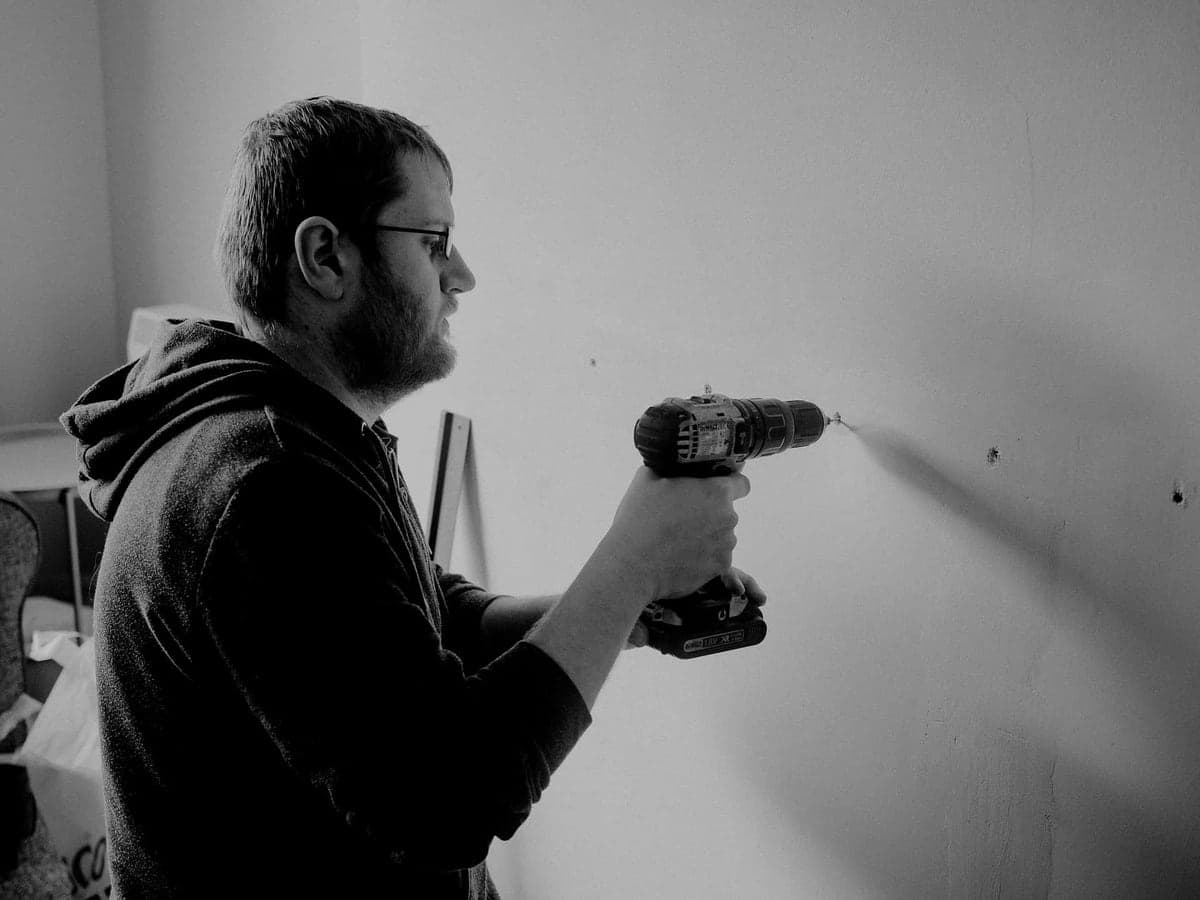
For a standard 4x8 rack on 16 in timber joists at an 8 ft ceiling, this is a two-person, two-to-three-hour job with ordinary tools:
- Locate and mark every joist across the rack's footprint. Verify the spacing in two places rather than assuming it is consistent.
- Confirm the joist size and check the span against the storage-load table before you drill anything.
- Mark and pre-drill the bracket holes. Pre-drilling matters — driving a lag screw into dry timber without a pilot hole splits it, and a split joist is not a joist.
- Fix the ceiling brackets, checking level as you go.
- Assemble the frame on the floor, then lift it into the brackets. This is the step that is genuinely two people.
- Set the drop height, tighten everything, and add decking if the rack requires it for its rating.
The tools are a stud finder, a drill, a socket set, a level, a tape measure and a stepladder. Nothing exotic. The FlexiMounts GR48F also needs a sheet of 3/8 in plywood or thicker, which is a real line item — its published 600 lb rating is conditional on it.
When paying somebody is the right call
Three situations, and they are not about skill:
- High or vaulted ceilings. The risk here is not the carpentry, it is being up a tall ladder holding a heavy frame.
- Finished ceilings where you are not confident locating joists. A wrong bracket into drywall alone is a failure waiting to happen with a few hundred pounds above your car.
- You do not have a second person. Lifting a loaded 4x8 frame into ceiling brackets alone is where injuries happen.
The cost people forget
If the joist arithmetic says your ceiling was framed without a storage allowance, the real cost is not installation — it is a structural engineer's opinion, and possibly reinforcement work. That is a much larger number, and it is the one worth finding out about before you buy a rack rather than after.
How to read a quote
Ask the installer three questions. The answers tell you a lot about whether they know the job:
- What are you fixing into, and how will you confirm it? A good answer names the joist size and how they will verify spacing.
- What happens if the joists are not at standard spacing? A good answer is that they will tell you before drilling, not after.
- Does the quote include decking? On a rack whose rating depends on plywood, this is a real cost that is easy to leave out of a headline price.
If you are still choosing the rack itself, the shortlist is on the best overhead garage storage racks, and if headroom is the constraint, start instead with low ceiling garage storage.
What we would buy for this
Every pick carries the manufacturer's published specs, our scoring against stated criteria, and a reason you might want to skip it.
#1 · Best drop range and warranty
SafeRacks 4 x 8 Overhead Rack
SafeRacks
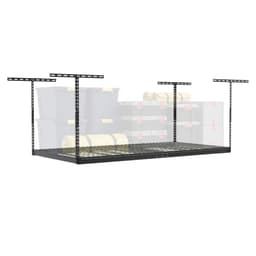
A 12 to 45 inch drop range is the widest published in this category, which makes it the rack that fits both a 7 ft ceiling and a cathedral one. The limited lifetime warranty is the other reason it is here.
Published specs
- Size
- 4 ft x 8 ft
- Rated capacity
- 600 lb total, evenly distributed
- Ceiling drop
- 12 in to 45 in, adjustable
- Brackets
- Patented 27 in brackets spanning two wood joists
- Warranty
- Limited lifetime
- Included
- 8 accessory hooks
Figures are the manufacturer's, from the SafeRacks 4x8 product page, read 2026-09-01. We have not verified them by testing and do not imply that we have.
Our scoring
- Published capacity
- 9.0
- Fit range
- 9.5
- Mounting honesty
- 9.0
- Low-ceiling suitability
- 9.5
- Documentation
- 8.5
What works
- 12 in minimum drop is the shortest published in the mainstream field — this is the low-ceiling answer
- Brackets are designed to span two joists rather than load one
- Limited lifetime warranty, which almost nobody else in the category offers
- Accessory hooks included rather than sold separately
What doesn't
- Wood joists only. The instructions explicitly rule out I-beams, steel joists and concrete ceilings
- The 12 to 24 in and 24 to 45 in drop ranges are separate purchases, so you have to measure before you order rather than after
- 600 lb assumes even distribution; a concentrated load in one corner is not the rated case
Skip this one if your garage ceiling is concrete, steel joist, or an engineered I-beam floor system. SafeRacks says in writing not to install into any of those, and that is not a warning to work around.
#2 · Best overall overhead rack
FlexiMounts GR48F 4 x 8 Overhead Rack
FlexiMounts
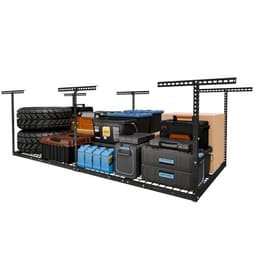
The widest useful drop range in its class and the only major rack that publishes what happens when your joists are further apart than 24 inches. That second fact is why it goes first.
Published specs
- Size
- 4 ft x 8 ft
- Rated capacity
- 600 lb, with 3/8 in plywood decking or thicker
- Ceiling drop
- 22 in to 40 in, adjustable
- Volume
- Up to 105 cu ft
- Joist spacing
- Any spacing up to 24 in; at wider spacing, fits 48 in exactly
Figures are the manufacturer's, from the FlexiMounts product page for the GR48F, read 2026-09-01. We have not verified them by testing and do not imply that we have.
Our scoring
- Published capacity
- 9.0
- Fit range
- 8.5
- Mounting honesty
- 9.5
- Low-ceiling suitability
- 7.0
- Documentation
- 9.0
What works
- 600 lb rating is at the top of the mainstream 4x8 field
- Publishes an explicit answer for joists wider than 24 in on center, which most brands leave you to discover on the ladder
- 22 in minimum drop is short enough for a lot of 8 ft ceilings
- Decking is your own plywood, so you can replace a sagging panel for the price of a sheet
What doesn't
- The 600 lb rating is conditional on you supplying 3/8 in plywood or thicker; the frame alone is not the rated system
- 22 in is still a real drop; under a 7 ft ceiling it leaves very little headroom
- Plywood is not included, so the real cost is the rack plus a sheet
Skip this one if your joists are 32 in or 36 in on center. The published fit is up to 24 in, or exactly 48 in — the in-between spacings mean mounting into a single joist per bracket, and that is how ceilings crack.
Questions people actually ask
How much does it cost to install an overhead garage rack?
We could not find an authoritative published national figure and are not going to invent one. The cost is driven by ceiling height, whether the ceiling is finished, joist type and spacing, and how many racks go up at once. The four sections above let you read a quote against those.
Can I install an overhead rack by myself?
The drilling and bracket work is a one-person job. Lifting the assembled frame into the ceiling brackets is genuinely a two-person step, and it is the step where people get hurt doing it alone.
How long does installation take?
For a standard 4x8 rack on 16 in timber joists at an 8 ft ceiling, budget two to three hours for two people, including locating joists and fitting decking.
Do I need a permit to install an overhead garage rack?
Requirements vary by jurisdiction and we are not going to generalize about yours. If the work extends beyond hanging a rack — sistering joists, adding a beam, altering the structure — that is exactly the kind of work that commonly does require review.
Sources
- SafeRacks installation guidance and installer referralChecked September 1, 2026
- MonsterRax installation services and installation guidesChecked September 1, 2026
- FlexiMounts GR48F decking requirement for the published ratingChecked September 1, 2026
Manufacturer documentation, manuals, warranty terms and exact product models reviewed September 1, 2026.
Read next
- The best overhead garage storage racksFour overhead racks ranked on capacity, drop range and joist fit, with a reason to skip each one.
- How much weight can a garage ceiling hold?The complete 2x4 to 2x10 joist span tables at four spacings, and the arithmetic for your own ceiling.
- Garage storage for a low ceilingThe clearance arithmetic for a 7 or 8 ft ceiling, and the two places a rack still works.
- Your garage is full. Start here.Four passes that turn a full garage into a list of piles, each with a system that fits it.