Bins
Labeling a garage bin system that keeps working
Most bin labels fail for one of three reasons, and none of them is the handwriting. Here is what a garage label has to survive, and the system that outlasts its own contents.
Disclosure: Rail & Rafter earns a commission on qualifying purchases made through links on this page, at no cost to you. Commission does not decide what we recommend — our criteria do, and here is how we are funded.
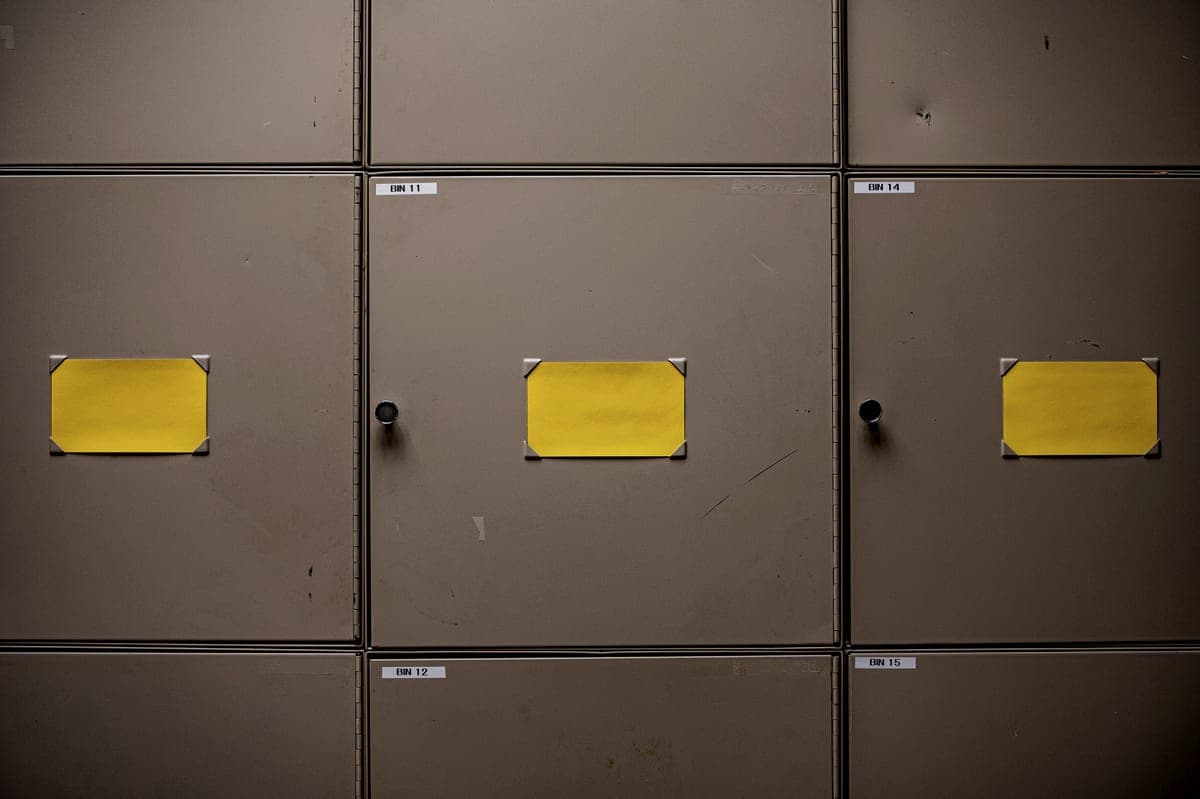
A wall of unlabeled opaque totes is not storage. It is a filing cabinet with the drawers welded shut, and it is the single most common way a garage thatlooks organized fails to be organized.
Labels fix that, but garage labels fail in three specific ways, and knowing which one is about to happen to you decides what you buy. This guide is about the system rather than the label maker — the sorting that comes before it is in how to organize garage bins, and the wider category is in the bins and totes hub.
The three ways garage labels fail
1. The adhesive lets go
A garage swings through temperature and humidity in a way a kitchen does not, and polypropylene is a low-surface-energy plastic that adhesive struggles with in the first place. Paper labels curl at the corners, then drop off, usually in the coldest month.
2. The label is still there and the contents have changed
This is the failure nobody plans for. The bin marked "CHRISTMAS" now contains Halloween decorations and a tent. The label was accurate for two years and has been actively misleading ever since — worse than no label, because you trust it.
3. You cannot read it from where you stand
A neat 12-point label is illegible from the top of a ladder or across the garage. Overhead racks and top shelves are exactly where the least-used bins go, which is exactly where you most need to read the label from a distance.
What a garage label has to survive
| Condition | Paper label | Vinyl / laminated label | Card in a pocket |
|---|---|---|---|
| Humidity swing | Curls and lifts | Unaffected | Unaffected |
| Cold | Adhesive stiffens and releases | Generally holds | Not adhesive dependent |
| Contents changing | Has to be scraped off | Has to be scraped off | Swap the card |
| Reading at distance | Depends on print size | Depends on print size | Depends on print size |
The right-hand column is the interesting one, and it is the reason the system below is built the way it is.
The system: number the bin, not the contents
Label the bin with a permanent number. Keep the list of what is in each number somewhere else. That one move solves failure mode 2 completely, because the label never has to change when the contents do.
- Give every bin a number, permanently. Large, high contrast, on at least two faces — the end you see from the aisle and the end you see from the ladder. This number is never reused for a different bin and never changes.
- Add a one-word zone tag. HOLIDAY, CAMP, AUTO, TOOLS. Not the contents — the category. This is what lets someone else find something without the list.
- Keep the contents list separately. A note on your phone, a spreadsheet, or a laminated sheet on the wall by the door. Bin 14: string lights, spare bulbs, timer. When the contents change, you edit the list, not the bin.
- Write the date you last opened it. On the list, not the bin. A bin nobody has opened in three years is telling you something important about whether you should still own its contents.
Why numbering beats describing
A described label is only correct until the day you repack. A number is correct forever, and the description lives somewhere you can edit in five seconds from a phone. This is the same reason warehouses number locations rather than naming them — the shelf outlives whatever is on it.
Practical details that make it stick
Label both ends, and the lid
Bins get turned around. A label on one end is a coin flip. Ends plus lid means you can read it from the aisle and from above on an overhead rack, which is where the seasonal bins live — the fit numbers for that are on bin sizes that fit overhead racks.
Size the text for the distance
If the bin is going above head height, the number needs to be readable from the floor. That means big — several inches tall, not a label-maker strip. A zone tag can be smaller because you are usually closer when you need it.
Clear bins change the calculation
If you can see the contents, the label does less work and the number system matters less. That is a legitimate reason to choose clear over opaque, and it is worth deciding before you buy forty of the wrong thing — the trade-offs are in the storage bin roundup.
Small parts are a different problem
A drawer cabinet is not a bin system and does not want numbers. Drawers want the contents written on the front, because the whole point of a clear drawer is that you find things without opening anything. The organizer options are in the small parts organizer roundup.
A worked example: twenty bins in an afternoon
The system above is simple enough that the only real risk is never starting. This is the version that fits in one session.
- Number every bin first, before opening any of them. One to twenty, big, on both ends and the lid. Do not think about contents yet — this step is mechanical on purpose, and separating it from the deciding is what makes it finishable.
- Open each one and write a single line. "7: camping — tent, two sleeping bags, lantern." One line per bin, in a note on your phone. Resist reorganizing the contents; you are cataloguing, not sorting.
- Add the zone tag to the bin. Now that you know what is in it, CAMP goes on the end under the number. This is the only step that requires a decision, and by now it is an easy one.
- Put the list where you will find it. Pinned note on your phone, and a printed copy in a sleeve by the door for anyone who is not you.
- Date the list. One date at the top. Next year you will know whether it is still true.
The bins that turn out to be genuinely mysterious — and there are always two or three — do not get a number yet. They get moved to the middle of the floor and dealt with as a sorting problem rather than a labeling one, which is a different job covered in how to organize garage bins.
Keeping it true
A labeling system fails slowly, not suddenly, and it fails at exactly one moment: when you repack a bin and do not edit the list. Two habits prevent it.
- Edit the list before the lid goes on, not afterwards. Ten seconds while the bin is open, or never.
- One annual pass. Read the list, note anything you have not opened in a year, and decide whether you still want to own it. A numbered system makes this a five-minute review rather than an afternoon, because the list is the inventory.
What to put it on
Sterilite 27 gal Industrial totes at 28.5 x 19.625 x 15.5 in are the shelf standard on this site, and their flat end panels take a large label cleanly.
HDX 27 gal Tough Totes at 15.27 in tall are the overhead-rack choice, and they are the ones that most need a lid label — from underneath, the lid is all you can see.
The Akro-Mils 10124 drawer cabinet is the exception that proves the rule: 24 clear drawers at 6 x 4-9/16 x 2-3/16 in inside, where you write the contents on the drawer and never number anything.
Do not start here. Labeling a garage that has not been sorted just produces accurate labels on the wrong bins. Sort first — the triage order is in start here, and the seasonal case that most needs this system is in holiday decorations.
What we would buy for this
Every pick carries the manufacturer's published specs, our scoring against stated criteria, and a reason you might want to skip it.
#1 · Best on shelving
Sterilite 27 Gallon Industrial Tote (4-pack)
Sterilite
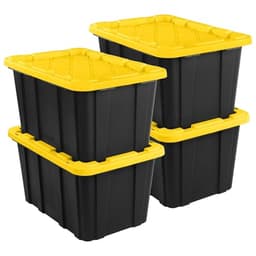
Practically the same footprint as the HDX at 28.5 by 19.625 inches, but with 14.75 in of usable interior height at the base rather than 13 in. Nearly two more inches of what you actually load.
Published specs
- Capacity
- 27 gallons
- Exterior
- 28.5 in L x 19.625 in W x 15.5 in H
- Interior at base
- 23.375 in L x 14.625 in W x 14.75 in H
Figures are the manufacturer's, from the Sterilite product pages, read 2026-09-01. We have not verified them by testing and do not imply that we have.
Our scoring
- Overhead rack fit
- 8.5
- Stackability
- 9.0
- Durability
- 8.5
- Findability
- 5.5
- Availability
- 9.5
What works
- 14.75 in interior height at the base is nearly two inches more usable depth than the comparable HDX
- Same exterior footprint, so the two mix on the same shelf without a stepped run
- Industrial line is thicker-walled than the standard Sterilite totes
What doesn't
- 15.5 in exterior height is a quarter-inch taller than the HDX, which matters under a tight rack
- Snap-on lid, not a latching one
- No handles on some colorways
Skip this one if your overhead rack drop leaves you less than 16 in of clearance. A quarter-inch sounds like nothing until the lid catches on the joist every time.
#2 · Best overhead-rack tote
HDX 27 Gallon Tough Tote (4-pack)
HDX
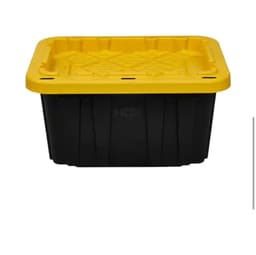
28.55 by 19.61 by 15.27 inches. Those three numbers are why it is here: two of them fit across a 4 ft rack, and the 15.27 in height clears the drop on most overhead racks.
Published specs
- Capacity
- 27 gallons
- Exterior
- 28.55 in L x 19.61 in W x 15.27 in H
- Interior at base
- 23.5 in L x 14.5 in W x 13 in H
- Material
- Polypropylene
Figures are the manufacturer's, from the HDX Tough Tote listing, read 2026-09-01. We have not verified them by testing and do not imply that we have.
Our scoring
- Overhead rack fit
- 9.5
- Stackability
- 8.5
- Durability
- 8.0
- Findability
- 5.5
- Availability
- 9.5
What works
- 15.27 in tall is short enough to clear the drop on most overhead racks
- Two fit across the 48 in width of a standard 4x8 rack
- Opaque, so contents do not degrade in the light through a garage window
- Sold everywhere, so matching more later is easy
What doesn't
- Opaque means you cannot see what is in it without a label
- Snap-on lids are not weathertight
- Polypropylene gets brittle in a cold garage over years
Skip this one if you need to see the contents. In a garage you will not remember what is in bin four, and an opaque tote without a labeling system is a box you open every time.
#3 · Best for mixed hardware sizes
Akro-Mils 10124 24-Drawer Storage Cabinet
Akro-Mils
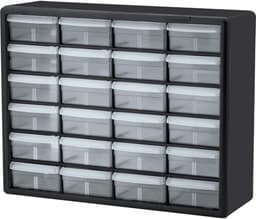
Same cabinet footprint as the 64-drawer, 24 larger drawers instead. This is the one most garages actually want, because most garage hardware is bigger than a wood screw.
Published specs
- Model
- 10124
- Outside dimensions
- 20 x 6-3/8 x 15-13/16 in
- Drawers
- 24
- Drawer inside size
- 6 x 4-9/16 x 2-3/16 in
- Mounting
- Wall mountable via keyhole slots
- Stacking
- Cabinets stack securely
Figures are the manufacturer's, from the Akro-Mils product pages on akro-mils.com, read 2026-09-06. We have not verified them by testing and do not imply that we have.
Our scoring
- Sorting density
- 7.5
- Findability
- 9.0
- Space efficiency
- 9.5
- Capacity per drawer
- 7.5
- Published data
- 6.0
What works
- Drawer inside height of 2-3/16 in takes bolts, couplers and hose fittings that will not go in the 64-drawer
- Identical outside footprint to the 10164, so the two stack and line up on the same wall
- Clear drawers, keyhole wall mounting, finger-grip pulls
- 24 categories is a realistic number to actually maintain
What doesn't
- 24 drawers means broader categories, so you still sort by hand inside a drawer
- No published load rating from Akro-Mils
- Same plastic rails as the 64-drawer, with more weight per drawer riding on them
Skip this one if you genuinely have hundreds of distinct fastener sizes. At that point the 64-drawer is the right cabinet and this one just re-creates the coffee can in 24 larger pieces.
Questions people actually ask
What is the best way to label garage bins?
Number the bin permanently, add a one-word zone tag such as HOLIDAY or AUTO, and keep the contents list separately on your phone or a sheet by the door. The number never changes when the contents do, which removes the most common failure — an accurate-looking label that is now wrong.
Why do labels fall off garage bins?
Two reasons together: a garage cycles through big humidity and temperature swings, and tote plastic is a low-surface-energy surface that adhesive struggles to hold. Paper labels curl at the corners first and release in the coldest month.
Should I use clear bins instead of labeling?
Clear bins reduce how much work the label does but do not replace it — you still cannot identify a bin on a top shelf from the floor. Clear plus a large number is the strongest combination; opaque plus no label is the worst.
Where should the label go on a tote?
Both ends and the lid. Bins get turned around, so a single label is a coin flip, and on an overhead rack the lid is the only face you can see from below.
Sources
- Sterilite 27 gal Industrial Tote — published exterior dimensionsChecked September 6, 2026
- HDX 27 gal Tough Tote listing — published exterior dimensionsChecked September 6, 2026
- Akro-Mils 10124 — 24 drawers, large drawer inside 6 x 4-9/16 x 2-3/16 inChecked September 6, 2026
Manufacturer documentation, manuals, warranty terms and exact product models reviewed September 6, 2026.
Read next
- How to organize garage binsA labeling system that survives a decade, and the sorting rule for what belongs in a bin at all.
- The best garage storage binsThree 27-gallon totes on published exterior dimensions, and where each one actually fits.
- The best small parts organizers for a garageDrawer cabinets, a louvered bin wall and a sealed portable case, ranked on sorting density and drawer size.
- Where the holiday decorations goThe textbook overhead case. Six bins on one rack, how to label them, and what a garage breaks.
- Where the bins and totes goThe easiest pile in the garage to fix. Where totes go, how many fit, and the labeling that works.