Bins
How to organize garage bins
The bin is not the problem. Not being able to see into it is. Here is the system that fixes that, and the sorting rule that decides what belongs in a bin at all.
Disclosure: Rail & Rafter earns a commission on qualifying purchases made through links on this page, at no cost to you. Commission does not decide what we recommend — our criteria do, and here is how we are funded.

Everybody buys the bins and almost nobody solves the actual problem. The bins are fine. The problem is that an opaque box on a shelf is a question you have to answer by opening it, and after a year nobody remembers the answer to any of them.
That is what turns a garage full of matching totes into a garage where you buy a second one of something you already own.
First: what belongs in a bin at all
Before organizing bins, cut the number of them. A bin is the right container for things that are bulky, light and rarely needed. Anything outside that profile is in a bin because a bin was there, not because a bin was right.
| Bin it | Do not bin it | Put it here instead |
|---|---|---|
| Holiday decorations | Hand tools you use weekly | A tool wall |
| Camping and outdoor gear | Loose hardware and fixings | A small-parts drawer unit |
| Spare bedding, seasonal clothing | Anything you need to see at a glance | Open shelf or a wall |
| Outgrown kids' gear | Anything dense enough to make it unliftable | A shelf, at waist height |
| Keepsakes and paperwork | Chemicals and fuel | A lockable cabinet |
The tool line matters most. Tools in a bin is the single most common garage mistake, and it is why tools are a wall problem rather than a bin problem.
The labeling system that survives
Three rules, and all three exist because of a specific failure:
1. Label the end AND the lid
The end is what you see when the bin is on a shelf. The lid is what you see when it is on the floor or on an overhead rack looked at from below. Label only one and half the time you cannot read it.
2. Write the contents, not the category
"Christmas" is a category. "Tree, stand, tree lights" is contents. The difference matters when you have four Christmas bins and you need the one with the outdoor lights in it.
The test: could somebody else in the house find the right bin from the label alone? If not, the label is a category rather than contents.
3. Use something you can change
Bin contents change. A permanent marker on the bin is a label you cannot update, so the bin ends up with three crossed-out labels and one true one. Tape, a card in a sleeve, or a label you can peel — anything you will actually update rather than annotate.
The upgrade worth the ten minutes
Number the bins and keep a list — a note on your phone is enough. Bin 7: outdoor Christmas lights, extension cords, timers. It sounds excessive until the first time you find something in ten seconds without a ladder, and it is the single highest-return ten minutes in this entire article.
The full version of this — why numbering the bin beats describing it, and the three ways garage labels fail — is on labeling a garage bin system.
Where each bin belongs
Frequency decides height. This is the same logic as a garage wall, applied to bins:
| How often | Where | Why |
|---|---|---|
| Once or twice a year | Overhead rack | A ladder twice a year is not a hardship |
| A few times a year | Top shelf | Reachable with a step, out of the way |
| Monthly | Waist-height shelf | The zone you reach into without thinking |
| Weekly | It should not be in a bin | See the sorting rule above |
The seasonal ones go up. Six flat totes fit on a standard 4x8 overhead rack — the arithmetic is on bin sizes that fit overhead racks, and for most households six bins is the entire seasonal store.
Group by when, not by what
The instinct is to group by category: all the camping gear together, all the decorations together. Better is to group by when it comes down.
Everything that comes down in December goes on one section of the rack. Everything for the summer goes on another. Then a seasonal changeover is one trip up the ladder to one place, rather than four trips hunting across the whole rack.
The one habit that keeps it working
When a bin comes down, before it goes back up, take thirty seconds and take out anything you did not use. Not a whole decluttering project — just the things that came down and went back up untouched.
Do that once a year per bin and the garage never silently refills, which is the actual failure mode. It is also the only maintenance in this article and it costs nothing.
What not to do
- Do not fill bins to the weight limit of your arms. A bin you cannot lift down safely is a bin that stays up regardless of what is in it.
- Do not put bins on the floor near the garage door. Slabs slope toward the door for drainage and snap-on lids are not weathertight.
- Do not buy more bins to solve a bin problem. If the bins are full of things you have not touched in three years, more bins is not the intervention required — that starts at the mess: start here.
What we would buy for this
Every pick carries the manufacturer's published specs, our scoring against stated criteria, and a reason you might want to skip it.
#1 · Best overhead-rack tote
HDX 27 Gallon Tough Tote (4-pack)
HDX
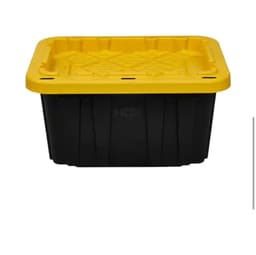
28.55 by 19.61 by 15.27 inches. Those three numbers are why it is here: two of them fit across a 4 ft rack, and the 15.27 in height clears the drop on most overhead racks.
Published specs
- Capacity
- 27 gallons
- Exterior
- 28.55 in L x 19.61 in W x 15.27 in H
- Interior at base
- 23.5 in L x 14.5 in W x 13 in H
- Material
- Polypropylene
Figures are the manufacturer's, from the HDX Tough Tote listing, read 2026-09-01. We have not verified them by testing and do not imply that we have.
Our scoring
- Overhead rack fit
- 9.5
- Stackability
- 8.5
- Durability
- 8.0
- Findability
- 5.5
- Availability
- 9.5
What works
- 15.27 in tall is short enough to clear the drop on most overhead racks
- Two fit across the 48 in width of a standard 4x8 rack
- Opaque, so contents do not degrade in the light through a garage window
- Sold everywhere, so matching more later is easy
What doesn't
- Opaque means you cannot see what is in it without a label
- Snap-on lids are not weathertight
- Polypropylene gets brittle in a cold garage over years
Skip this one if you need to see the contents. In a garage you will not remember what is in bin four, and an opaque tote without a labeling system is a box you open every time.
#2 · Best on shelving
Sterilite 27 Gallon Industrial Tote (4-pack)
Sterilite
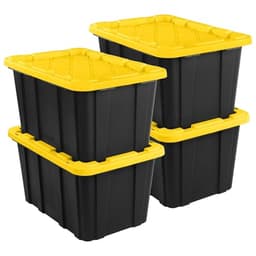
Practically the same footprint as the HDX at 28.5 by 19.625 inches, but with 14.75 in of usable interior height at the base rather than 13 in. Nearly two more inches of what you actually load.
Published specs
- Capacity
- 27 gallons
- Exterior
- 28.5 in L x 19.625 in W x 15.5 in H
- Interior at base
- 23.375 in L x 14.625 in W x 14.75 in H
Figures are the manufacturer's, from the Sterilite product pages, read 2026-09-01. We have not verified them by testing and do not imply that we have.
Our scoring
- Overhead rack fit
- 8.5
- Stackability
- 9.0
- Durability
- 8.5
- Findability
- 5.5
- Availability
- 9.5
What works
- 14.75 in interior height at the base is nearly two inches more usable depth than the comparable HDX
- Same exterior footprint, so the two mix on the same shelf without a stepped run
- Industrial line is thicker-walled than the standard Sterilite totes
What doesn't
- 15.5 in exterior height is a quarter-inch taller than the HDX, which matters under a tight rack
- Snap-on lid, not a latching one
- No handles on some colorways
Skip this one if your overhead rack drop leaves you less than 16 in of clearance. A quarter-inch sounds like nothing until the lid catches on the joist every time.
Questions people actually ask
How do you label garage storage bins?
Label both the end and the lid, write the actual contents rather than a category, and use something you can change. Numbering the bins and keeping a list on your phone is the upgrade worth the extra ten minutes.
What should not go in a garage bin?
Hand tools you use weekly, loose hardware, anything you need to see at a glance, anything dense enough to make the bin unliftable, and chemicals or fuel. Those want a wall, a drawer unit, an open shelf or a lockable cabinet respectively.
Are clear bins better than opaque ones?
They solve findability and create two problems: contents degrade in light through a garage window, and jumbled contents look worse through a clear wall. An opaque bin plus a real labeling system usually wins.
Where should garage bins be stored?
By frequency. Once or twice a year goes on an overhead rack, a few times a year on a top shelf, monthly at waist height. Anything you need weekly should not be in a bin at all.
How do I stop the garage filling up with bins again?
When a bin comes down, take out anything you did not use before it goes back up. Thirty seconds a bin, once a year. That is the whole maintenance requirement and it is what stops the silent refill.
Sources
- Sterilite 27 gal Industrial Tote — published dimensions and lid typeChecked September 1, 2026
- HDX 27 gal Tough Tote — published dimensionsChecked September 1, 2026
Manufacturer documentation, manuals, warranty terms and exact product models reviewed September 1, 2026.
Read next
- The best garage storage binsThree 27-gallon totes on published exterior dimensions, and where each one actually fits.
- Which bins actually fit an overhead rackPublished tote dimensions against published rack drops, with the clearance arithmetic run for you.
- Where the bins and totes goThe easiest pile in the garage to fix. Where totes go, how many fit, and the labeling that works.
- Where the holiday decorations goThe textbook overhead case. Six bins on one rack, how to label them, and what a garage breaks.
- Your garage is full. Start here.Four passes that turn a full garage into a list of piles, each with a system that fits it.
- Garage shelving that actually fits your totes27-gallon totes are 19.6 in wide. Which shelf depths take them, and what to do when you cannot fit 24 inches.
- Plastic totes or cardboard boxes in a garage?What humidity does to corrugated, what it does not do to polypropylene, and the two cases where cardboard still wins.
- Labeling a garage bin system that keeps workingThe three things a garage label must survive, and a numbered system that outlives the contents.