Walls
Steadyrack: what the pivot is really for
Most wall bike racks hold a bike. This one swings it flat against the wall afterwards, and in a single-car garage that is the entire product.
Disclosure: Rail & Rafter earns a commission on qualifying purchases made through links on this page, at no cost to you. Commission does not decide what we recommend — our criteria do, and here is how we are funded.

What this review is and is not
We have not owned or installed a Steadyrack. What follows is a reading of Steadyrack's own published specifications against the constraints of a real garage wall. Our position on testing is on how we pick.
A bike on a wall hook sticks out about the width of its handlebars and stays there. In a two-car garage that is fine. In a single-car garage with a car in it, the bike is in the way from the moment you hang it.
Steadyrack's answer is a rack that holds the front wheel and then pivots the whole bike flat against the wall. That mechanism is what you are paying for, and whether it is worth it comes down to one measurement in your own garage.
The published specification
| Specification | Published figure |
|---|---|
| Maximum bike weight | 35 kg / 77 lb |
| Maximum tire width | 2.1 in |
| Wheel diameter range | 20 in to 29 in |
| Material | Chrome plated steel |
| Fixings | Installation kit with fixings for masonry and timber |
| Wall types | Timber stud, masonry, brick or concrete |
| Protrusion when pivoted | About 16 in for road bikes; more for wide bars |
| Warranty | 5 years |
Two of those rows are worth pausing on, because they are the ones that decide whether this rack suits your bike at all.
2.1 inches is the real constraint
The Classic takes a maximum tire width of 2.1 in. That covers road bikes, gravel bikes, hybrids and older mountain bikes comfortably.
It does not cover most modern mountain bikes. A current trail bike runs 2.4 to 2.6 in, a plus-size tire wider still, and a fat bike is 3.8 in and up. Steadyrack sells separate models for wider tires — the range includes fat bike and swivel versions — but the Classic is the road and hybrid rack, and buying it for a modern mountain bike is the most common mistake with this product.
Measure the tire sidewall, which carries the width printed on it, before ordering. It is a thirty-second check that avoids a return.
77 lb, and why that number is unusual
Steadyrack publishes 35 kg / 77 lb as the maximum bike weight. Most wall racks publish nothing at all, which is a running complaint on this site — so a stated figure is worth crediting.
| Bike | Rough weight | Inside 77 lb? |
|---|---|---|
| Road bike | 17 to 25 lb | Easily |
| Hybrid or commuter | 25 to 32 lb | Easily |
| Hardtail mountain bike | 26 to 33 lb | Easily, if the tire fits |
| Commuter e-bike | 45 to 60 lb | Yes, with margin |
| Cargo e-bike | 60 to 80 lb and up | At or over the limit — weigh it |
The practical read: weight is rarely the binding constraint on this rack — tire width is. A 77 lb ceiling covers everything most people own, including commuter e-bikes, while the 2.1 in tire limit rules out a large slice of the bikes sold today.
The pivot, and the measurement that decides it
Loaded and swung flat, Steadyrack publishes a protrusion of about 16 in for road bikes, with wider handlebars pushing that out further — up to around 39 in for mountain bikes with wide bars, on Steadyrack's own figures.
That range is the whole buying decision, and it is decided by your handlebars rather than by the rack:
- Park the car where it normally sits. Not neatly — where it actually ends up.
- Measure from the wall to the car. That is your budget.
- Measure your handlebar width. A drop bar is 40 to 44 cm, a flat bar 68 to 80 cm. Half of that, plus a little, is roughly how far the bike sits off the wall when pivoted.
- Compare. If the numbers are close, a hoist over the hood is the better answer.
Where the pivot genuinely wins
A hook holds a bike perpendicular to the wall permanently. Steadyrack lets you pull the bike out to load a pannier or check a tire, then push it flat again. You get working access without giving up the walkway the rest of the time.
It holds the wheel, not the frame
The bike goes in front wheel first and hangs by the wheel. Two consequences, one good and one to check.
Good: no frame contact
Nothing touches the top tube or the paint. On a carbon frame, or any bike you care about cosmetically, that is worth more than the price difference against a bare hook.
To check: fenders and clearance
Steadyrack states the Classic is not compatible with fenders or mudguards, and that it needs a minimum 15 mm (about half an inch) of downtube and tire clearance. A commuter bike with full fenders is outside the specification — which is frustrating, because a fendered commuter is exactly the bike that lives in a garage.
Installing it: four screws and one decision
Steadyrack ships an installation kit with fixings for both masonry and timber, and publishes support for timber stud, masonry, brick and concrete. That covers almost every garage wall.
The decision is height. Too low and the rear wheel rests on the floor; too high and lifting a 30 lb bike above your shoulders gets old in a week. Follow Steadyrack's own mounting height guidance for your wheel size, and if you are fitting several racks, stagger them so the handlebars interleave rather than collide.
The fixing has to go into something structural — that argument, and what a stud actually takes, is in how much weight a garage wall can hold.
When something else is the better buy
A hoist, if the walls are full. A ceiling hoist uses space nothing else wants and publishes 70 lb at StoreYourBoard. It takes about a minute each way, so it suits the bike you ride monthly — the options are in the best ceiling bike hoists.
A floor stand, if you cannot drill. A gravity stand holds two bikes with no fixings, which is the answer for a rented garage or a finished wall.
A plain hook, if the garage is wide. If the bike is never in the way, the pivot is a feature you are paying for and not using. Hook ratings are in the garage hooks guide.
A different Steadyrack, if the tire is wide. The Classic is the 2.1 in model; the range includes wider versions for mountain and fat bikes.
The honest cons
- 2.1 in tire maximum. Rules out most current mountain bikes. The single most important line on the spec sheet.
- No fenders. Published, and it excludes a lot of commuter bikes.
- One bike per rack. A family of four is four racks, four sets of fixings and a lot of wall.
- Wide bars eat the benefit. The pivot saves far less on a flat bar bike than on a road bike, and Steadyrack's own figures say so.
- It costs multiples of a hook. If the bike is never in the way, that money buys nothing.
What we could not verify
- Fixing specification detail. An installation kit is included but screw size and embedment depth are not published on the page we read.
- Folded depth with no bike in it. Published figures cover the loaded, pivoted case rather than the empty rack.
- Long-term pivot wear. We have not run one for a season.
- Whether the 77 lb figure is static or includes any dynamic allowance. Not stated.
Who should buy it
Buy it if your bike runs a tire 2.1 in or narrower, has no fenders, and shares a garage with a car. That is the exact case the pivot was designed for, and on published figures nothing else on our bike rack ranking solves it as cleanly.
Buy it especially if the bike is expensive. Holding the wheel rather than the frame, plus a published 5 year warranty, is the combination that justifies the price over a bare hook.
Do not buy it if the tire is wider than 2.1 in, the bike has fenders, or the garage is wide enough that a bike on a hook was never in anybody's way. The whole bike decision, including the floor option, is in where the bikes go.
What we would buy for this
Every pick carries the manufacturer's published specs, our scoring against stated criteria, and a reason you might want to skip it.
#1 · Best wall-mounted bike rack
Steadyrack Classic Road Bike Rack
Steadyrack
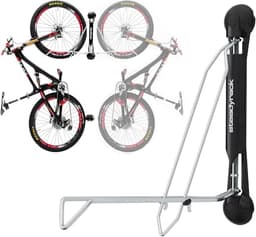
77 lb per bike, published, on a rack that pivots flat against the wall so the bike stops being an obstacle when you are not riding it. That pivot is what you are paying for.
Published specs
- Max recommended bike weight
- 35 kg / 77 lb
- Wheel diameter
- 20 in to 29 in
- Maximum tire width
- 2.1 in
- Material
- Chrome plated steel
- Mounting
- Four screws into timber stud, masonry, brick or concrete
Figures are the manufacturer's, from the Steadyrack Classic Road Bike Rack product page on steadyrack.com, read 2026-09-13. We have not verified them by testing and do not imply that we have.
Our scoring
- Published capacity
- 9.0
- Space saved
- 9.5
- Bike protection
- 9.0
- Tire compatibility
- 6.0
- Install simplicity
- 7.5
What works
- 77 lb per bike published — comfortably more than any road or hybrid bike weighs
- Pivots so the bike swings flat to the wall, which is the difference between parking a car alongside it and not
- Holds the bike by the wheel, so there is no frame contact to mark paint or carbon
- Fixings included for both timber and masonry
What doesn't
- 2.1 in maximum tire width rules out most mountain and fat bikes — those need the MTB or Fat version instead
- Steadyrack states it is for bikes without fenders
- One bike per rack, so a family of four is four racks and four sets of studs
Skip this one if your bikes are mountain bikes with 2.4 in or wider tires, or they have fenders. Buying the road version for an MTB is the most common mistake with this product and the tire width is published precisely so you can avoid it.
#2 · Best if you cannot drill
Delta Cycle Michelangelo 2-Bike Gravity Stand
Delta Cycle
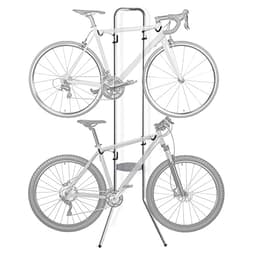
Two bikes, 80 lb total, and not a single hole in the wall. For a rented garage this is frequently the only bike storage you are allowed to install.
Published specs
- Capacity
- Holds up to 80 lb
- Bikes
- 2
- Mounting
- Gravity stand — no drilling required
- Adjustment
- Fully adjustable arms
Figures are the manufacturer's, from Delta Cycle's own published product listings for the Leonardo and Michelangelo racks, read 2026-09-13. We have not verified them by testing and do not imply that we have.
Our scoring
- Published capacity
- 7.5
- Space saved
- 5.5
- No-drill suitability
- 10.0
- Stability
- 6.0
- Install simplicity
- 9.5
What works
- No drilling at all, which makes it the renter's answer and the block-wall answer
- 80 lb published across two bikes
- Adjustable arms take road, mountain and hybrid frames
- Moves with you — it is furniture rather than a fixture
What doesn't
- A gravity stand leans on the wall and stands on the floor, so it does NOT save floor space the way a wall rack does
- Two bikes is the limit, and the upper bike has to be lifted to shoulder height
- Anything that leans can be knocked over; this is the wrong choice where children play
Skip this one if you can drill. A wall-mounted rack holds more, takes no floor, and cannot be knocked over — the gravity stand exists to solve a permission problem, not a storage one.
#3 · Best bike hoist overall
StoreYourBoard Heavy Duty Bike Hoist
StoreYourBoard
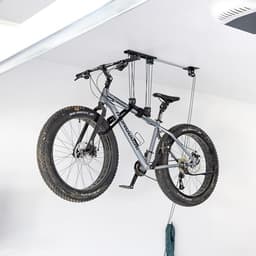
70 lb on a 4:1 pulley, which the manufacturer says cuts the lifting effort by three quarters, plus straps that hold the top tube and front wheel instead of hooks that hold a rim.
Published specs
- Weight capacity
- 70 lb
- Mechanical advantage
- 4:1, reducing lifting effort by 75 percent
- Ceiling height
- Fits ceilings up to 14 ft
- Mounting
- Parallel or perpendicular joists, any stud spacing
- Warranty
- Lifetime
Figures are the manufacturer's, from the StoreYourBoard Heavy Duty Bike Hoist page on storeyourboard.com, read 2026-09-21. We have not verified them by testing and do not imply that we have.
Our scoring
- Published capacity
- 8.5
- Lifting effort
- 9.5
- Bike protection
- 9.0
- Install flexibility
- 9.0
- Value
- 6.0
What works
- 70 lb covers an e-bike, which most hoists in this category do not
- Straps around the top tube and front wheel rather than hooks under the rims
- Mounts across joists in either direction, so the bike does not have to hang where the framing says
- Lifetime warranty, published
What doesn't
- Costs several times what a basic hook-and-pulley hoist costs
- A hoist is slower to use than a wall hook — this is for the bike you ride monthly, not daily
- 70 lb is the system limit, so a heavy cargo e-bike is out
- Ceiling storage means the bike is over whatever you park underneath it
Skip this one if the bike gets ridden several times a week. A wall rack takes seconds and a hoist takes a minute, and that difference decides whether you keep using it.
Questions people actually ask
How much weight does a Steadyrack hold?
Steadyrack publishes a maximum bike weight of 35 kg / 77 lb for the Classic, which covers everything from a road bike to a commuter e-bike. Weigh a cargo e-bike before trusting it.
What tire width does the Steadyrack Classic fit?
Up to 2.1 in, on wheels from 20 to 29 in. That suits road, gravel, hybrid and older mountain bikes; most current mountain bikes run wider and need a different model in the range.
How far does a Steadyrack stick out from the wall?
Steadyrack publishes about 16 in for road bikes when pivoted flat, rising to roughly 39 in for mountain bikes with wide handlebars. Your handlebar width drives that figure more than the rack does.
Does a Steadyrack work with fenders?
No. Steadyrack states the Classic is not compatible with fenders or mudguards, and that it needs a minimum 15 mm of downtube and tire clearance.
Can a Steadyrack mount on brick or concrete?
Yes. Steadyrack publishes support for timber stud, masonry, brick and concrete walls, and the installation kit includes fixings for both masonry and timber installs.
Sources
- Steadyrack Classic road bike rack — 35 kg / 77 lb maximum bike weight, 2.1 in maximum tire width, 20 to 29 in wheel diameter, chrome plated steel, installation kit with masonry and timber fixings, about 400 mm (16 in) protrusion for road bikes, not compatible with fenders, minimum 15 mm downtube and tire clearance, 5 year warrantyChecked September 27, 2026
- StoreYourBoard Heavy Duty Bike Hoist — 70 lb capacity, for the ceiling alternativeChecked September 21, 2026
- Delta Cycle Michelangelo — two-bike floor-to-ceiling gravity stand requiring no fixingsChecked September 13, 2026
Manufacturer documentation, manuals, warranty terms and exact product models reviewed September 27, 2026.
Read next
- The best garage bike racksWall-mounted bike racks ranked on published per-bike capacity, tire fit and whether they pivot.
- Where the bikes goBikes are a wall problem, not a floor problem. The system, the stud check, and why hoists get abandoned.
- The best ceiling bike hoistsBike hoists on published capacity, pulley ratio and ceiling height — and when a wall rack beats all of them.
- How much weight can a garage wall hold?The fixing decides it, not the wall. Published stud-versus-drywall figures and how to find your studs.
- Garage hooks: what the weight ratings actually meanWhat garage hook ratings really mean, and which wall system to hang heavy things from.
- The best garage wall storage systemsTrack, slatwall, panels and metal pegboard on published load ratings, converted into one comparable question.